




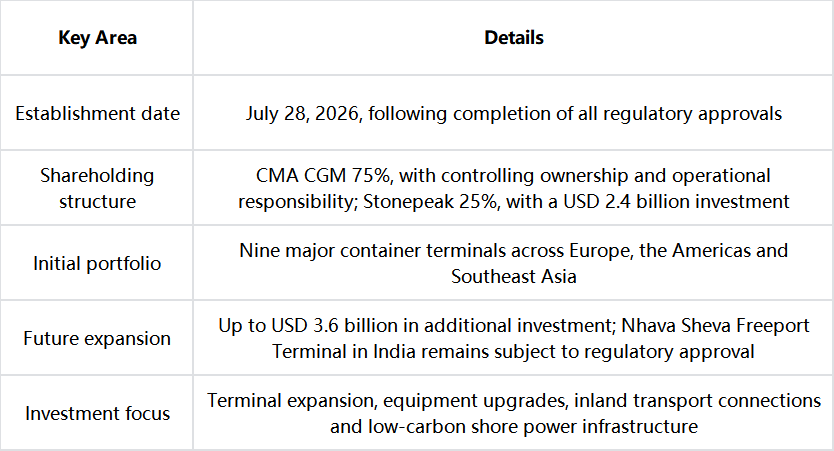
Another major port and shipping integration project has been completed. On July 28 local time, UNITED PORTS LLC, the port joint venture established by CMA CGM Group and international infrastructure investment firm Stonepeak, received all required regulatory approvals and was officially established.
The USD 2.4 billion transaction brings nine major container terminals worldwide under one platform, with scope for further investment. The transaction expands CMA CGM’s global port infrastructure network and may provide long-term support for berthing efficiency, more stable space availability and shipment planning for freight forwarders.
Key Highlights
• Transaction completed: The USD 2.4 billion transaction has closed, with CMA CGM holding 75% and retaining operational control, and Stonepeak holding 25%
• Asset integration: The initial portfolio includes nine terminals across the United States, Spain, Brazil, Taiwan and Vietnam
• Further investment: Up to USD 3.6 billion may be invested in the future, while the terminal in India remains subject to regulatory approval
• Industry trend: Major carriers are increasing investment in port infrastructure, with port and shipping integration becoming an important source of competitiveness
Summary of the UNITED PORTS Project
Nine Major Terminals Form a Global Port Network
Introduction: The portfolio covers major global trade hubs, strengthens CMA CGM’s cross-regional port network and improves berthing support for its services.
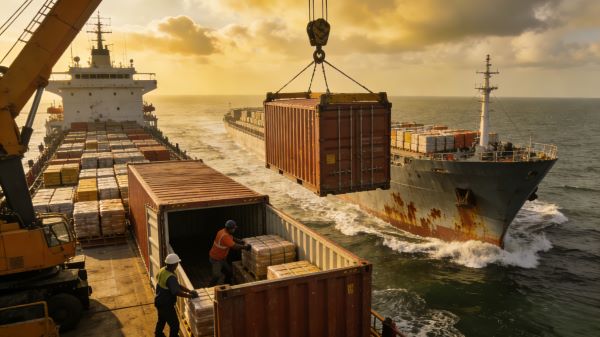
The UNITED PORTS platform has initially integrated nine container terminals along major global trade routes: Fenix Marine Services in Los Angeles, Port Liberty in New York, a terminal at the Port of Santos in Brazil, terminals in Valencia, Bilbao and Algeciras in Spain, a terminal at the Port of Kaohsiung in Taiwan, and Gemalink Terminal in Vietnam.
These terminals are major regional hubs serving key trade routes across Europe, the Americas, Latin America and Southeast Asia.
Nhava Sheva Freeport Terminal in India will also be added to the platform once local regulatory approval is obtained, further expanding the network in South Asia and increasing its global coverage.
Freight forwarders may use the Inquiry Board to identify suitable agents and make use of stable port resources to improve shipment efficiency and service fulfillment.
Additional Investment Focuses on Low-Carbon Infrastructure and Inland Connections
Introduction: Continued capital investment will support terminal upgrades and the development of terminals from cargo-handling facilities into integrated logistics hubs.
In addition to the USD 2.4 billion transaction, the partners may invest up to a further USD 3.6 billion in high-growth port projects.
Investment will focus on infrastructure upgrades and low-carbon improvements, including berth expansion, cargo-handling equipment upgrades, rail and road connections for inland transport, shore power facilities and equipment electrification. These projects are intended to improve terminal operating efficiency and handling capacity.
For CMA CGM, the partnership provides access to long-term capital and reduces reliance on fleet capacity competition alone. Through controlling interests in terminals, the group can secure berthing priority, reduce congestion risks and further develop its integrated shipping, port and inland logistics network.
Port and Shipping Integration Becomes a Key Area of Industry Competition
Introduction: Major carriers are increasing investment in port infrastructure, making terminal resources an important factor in schedule stability, cost control and operating efficiency.
Competition in global shipping now extends beyond fleet capacity. Maersk operates through APM Terminals, MSC continues to expand its port assets, and CMA CGM has established UNITED PORTS. The three major carriers are all increasing their investment in port infrastructure.
Compared with fleet expansion alone, owning or operating terminals can help carriers reduce the effects of port congestion, limited berth availability and operational delays, while improving cost and schedule stability.
Amid supply chain disruption and frequent geopolitical risks, coordination between ports, shipping services and inland transport has become an important part of carrier competitiveness. It may also provide freight forwarders with more stable space availability, transit times and quotations.
Operational Checklist for Freight Forwarders
• Monitor schedule stability and berthing efficiency on CMA CGM services covering Europe, the Americas and Southeast Asia
• Follow the progress of terminal infrastructure projects and assess potential changes in freight rates and space availability
• Review the proportion of shipments routed through CMA CGM services and use its port resources to reduce delay risks
• Inform customers of relevant terminal upgrades and adjust long-term shipment plans and transit-time commitments accordingly
Action Summary
CMA CGM’s USD 2.4 billion port platform has been officially established, further strengthening its integrated port and shipping network.
Its global terminal portfolio may improve service transit times and reduce congestion and delay risks. Freight forwarders may make use of CMA CGM’s port resources to adjust route allocations and customer fulfillment plans, improving shipment stability and business competitiveness.
Sources: Official CMA CGM announcement, Stonepeak investment statement, gCaptain and publicly available maritime industry reports
Disclaimer: All information is obtained from publicly available sources and is provided for industry reference only. It does not constitute commercial or logistics operational advice.
Last
Black Sea Shipping Risks Escalate! FESCO Container Ship Attacked and Sunk as Regional Route Risk Controls Tighten
On August 1, the container ship Yanina, operated by Russia’s FESCO Group, was attacked by drones and sank in international waters
Next
Drought Halts Navigation on Dutch Canal! Hapag-Lloyd Imposes Temporary Inland Surcharge as European Inland Transport Costs Rise
European inland logistics are being disrupted by drought. The Eefde lock on the Twente Canal in the Netherlands has been closed du

