




European inland logistics are being disrupted by drought. The Eefde lock on the Twente Canal in the Netherlands has been closed due to extremely low water levels, bringing barge services on the canal to a halt.
Hapag-Lloyd has introduced a temporary inland location surcharge to cover the additional logistics costs caused by inland transfers and route diversions. Import and export cargo moving through inland locations in the eastern Netherlands is directly affected. Freight forwarders handling European inland distribution should promptly include the additional charge in their cost calculations.
Key Highlights
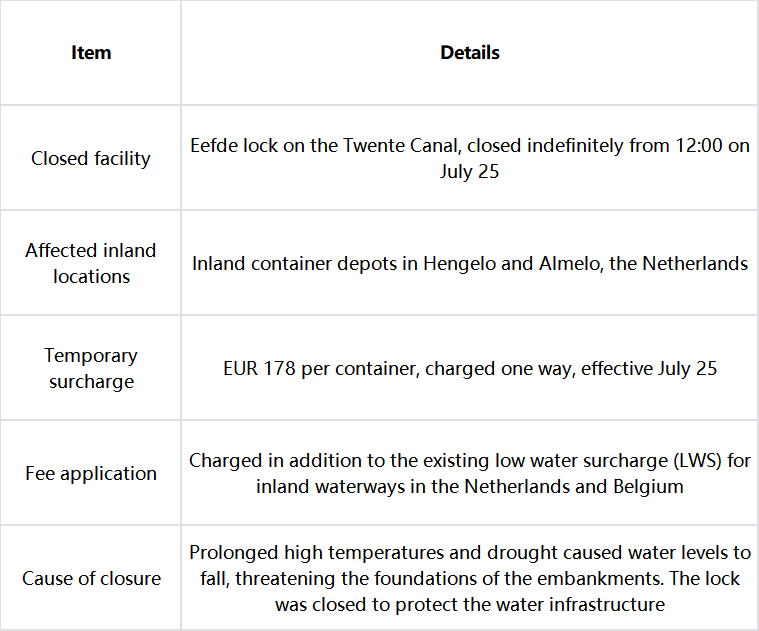
• Waterway disruption: The Eefde lock on the Twente Canal was closed on July 25, marking its first drought-related closure
• Carrier surcharge: Hapag-Lloyd is imposing a temporary one-way surcharge of EUR 178 per container for cargo moving through the inland locations of Hengelo and Almelo
• Combined costs: The existing low water surcharge remains in effect, further increasing European multimodal transport costs
• Long-term warning: More frequent summer droughts are reducing navigation reliability on the Rhine and major inland waterways in the Netherlands
Summary of the Canal Closure and Carrier Surcharge
Drought-Related Lock Closure Cuts Off Major Inland Waterway in the Eastern Netherlands
Introduction: The Twente Canal is a major inland waterway hub in the eastern Netherlands. Its closure has directly interrupted the main barge route between seaports and inland locations.
The Twente Canal connects industrial areas in the eastern Netherlands with the country’s main inland waterway network. It is a key barge corridor for transporting containers from the ports of Rotterdam and Antwerp to inland destinations.
To prevent extremely low water levels from eroding the embankments and causing irreversible damage, the Dutch water authority closed the Eefde lock on July 25, bringing inland navigation on the canal to a halt.
Existing direct barge transport arrangements are no longer available. Freight forwarders must switch to road or rail transport for inland container movements. Barge loading restrictions and longer diversion distances have significantly increased operating costs for inland waterway carriers.
Hapag-Lloyd Adds Temporary Surcharge on Top of Existing Low Water Surcharge
Introduction: The new temporary diversion surcharge will be charged in addition to the existing low water surcharge, requiring quotations for inland cargo in the Netherlands and Belgium to be recalculated.
Hapag-Lloyd has officially announced a temporary one-way surcharge of EUR 178 per container for cargo moving to or from the inland locations of Hengelo and Almelo. The surcharge is intended to cover additional costs arising from cargo transfers, warehousing and vehicle deployment.
The temporary charge will be collected in addition to the existing low water surcharge for inland waterways in the Netherlands and Belgium. Both charges will remain applicable until navigation on the canal resumes.
According to the carrier, the canal closure has sharply reduced barge capacity and lowered turnaround efficiency. Without the additional surcharge, it would be difficult to maintain basic delivery services at the affected inland locations. The revised charge applies to all import and export cargo.
Drought Risks Become More Frequent as European Multimodal Transport Faces Greater Pressure
Introduction: Repeated low-water restrictions on the Rhine and Meuse highlight the vulnerability of European inland shipping to drought.
In recent years, Europe has experienced frequent periods of high temperatures and drought during the summer. Low water levels have repeatedly resulted in loading restrictions on the Rhine and Meuse. The latest incident marks the first full suspension of navigation on the Twente Canal due to drought.
Major European ports rely heavily on inland barges for hinterland container transport. Restrictions on inland waterways can lead to heavier road congestion, tighter warehouse capacity and longer overall delivery times.
The incident is a regional disruption and has no material impact on the main Asia-Europe ocean routes. However, trading companies and freight forwarders handling inland routes across the Netherlands, Germany and Belgium should closely monitor the resumption of canal operations and carrier surcharge notices.
Operational Checklist for Freight Forwarders
• Review all in-transit cargo bound for Hengelo and Almelo in the Netherlands and inform customers of the additional surcharge
• Prepare alternative road and rail transport arrangements to reduce reliance on a single barge route
• Continue monitoring Dutch canal water-level notices and assess when the surcharge may be withdrawn
• Use freight rate comparison channels to secure suitable European inland transport rates and manage unexpected costs
Action Summary
The drought-related closure of the Twente Canal, together with the temporary surcharge and the existing low water surcharge, has significantly increased inland logistics costs in the eastern Netherlands.
Freight forwarders should promptly update quotations for inland routes, use the Inquiry Board to identify suitable inland transport resources at competitive rates, adjust delivery routes where necessary, and inform cargo owners of additional costs in advance to reduce the risk of settlement disputes and shipment delays.
Sources: Rijkswaterstaat, official Hapag-Lloyd announcement and Dutch shipping media outlet Transport Online
Disclaimer: All information is obtained from publicly available sources and is provided for industry reference only. It does not constitute commercial or logistics operational advice.
Last
Global Shipping Landscape Shifts as CMA CGM's USD 2.4 Billion Port Joint Venture Integrates Nine Terminals Worldwide
Another major port and shipping integration project has been completed. On July 28 local time, UNITED PORTS LLC, the port joint ve
Next
August Container Shipping Market Shifts: Spot Rates Decline for a Third Consecutive Week as MSC and Maersk Adjust Charges Across Major Trade Lanes
The container shipping market is entering a key period of structural change in August. Global spot freight rates have declined for

