




On August 1, the container ship Yanina, operated by Russia’s FESCO Group, was attacked by drones and sank in international waters in the Black Sea. It was the first container liner underway to sink during the Black Sea conflict.
The risk has spread from ports and anchorages to navigation waters across the region. The incident may prompt carriers to tighten risk controls for Black Sea services, increase war risk insurance costs and adjust their regional service networks.
Key Highlights
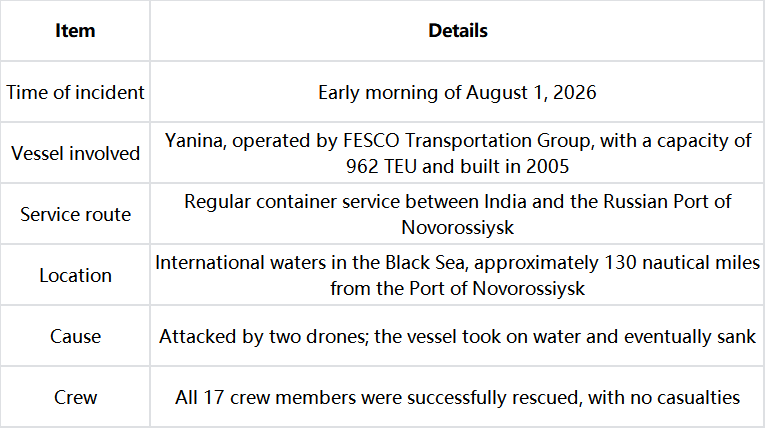
• Incident: A FESCO container ship was attacked and sank while sailing in the Black Sea, with all crew members successfully rescued
• Risk escalation: Attacks have extended to merchant vessels sailing in open waters, spreading security risks across the Black Sea
• Conflicting accounts: Russia and Ukraine have given different accounts of the incident, and no authoritative conclusion has been reached
• Industry impact: Route risk controls, war risk insurance premiums and carriers’ regional service networks may all be adjusted
Summary of the Vessel Sinking
Merchant Vessel Attacked During Routine Voyage as Security Risks Spread
Introduction: The incident has extended the risk beyond coastal waters. The attack and sinking of a merchant vessel in open waters marks a further escalation of Black Sea shipping risks.
According to information from Russia’s Rosatom and maritime industry media, Yanina was carrying only civilian cargo, including frozen food and construction materials. It was operating a regular commercial container service between India and the Russian Port of Novorossiysk and was not carrying military cargo.
The vessel was sailing normally in international waters in the Black Sea when it was attacked by drones. After its hull was damaged and began taking on water, the vessel eventually sank.
Following the incident, nearby merchant vessels were the first to carry out rescue operations. The Russian Black Sea Fleet later deployed helicopters to assist with the search and rescue operation. All 17 crew members were safely evacuated, with no casualties.
Freight forwarders may use the Inquiry Board to identify stable capacity and reduce exposure to unexpected regional shipping risks.
Conflicting Accounts as Incident Details Await Verification
Introduction: Russia and Ukraine have given different accounts of the incident. No authoritative investigation results have been released, increasing uncertainty in the region.
Russia described the incident as a deliberate attack on a civilian merchant vessel, stating that the vessel was operating in compliance with applicable requirements and was carrying only civilian cargo.
Ukraine publicly confirmed that it had carried out a strike against the vessel and stated that related military operations had also been conducted in the Sea of Azov that evening.
To date, neither side has released an authoritative investigation report or complete video footage. Key details, including the exact method of attack and the basis for identifying the target, remain unconfirmed. Considerable uncertainty therefore remains over shipping risks in the Black Sea region.
Black Sea Shipping Risks Become Persistent as Industry Practices Change
Introduction: Conflict-related shipping risks continue to spread across the Black Sea, significantly reducing navigational safety throughout the region.
Over the past two years, Black Sea shipping risks were largely concentrated around ports and coastal areas, with bulk carriers, tankers and port facilities occasionally sustaining damage.
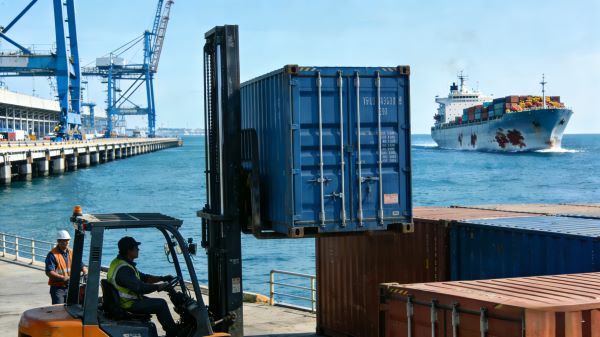
The sinking of a container ship while underway in open waters indicates that conflict-related risks have extended across the Black Sea. Merchant vessels sailing to and from ports around the Black Sea may face potential security threats, regardless of vessel nationality or cargo type.
As the regional conflict continues, uncertainty surrounding navigation in the Black Sea is increasing. This is changing existing shipping safety practices and creating long-term risks for the stable operation of regional services.
Long-Term Market Impact: Adjustments to Insurance, Services and Risk Controls
Introduction: The incident may increase insurance and shipping costs, prompting carriers to adjust their Black Sea service strategies.
The attack and sinking of a merchant vessel in open waters is expected to prompt carriers to tighten risk control standards for Black Sea services.
In the short term, war risk insurance premiums for Black Sea routes are likely to increase, while underwriting requirements may continue to tighten. This will further raise overall cross-border logistics costs in the region.
The industry may also see wider service reductions, suspensions and route adjustments. Freight forwarders and trading companies should continue to monitor service changes, surcharge adjustments and port developments, and revise transport arrangements in advance to reduce the risks of service suspensions, delays and cargo damage.
Operational Checklist for Freight Forwarders
• Closely monitor navigation conditions in the Black Sea and the Sea of Azov, as well as carriers’ service adjustment policies
• Update risk control standards for Black Sea routes and promptly inform customers of regional risks and cost changes
• Maintain alternative routing options, reduce reliance on a single Black Sea service and support shipment continuity
• Closely monitor fluctuations in war risk insurance premiums, calculate quotation costs accurately and avoid margin losses
Action Summary
Black Sea shipping has entered a high-risk stage across the region, and merchant vessels sailing in open waters are also exposed to conflict-related risks.
Freight forwarders should update their existing risk assessments, monitor regional developments in real time, and adjust Black Sea shipping arrangements and quotation structures accordingly. They should secure stable capacity to mitigate the operational risks arising from service reductions, rising insurance premiums and unexpected incidents.
Sources: The Maritime Executive, Russia’s Rosatom, official FESCO announcements and publicly available maritime information
Disclaimer: All information is obtained from publicly available sources and is provided for industry reference only. It does not constitute commercial or logistics operational advice.
Last
Strait of Hormuz Shipping Alert! Successive Security Incidents Raise Risks to LNG and Energy Shipping
Security concerns have again emerged along a key global energy shipping route. On July 31 local time, two vessel security incident
Next
Global Shipping Landscape Shifts as CMA CGM's USD 2.4 Billion Port Joint Venture Integrates Nine Terminals Worldwide
Another major port and shipping integration project has been completed. On July 28 local time, UNITED PORTS LLC, the port joint ve

