



The global container shipping market is showing structural divergence. Freight rates on traditional major trade lanes continue to decline, while routes exposed to geopolitical risks are moving higher.
The latest freight indices released by Drewry and the Shanghai Shipping Exchange show that the global container shipping market remains under downward pressure. Rates on major transpacific, European, and Mediterranean routes have generally fallen. However, disruptions in the Middle East have pushed Persian Gulf rates sharply higher, making it the only major route to record a substantial increase.
The pricing logic of the container shipping market is changing from one driven mainly by supply and demand to one shaped by capacity, demand, and geopolitical risk.
This divergence marks the end of a market in which ocean freight rates rise or fall broadly together. Supply and demand now determine rates on major trade lanes, while risk drives rates on high-risk routes. Freight forwarders and importers and exporters must therefore adjust their quotation systems and shipment planning.
Key Highlights
• Overall market weakness: Both the World Container Index (WCI) and the Shanghai Containerized Freight Index (SCFI) declined, with rates falling across most major global routes.
• Sharp regional increase: Persian Gulf rates rose 7.5% week on week, making it the only major route to record a sharp increase this week.
• Pricing logic changes: Geopolitical risks are now being incorporated into freight rates, with rerouting, fuel, and insurance costs raising the cost floor.
• Greater route divergence: Rates declined across transpacific, European, Mediterranean, and South American routes, while Australia and New Zealand recorded a slight increase and Japan remained stable.
• Cost transmission begins: Carriers will introduce additional fuel surcharges from August, and total logistics costs may continue to rise.
Market Review: Both Global Indices Decline as Major Trade Lanes Come Under Pressure
Key conclusion: Supply and demand in the global container shipping market have weakened at the margin. Additional capacity and soft demand are continuing to push down rates on major routes.
As of July 23, Drewry’s World Container Index fell 4% from the previous week to USD 4,374 per FEU, marking its second consecutive weekly decline as the global container shipping market continued to cool.
The domestic market also weakened. On July 24, the Shanghai Containerized Freight Index stood at 3,062.95 points, down 0.6% week on week, indicating that China’s export container shipping market has entered a period of adjustment.
On the transpacific trade, additional capacity has been the main factor behind lower rates. Data show that only six blank sailings are scheduled for next week, compared with nine this week, resulting in a significant increase in deployed capacity.
With export demand showing limited growth, the supply-demand balance continues to shift in favor of shippers, placing further downward pressure on rates.
Route-specific data show that the Shanghai–Los Angeles rate fell 6% week on week to USD 5,878 per FEU, while the Shanghai–New York rate declined 4% to USD 7,598 per FEU.
SCFI data showed the same trend. Rates on the US West Coast stood at USD 5,535 per FEU, while rates on the US East Coast reached USD 8,040 per FEU, down 3.3% and 1.6% respectively.
At the same time, US tariff policy is entering a transition period. With the existing policy approaching expiry and new tariffs due to take effect in August, some shippers are delaying shipments while waiting for further market developments.
This is placing additional pressure on short-term cargo volumes, leaving limited support for a near-term recovery in transpacific rates.
The Asia–Europe market also remained weak, with softer demand and excess capacity.
On July 23, the Shanghai–Genoa rate fell 5% to USD 5,988 per 40-foot container, while the Shanghai–Rotterdam rate edged down 1% to USD 4,824 per 40-foot container.
Four blank sailings are scheduled on Asia–Europe routes next week, two more than this week. However, carrier capacity reductions remain insufficient to offset weak demand.
SCFI data show that rates to major European ports fell to USD 3,155 per TEU, down 1.9%, while rates to major Mediterranean ports declined 2.8% to USD 4,351 per TEU.
With inflationary pressure and higher energy prices continuing to weigh on European import demand, Asia–Europe rates are expected to remain under pressure in the near term.
Structural Divergence: Persian Gulf Route Surges 7.5% as Geopolitical Risk Is Priced In
Key conclusion: Supply and demand are no longer the only main drivers. Geopolitical risks in the Middle East are reshaping the cost floor and pushing Persian Gulf rates higher.
In sharp contrast to the decline across major global routes, the Persian Gulf trade recorded a separate upward trend driven by geopolitical risks.
On July 24, rates from Shanghai to major Persian Gulf ports rose to USD 4,584 per TEU, up 7.5% week on week. This was the largest increase among major global routes during the week and broke with the broader downward trend.
The increase was not driven by stronger demand. It directly reflected rising security risks in the Strait of Hormuz and the Red Sea.
Tensions in the Middle East have increased uncertainty along shipping lanes. Rerouting and vessels waiting in safer waters to avoid risks have become more common, directly increasing fuel consumption, transit times, and vessel operating costs.
War-risk and hull insurance costs in the region have also continued to rise. The combined effect of these risk-related expenses has raised the cost floor for Persian Gulf services.
Risk costs are now being passed through the market. CMA CGM has announced that it will introduce an Emergency Fuel Surcharge (EFS) from August 1, citing higher fuel costs caused by escalating tensions in the Strait of Hormuz.
If geopolitical tensions continue, insurance premiums, rerouting costs, and port handling surcharges may rise further. Persian Gulf rates may therefore continue to move independently of the overall market and remain at elevated levels.
Route-by-Route Review: Mixed Performance as the Market Enters a More Targeted Adjustment Cycle
Key conclusion: Different routes are moving independently, with no single market trend applying across all regions.
Beyond the major transpacific, European, and Persian Gulf routes, other regional markets also showed clear divergence. The container shipping market is no longer moving in a uniform direction.
Australia and New Zealand Routes Edge Higher
Demand remained relatively stable, with rates rising 1.3% week on week to USD 2,233 per TEU. The market remained firm despite the broader decline.
South America Routes Lead the Decline
Weak demand and excess capacity pushed rates down 7.6% week on week to USD 5,453 per TEU, making South America one of the routes with the largest declines this week.
Japan Routes Remain Stable
Supply and demand remained broadly balanced, with the freight index at 925.31 points and no significant movement recorded.
The current market pattern is clear: transpacific and European routes are being driven by excess capacity and declining rates; Persian Gulf routes are being driven by geopolitical risks and rising rates; and smaller regional routes are moving according to local cargo volumes.
A single composite freight index can no longer fully reflect overall market conditions.
Deeper Industry Shift: Lower Freight Rates Do Not Mean Lower Logistics Costs
Key conclusion: While visible freight rates are declining, less visible risk-related costs are increasing. Total logistics costs are therefore not falling in line with the overall market.
Many importers, exporters, and freight forwarders assume that falling global freight rates automatically mean lower shipping costs. Under the current market structure, this assumption is no longer valid.
Although base ocean freight rates on major routes have declined, geopolitical risks continue to increase additional costs, including fuel surcharges, emergency surcharges, war-risk insurance premiums, longer transit times caused by rerouting, and unexpected diversion and transshipment expenses.
This is particularly relevant to routes connected with the Middle East and the Red Sea. Even where base freight rates decline, total shipping costs may remain high after risk-related surcharges are included.
Two key factors will determine future market movements.
The first is capacity management and blank sailing adjustments on transpacific and European routes, together with the timing of the new US tariff policy. These factors will determine the extent of freight rate movements on major trade lanes.
The second is the development of tensions in the Middle East, which will directly affect surcharges, insurance costs, and schedule reliability on high-risk routes.
Logistics companies must therefore update their market assessment methods. Instead of focusing only on changes in ocean freight rates, they should calculate both freight rates and risk-related costs.
This will help prevent quotation losses caused by focusing only on low freight rates while overlooking additional costs.
For shipments to the Middle East, freight forwarders can use the platform’s Company Directory to identify reliable overseas service providers familiar with Persian Gulf operating requirements and experienced in emergency risk management.
This can help reduce risks arising from sudden rerouting, port delays, and sharp surcharge increases and support more stable shipping costs and transit times.
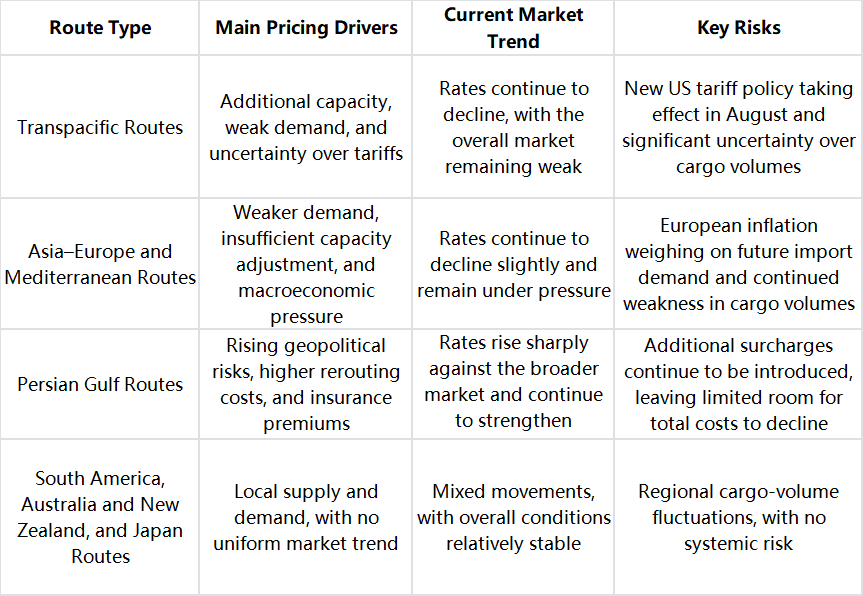
Operational Alerts and Recommended Actions for Freight Forwarders: Comparison of Current Route Pricing Drivers
Three Self-Check Questions for Freight Forwarders
• Has the quotation system been updated? Does it distinguish between major trade lanes and routes exposed to geopolitical risks and include surcharges, insurance, rerouting, and other additional costs?
• Has shipment planning been adjusted? Are booking, cargo preparation, and shipment schedules being updated according to route-specific market conditions?
• Have risks been assessed in advance? Have customers been informed of the cost, transit-time, and policy risks associated with different routes, with responsibilities and liabilities clearly defined?
Industry Summary
Overall, the global container shipping market has entered a new phase of structural divergence. Supply and demand determine the lower limit of freight rates, while geopolitical risks raise the upper limit of total costs.
The value of relying on a single freight index is continuing to decline. Route-specific analysis, full-cost calculations, and comprehensive risk control will become increasingly important for freight forwarders.
Industry participants should move away from the traditional assumption that all routes rise or fall together. They must closely monitor capacity, policy changes, and geopolitical developments, assess each route separately, and reduce quotation losses and operational risks.
Sources: Drewry, Shanghai Shipping Exchange, official carrier announcements, World Ports
Disclaimer: This content is based on publicly available information and is provided for industry reference only. It does not constitute commercial or logistics operating advice.
Last
USD 15.7 Billion in Revenue: CMA CGM's Q2 2026 Shipping Revenue Rises 22%, While Logistics Earnings Come Under Pressure
Against a complex backdrop of continued geopolitical disruption in the Middle East and growing uncertainty over international trad

Next
Maersk and Hapag-Lloyd Revise Tango Service: Direct Salvador Call Removed and Pecem Added to Mainline Rotation
Global liner networks continue to be adjusted, with an important change announced for the US East Coast–East Coast South America t