




Against a complex backdrop of continued geopolitical disruption in the Middle East and growing uncertainty over international trade policies, leading carriers continue to demonstrate resilience. CMA CGM recently released its financial results for the second quarter of 2026, reporting strong year-on-year growth in both revenue and earnings. Its core shipping business led the increase and remained the main contributor to the Group’s performance.
At the same time, results varied significantly across business segments. Shipping volumes, revenue per TEU and earnings all increased. The logistics business recorded revenue growth but a sharp decline in earnings, while terminals, air freight and other infrastructure-related businesses delivered strong growth. The results reflect the changing structure of the global shipping and logistics market in the second half of 2026.
CMA CGM’s second-quarter results reflect the resilience of the current container shipping market while also highlighting several industry trends: geopolitical risks are reshaping carrier cost structures, profitability is diverging between shipping and logistics, and supply chain infrastructure is becoming more important to carrier operations. These developments provide useful reference for global freight forwarders and international trading companies when assessing freight-rate trends and adjusting shipping plans for the second half of the year.
Key Highlights
• Strong overall performance: CMA CGM generated USD 15.7 billion in second-quarter revenue, up 19.2% year on year, with overall profitability continuing to improve.
• Shipping leads growth: Shipping revenue exceeded USD 10 billion, up 22%, supported by higher volumes and higher average revenue per TEU.
• Diverging segment performance: Logistics revenue increased, but earnings declined as competition and margin pressure intensified.
• Infrastructure growth: Terminals, air freight and other businesses recorded strong growth as the Group continued expanding its global infrastructure network.
• Market outlook: Geopolitical costs, trade policies and capacity deployment are expected to remain key factors affecting freight rates and profitability in the second half of the year.
Strong Overall Performance: Revenue Reaches USD 15.7 Billion, with Earnings Growing Faster Than Revenue
CMA CGM reported broad-based growth in the second quarter of 2026 despite a complex macroeconomic and geopolitical environment.
The Group generated total revenue of USD 15.7 billion, up 19.2% year on year. EBITDA exceeded USD 3 billion, an increase of 31%, while the EBITDA margin rose to 19%, up 1.7 percentage points from the same period last year.
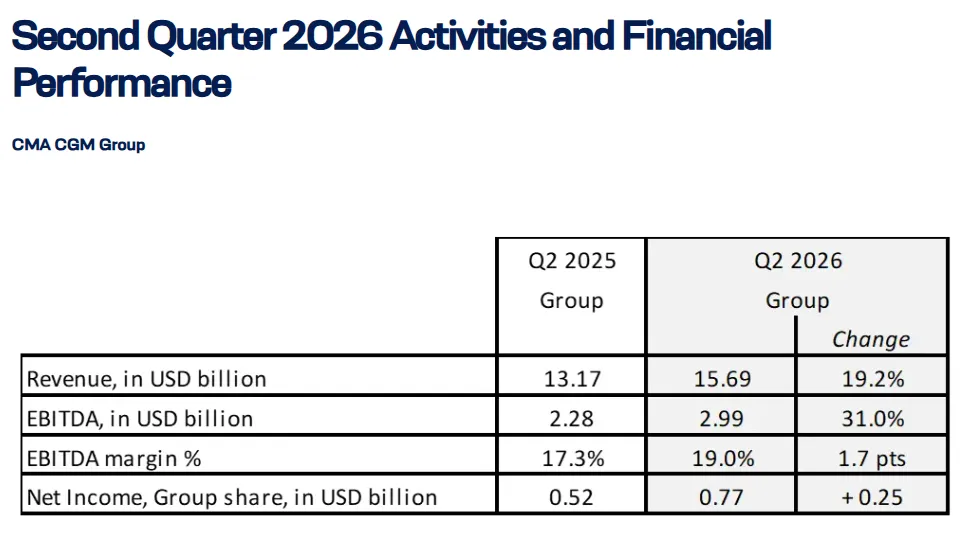
The faster growth in EBITDA than in revenue indicates that the Group expanded its business while improving its earnings and overall operating performance.
The main driver of the Group’s results was its core shipping business.
Shipping Volumes and Revenue per TEU Rise: Quarterly Revenue Exceeds USD 10 Billion, Up 22%
As CMA CGM’s core business, shipping recorded growth in volume, revenue per TEU and earnings during the second quarter of 2026, making it the main driver of the Group’s performance.
Shipping revenue exceeded USD 10 billion, up 22% year on year. Container volumes reached 6.3 million TEU, an increase of 6%, while average revenue per TEU rose by 15.1% to USD 1,575.
Earnings growth was even stronger. Shipping EBITDA reached USD 2.3 billion, compared with USD 1.6 billion in the same period of 2025. The segment’s EBITDA margin increased by 3.3 percentage points to 22.7%.
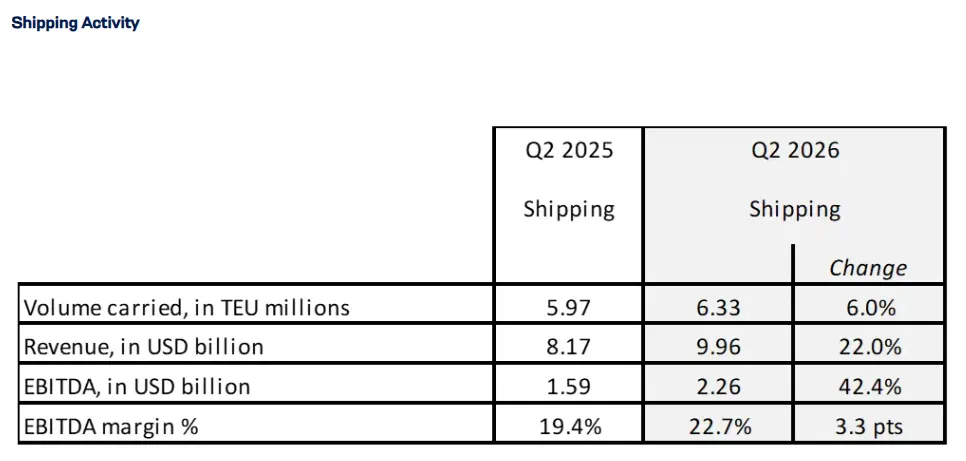
The figures show that the increase was supported by both resilient cargo demand and higher revenue per TEU.
The 6% increase in volumes indicates that global trade demand remained resilient, supported by consumer demand, inventory replenishment and shipments brought forward ahead of tariff changes.
The 15.1% increase in average revenue per TEU also shows that freight-rate conditions improved compared with the same period last year.
CMA CGM identified four main factors supporting global trade activity during the quarter:
• Resilient consumer demand.
• Business investment supporting import and export flows.
• Inventory replenishment in response to market uncertainty.
• Shipments brought forward before new tariff measures took effect.
Together, these factors supported the shipping segment’s second-quarter growth.
However, CMA CGM also noted that the current improvement reflected specific market conditions and did not mean that the entire industry had entered a sustained upward cycle. Geopolitical conflict, macroeconomic volatility and changes in trade policy remain major factors affecting long-term market stability, and the market continues to experience significant fluctuations.
Geopolitical Conflict Raises Operating Costs, While Improved Freight Rates Offset the Pressure
The increase in shipping earnings came despite continued geopolitical cost pressure.
CMA CGM stated that ongoing conflict in the Middle East had created additional costs across its global operations, including continued disruption to Red Sea services, higher marine insurance rates and declining or fluctuating cargo volumes on Middle East routes.
The impact extends beyond the direct cost of diversions. Carriers must restructure services, redeploy vessels, manage slower vessel turnaround, absorb changes in regional cargo volumes and deal with higher insurance and fuel costs.
These pressures continue to reduce carrier margins.
CMA CGM was able to increase shipping earnings because the benefits of higher freight rates and increased cargo volumes offset the additional operating costs caused by geopolitical disruption. Shipping revenue rose by 22%, while EBITDA increased by more than 40%.
The results also show that freight rates are no longer determined solely by cargo supply and demand. Service stability, diversion costs, insurance premiums and vessel-turnaround efficiency have also become important factors affecting rate movements. Freight forwarders and shippers therefore need to include these factors when assessing future freight-rate trends.
Clear Segment Divergence: Logistics Revenue Increases While Earnings Decline
In contrast to the strong performance of the shipping business, CMA CGM’s logistics segment recorded revenue growth but lower earnings, reflecting the pressure facing the global logistics market in 2026.
Second-quarter logistics revenue increased by 8.5% year on year to USD 5 billion. However, logistics EBITDA declined by 15.4% to USD 388 million, while the EBITDA margin fell by 2.2 percentage points to 7.8%.
CMA CGM attributed the decline mainly to intense competition in the global freight forwarding market and continued weakness in the automotive industry and related logistics demand.
The figures reflect a structural challenge facing the cross-border logistics sector. Demand remains resilient and business volumes can continue to grow, but competition between similar services, freight-rate volatility and greater cost transparency continue to place pressure on margins.
Revenue growth without corresponding earnings growth has become a major operating challenge for small and medium-sized freight forwarders and integrated logistics companies.
Terminals and Air Freight Record Strong Growth as CMA CGM Expands Its Global Supply Chain Network
While shipping and logistics delivered different results, CMA CGM’s other businesses, including terminals and air freight, recorded strong growth.
Revenue from other activities reached USD 1.5 billion in the second quarter, up 47.6% year on year. EBITDA increased by 44.5% to USD 338 million, while the EBITDA margin remained at 22.8%.
The results reflect CMA CGM’s continued investment in global supply chain infrastructure.
During the quarter, the Group:
• Began the second-phase expansion of the Gemalink container terminal in Vietnam.
• Reached a strategic cooperation agreement with the Kenyan government to expand its logistics infrastructure presence in Africa.
• Acquired Crystal Aero Solutions to strengthen aircraft maintenance capabilities within its air freight business.
These investments further develop CMA CGM’s terminal, air freight and multimodal transport network.
This approach differs from the traditional carrier strategy of relying mainly on fleet expansion. Amid frequent geopolitical disruption and supply chain instability, a broader network of terminals, air freight services and overseas infrastructure gives carriers more options for capacity deployment and service adjustments when individual routes are disrupted.
Second-Half Outlook: Costs and Service Deployment Remain Key Factors
CMA CGM maintained a cautious outlook for the global shipping and logistics market in the second half of 2026, with volatility and uncertainty expected to remain high.
Continued geopolitical tension in the Middle East may keep affecting Red Sea, transatlantic and other major services. Diversions, vessel delays and higher insurance costs may become recurring operating issues and continue to affect freight rates and expenses.
At the same time, changes in trade policies and tariffs may alter cargo flows and further increase market volatility.
Based on the second-quarter results, the shipping market in the second half of the year is unlikely to follow a simple upward or downward trend. Cargo volumes, freight rates, geopolitical costs and service efficiency will interact to determine market performance.
Geopolitical risks may temporarily support freight rates by reducing effective capacity and raising transportation costs. However, continued increases in operating expenses may also reduce margins, causing further divergence across companies and business segments.
For carriers and freight forwarders, competitiveness will increasingly depend on service-adjustment capability, cost management and end-to-end risk control rather than space resources alone.
Service stability, schedule reliability, the ability to respond to geopolitical disruption and total cost control will remain important factors in cross-border logistics services during the second half of the year.
Operational Alerts and Recommended Actions for Freight Forwarders and International Trading Companies
Based on the trends reflected in CMA CGM’s second-quarter results, freight-rate volatility, pressure on logistics margins and continuing geopolitical risks are expected to remain common in the second half of the year. Freight forwarders and international trading companies should adjust their operating and shipping strategies in advance.
1. Avoid Relying on Supply and Demand Alone When Assessing Freight Rates
Freight-rate forecasts should not be based only on cargo volumes and capacity.
Red Sea developments, carrier diversion policies, insurance costs and fuel costs should also be monitored. These factors should be included in freight-rate assessments, quotations and space-booking decisions.
2. Review the Profitability of Current Business
In response to revenue growth without corresponding profit growth in the logistics sector, companies should streamline less efficient business, improve end-to-end cost management and avoid excessive low-price competition.
Resources should be focused on stable cross-border logistics services with clearer profit potential.
3. Prioritize Carriers with Stable Services and Broad Infrastructure Coverage
Where possible, freight forwarders should use carrier services with stable routes, broad infrastructure coverage and stronger capacity to manage disruption. This can reduce fulfillment risks caused by service changes and schedule delays.
To identify available ocean freight resources and connect with stable space and shipping solutions, users may post cargo requirements on the Inquiry Board and engage with multiple service providers.
4. Establish Ongoing Market Monitoring
Geopolitical developments, trade policies, carrier financial results and service adjustments should be monitored continuously.
Shipping plans and customer quotations should be adjusted in line with market changes.
Three Operational Questions for Freight Forwarders
• Has the freight-rate assessment process for the second half of the year been updated to include geopolitical costs and service risks?
• Has the current business structure been reviewed to reduce exposure to low-price competition and improve profitability?
• Are multiple carrier options available to manage service changes and market uncertainty during the second half of the year?
Overall, CMA CGM’s second-quarter 2026 results reflect both temporary market support and changes in the industry structure.
Shipping recorded resilient demand and improved earnings, while the traditional logistics business faced stronger competition and margin pressure. Terminals, air freight and other infrastructure-related businesses delivered strong growth, further widening the difference in performance across business segments.
For cross-border logistics companies, following market developments, improving cost management, strengthening resource coverage and preparing for operational risks will be important for maintaining stable operations in a volatile market.
Sources
CMA CGM’s official financial results, publicly available data from global shipping institutions and cross-border logistics industry sources.
Disclaimer
All information is sourced from publicly available channels and is provided for industry reference only. It does not constitute commercial or logistics operational advice.
Last
One Service Cut, One Port Added: MSC Uses Blank Sailings to Support Rates While Hapag-Lloyd Expands Coverage as U.S. Trade Capacity Management Becomes More Precise
The trans-Pacific U.S. trade is undergoing a series of service adjustments in 2026, with leading carriers adopting distinctly diff
Next
Global Container Freight Rates Decline Overall as Persian Gulf Route Surges 7.5%, with Geopolitical Risks Reshaping Shipping Costs
The global container shipping market is showing structural divergence. Freight rates on traditional major trade lanes continue to

