




Global liner networks continue to be adjusted, with an important change announced for the US East Coast–East Coast South America trade.
Maersk and Hapag-Lloyd recently announced an update to their jointly operated Tango Service, revising the port rotation and operating arrangements. The main changes are the removal of the direct mainline call at Salvador and the addition of Pecém, Brazil, as a fixed mainline port of call.
The adjustment changes the transport arrangements for cargo moving through northeastern Brazil. It is a significant recent carrier update for South America logistics and will directly affect booking, transit-time planning, and transshipment arrangements for freight forwarders and trading companies.
Unlike a routine sailing adjustment, the Tango update is a structural change to the South America mainline network. Maersk and Hapag-Lloyd are moving from a model based on direct calls at a larger number of ports to one in which core ports receive direct mainline calls and regional ports are served by feeder connections.
Understanding the adjustment can help cross-border logistics companies assess South America service developments in 2026 and reduce the risks of booking errors, delays, and missed transshipment connections.
Key Highlights
• Joint carrier adjustment: Maersk and Hapag-Lloyd are updating their jointly operated Tango Service.
• Major port rotation change: The direct Salvador call will be removed, while Pecém will be added as a fixed weekly mainline call.
• Clear transition date: The direct mainline call at Salvador will end on August 27, 2026, with the revised arrangement taking effect from the designated sailing.
• Operating model update: Mainline efficiency will be improved while regional coverage is maintained through feeder services.
• Operational updates required: Transport arrangements for northeastern Brazil are changing, requiring updates to transit-time calculations and booking procedures.
Tango Service Adjustment Details: Direct Salvador Call Removed and Pecém Added to Mainline Rotation
Key conclusion: The adjustment does not discontinue logistics services to Salvador. The mainline call will move to Pecém, while a feeder connection will maintain service coverage for Salvador.
According to Maersk’s latest official service announcement, the revised Tango arrangement will take effect from the Wieland 634N sailing.
The adjustment introduces two main changes to the port structure in northeastern Brazil.
First, Pecém will be added as a fixed weekly mainline call.
Maersk has published the weekly schedule for the Tango Service at Pecém. Vessels are scheduled to arrive at 21:30 every Saturday, berth for operations at 23:00, and depart at 14:00 on Sunday.
The fixed weekly call adds a regular mainline connection for cargo moving through northeastern Brazil and provides more stable support for regional import and export shipments.
Second, the Tango Service will discontinue its direct mainline call at Salvador.
The Maersk Frankfurt 633N sailing will be the final Tango sailing to call at Salvador and is expected to arrive on August 27, 2026. After that date, the Tango mainline service will no longer call directly at the port.
To maintain service coverage, cargo between Salvador and the Tango mainline service will move through a feeder connection to Pecém. Cargo from Salvador will be transferred to Pecém before connecting with the mainline service.
The adjustment does not change the main transatlantic transport route. It only revises the Brazilian port calls within the service.
The change reflects the carriers’ efforts to improve their South America network, support schedule reliability, and reduce operating inefficiencies. It also indicates further optimization of South America logistics networks in 2026.
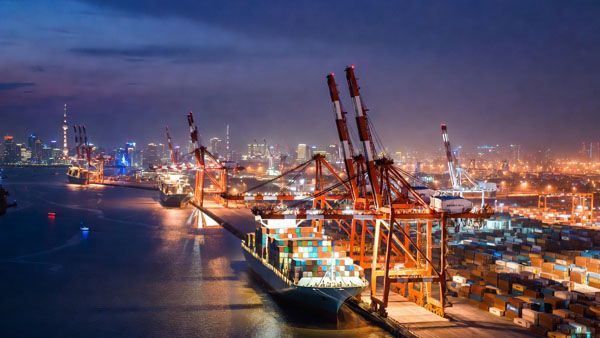
Why Maersk and Hapag-Lloyd Are Removing the Direct Salvador Call
Key conclusion: Reducing the number of mainline port calls can limit the spread of delays and improve vessel turnaround and schedule reliability.
For long-haul liner services, schedule reliability and vessel turnaround are key operating considerations. Directly calling at every regional port does not necessarily provide the most efficient service structure.
A large number of port calls can extend the overall service cycle because of repeated berthing operations, waiting times, and terminal handling. If one port experiences congestion or delays, the disruption may affect the remaining port rotation and the overall Tango schedule.
Operating conditions and cargo volumes also vary among South American ports. In the carriers’ network planning, maintaining a direct mainline call at a port with dispersed cargo volumes or lower handling efficiency may increase fuel and operating costs without providing sufficient economies of scale.
The Tango adjustment therefore reflects a balance between port coverage, logistics costs, and schedule reliability.
Compared with Salvador, Pecém serves as an important hub in northeastern Brazil, with established inland connections, port-handling capacity, and cargo volumes suitable for mainline vessel calls.
Making Pecém the mainline hub and serving Salvador through a feeder connection can reduce the number of direct mainline calls, limit berthing-delay risks, and improve vessel turnaround and schedule reliability.
The Salvador market will continue to be served, but through a mainline-and-feeder arrangement rather than a direct Tango call.
This approach maintains regional cargo coverage while improving the operating structure of the Tango Service.
Industry Trend: Liner Networks Shift Toward Fewer and More Efficient Mainline Calls
Key conclusion: Carrier network planning is shifting from broad direct-call coverage toward greater efficiency and more selective use of core hubs, changing South America transport arrangements.
As larger container vessels become more common, carriers place greater emphasis on terminal efficiency, berth availability, and vessel turnaround.
However, port infrastructure, operating capacity, and cargo density vary significantly between markets.
Adding more port calls can increase uncertainty, schedule volatility, and operating costs on South America mainline services.
Carrier network strategies are therefore changing.
Previously, carriers often expanded coverage by adding direct port calls. They are now more likely to remove inefficient calls, strengthen core hubs, and improve mainline schedule reliability.
Major hub ports retain direct mainline calls, while smaller regional ports are connected through feeder networks. This creates a layered network in which core ports receive direct mainline services and regional ports are covered through feeder connections.
This change also affects how freight forwarders assess South America services.
A direct call at the destination port is no longer the only consideration. Freight forwarders must also assess the carrier’s transshipment network, feeder connection times, and end-to-end transit-time reliability.
These factors are increasingly important in South America shipment planning.
Operational Alerts and Recommended Actions for Freight Forwarders: Managing Risks Following the Tango Service Adjustment
Key conclusion: South America routing, transit-time calculations, and booking procedures must be updated. Freight forwarders should adapt to the revised arrangements to reduce delays, missed delivery dates, and customer complaints.
As an important service connecting the US East Coast with the east coast of South America, the Tango adjustment directly affects cargo moving through northeastern Brazil.
Freight forwarders and trading companies should make the following four operational adjustments.
Update South America Routing Arrangements
After the August 27, 2026 transition, Salvador will no longer have a direct Tango mainline call.
Import and export cargo moving through Salvador will connect with the Tango mainline service through the Salvador–Pecém feeder service.
Shippers and overseas customers should be informed of the routing change in advance to prevent operating errors caused by continued use of the previous direct-service arrangement.
Recalculate End-to-End Transit Times
The removal of the direct Salvador call adds feeder transport, transshipment waiting time, and additional cargo handling.
End-to-end transit times may therefore change.
Freight forwarders should review the feeder schedule and the connection time at Pecém and update transit-time estimates accordingly.
Sufficient buffer time should be allowed for time-sensitive orders to reduce the risk of late delivery.
Adjust Booking and Cut-Off Procedures
The revised transshipment arrangement includes more operating stages and requires closer coordination.
Freight forwarders must update documentation, customs and cargo cut-off times, customs declaration schedules, and loading arrangements.
For long-haul orders with fixed delivery schedules, space should be booked in advance and transshipment milestones should be checked carefully.
Freight forwarders can also use the platform’s Company Directory to identify local service providers with established feeder, customs clearance, and delivery capabilities in South America.
This can support transshipment connections and destination operations and reduce the risk of disruption within the logistics chain.
Monitor Further South America Service Changes
South America services remain subject to ongoing adjustment.
Maersk, Hapag-Lloyd, and other major carriers may continue to revise port rotations and transshipment arrangements based on cargo volumes, port efficiency, and trade flows.
Freight forwarders should monitor carrier announcements and adjust South America shipment plans accordingly.
Comparison of the Previous and Revised Tango Service Models
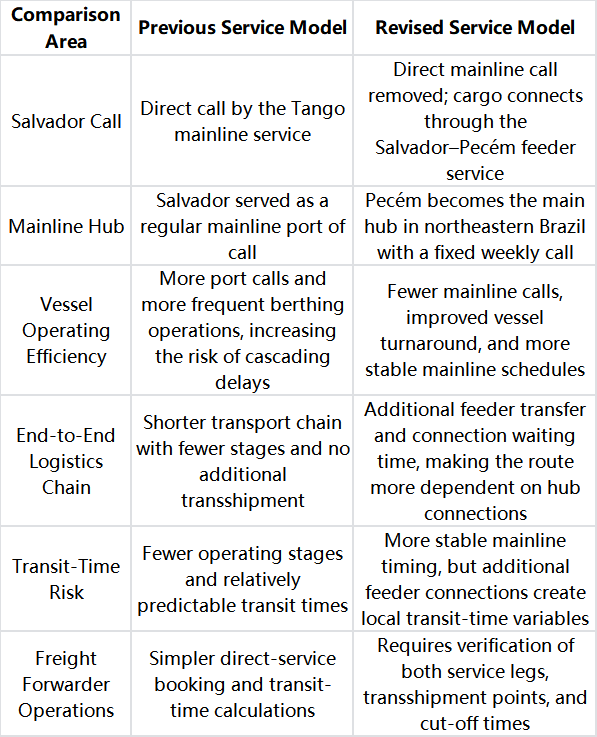
The Tango update is an example of network optimization through fewer mainline calls and additional feeder coverage.
The differences between the previous and revised models directly affect booking, transit-time calculations, and destination delivery.
Three Self-Check Questions for Freight Forwarders
• Have routing arrangements been fully updated? Has the August 27 transition date been confirmed, and has the previous direct Salvador arrangement been removed from operating plans?
• Have transit times been recalculated? Have customer notifications and delivery contingency plans been updated to include the feeder connection?
• Have local resources been arranged in advance? Are transshipment, customs clearance, and delivery services available in South America to support the revised routing?
Industry Summary
Overall, reducing inefficient mainline calls and strengthening core hubs have become common directions in global liner network optimization.
Major hub ports are becoming more important, while feeder networks are playing a greater role in maintaining regional coverage.
For freight forwarders active in South America, direct service alone is becoming less important as a measure of service quality.
The ability to coordinate the full transport chain, manage transshipment arrangements, and control transit-time risks is becoming increasingly important.
Freight forwarders should closely follow service changes announced by Maersk, Hapag-Lloyd, and other major carriers, update operating procedures in time, and manage end-to-end transit times carefully.
These measures can help reduce operating risks and maintain service quality in South America logistics.
Sources: Official Maersk announcement, Hapag-Lloyd service update, World Ports, authoritative cross-border shipping platforms
Disclaimer: This content is based on publicly available information and is provided for industry reference only. It does not constitute commercial or logistics operating advice.
Last
Global Container Freight Rates Decline Overall as Persian Gulf Route Surges 7.5%, with Geopolitical Risks Reshaping Shipping Costs
The global container shipping market is showing structural divergence. Freight rates on traditional major trade lanes continue to
Next
ONE Updates EC3 US East Coast Port Rotation with New Ningbo Call, Expanding East China Export Options
Global liner networks continue to undergo detailed optimization, with ONE introducing an important update to its US East Coast ser

