



CFR (Cost and Freight) is a shipping term that defines how transportation costs and risks are shared between buyers and sellers. The seller pays to ship the goods to the destination port, while the buyer takes responsibility for the goods once they are loaded onto the vessel. Understanding CFR helps businesses plan shipping costs and avoid confusion over their responsibilities.
A quote marked CFR Houston can look simple at first: the seller arranges and pays for the ocean freight to Houston. But that does not mean the seller carries every cost or every risk until the goods arrive at the destination port.
So, what does CFR stand for in shipping? CFR means Cost and Freight, one of the Incoterms used in sea trade. The important part is knowing what the seller pays for, when risk passes to the buyer, and which costs may still be waiting at the destination. This guide breaks those responsibilities down in practical terms.

What Does CFR Mean?
CFR stands for Cost and Freight, an international trade term used for goods shipped by sea. Under CFR, the seller arranges and pays for transportation to the agreed destination port. However, the risk of loss or damage transfers to the buyer once the goods are loaded onto the vessel at the port of departure.
In practice, the seller handles export clearance and ocean freight costs, while the buyer is responsible for import customs clearance, applicable duties and taxes, and transportation beyond the destination port. The buyer may also arrange cargo insurance to protect the shipment during transit.
When using CFR in a sales contract, clearly specify the destination port and the applicable Incoterms version. Both parties should also confirm which destination charges are included in the freight arrangement to avoid unexpected costs.
How Does CFR Work in Sea and Inland Waterway Trade?
CFR separates freight costs from shipping risks. The seller pays to transport goods to the agreed destination port, while the buyer takes on the risk once the cargo is loaded onto the vessel at the departure port.
The Seller Arranges Freight to the Destination Port
The seller books and pays for transportation to the named destination port, following the ICC's CFR shipping rules. For example, a Chinese exporter shipping goods to Houston would arrange the ocean freight and cover the transportation cost to that port.
Exporters can find an ocean freight forwarding partner through JCtrans to compare shipping services, sailing schedules, and freight rates for their chosen route.
Risk Transfers Once the Goods Are Loaded
Although the seller pays for transportation to the destination port, the buyer assumes the risk of loss or damage once the goods are loaded onto the vessel at the origin port.
For a shipment traveling from Shanghai to Houston, the risk transfers when the goods are on board in Shanghai. The seller still pays the agreed freight to Houston, but the buyer bears the risk during the ocean journey.
The Buyer Handles Insurance and Import Costs
Under CFR, the seller is not required to purchase cargo insurance. Buyers can arrange their own coverage to protect goods against damage or loss during transit.
The buyer also handles import customs clearance, duties and taxes, and transportation beyond the destination port. Destination terminal charges and unloading costs should be checked against the agreed freight arrangement, as some may already be included in the seller's shipping costs.
How Does CFR Differ From CIF, FOB and CPT?
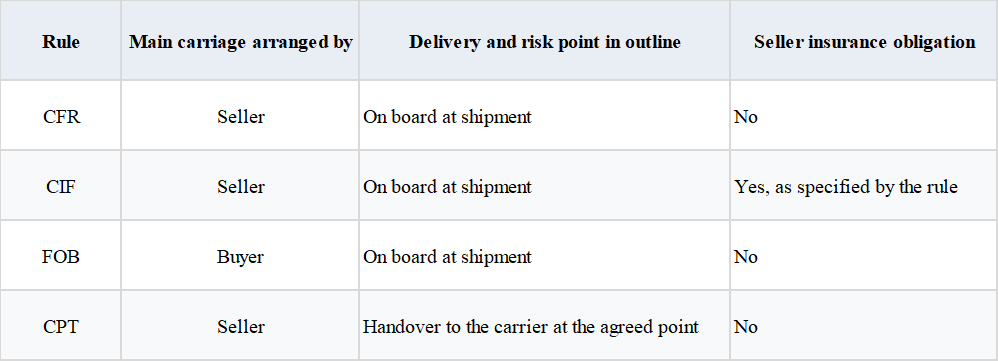
CFR, CIF, FOB, and CPT are commonly used in international trade, but they assign shipping costs, insurance, and transportation risks differently. Understanding these differences helps buyers and sellers choose suitable terms for their shipments.
CFR vs. CIF: Who Pays for Cargo Insurance?
CFR and CIF both require the seller to arrange and pay for shipping to the destination port. In both cases, the buyer assumes the risk once the goods are loaded onto the vessel at the departure port.
The main difference is insurance. CIF requires the seller to purchase cargo insurance for the buyer, while CFR leaves insurance arrangements to the buyer. CIF generally includes minimum insurance coverage, so buyers shipping valuable or sensitive goods may want additional protection.
CFR vs. FOB: Who Arranges Ocean Freight?
CFR and FOB transfer shipping risk at the same point: when the goods are loaded onto the vessel at the origin port. The difference is who arranges and pays for the main transportation.
With CFR, the seller books and pays for ocean freight to the destination port. With FOB, the buyer arranges the main carriage and pays the freight charges. FOB can be a better fit for importers who already work with a preferred shipping line or freight forwarder and want greater control over freight rates and sailing schedules.
CFR vs. CPT: Shipping Method and Risk Transfer
Both CFR and CPT require the seller to pay for transportation to an agreed destination. However, CFR applies to sea and inland waterway transport, while CPT can be used for road, rail, air, sea, or combined transportation.
The risk transfer point also differs. CFR transfers risk when the goods are loaded onto the vessel, while CPT generally transfers risk when the seller hands the goods to the first carrier. For container shipments delivered to a terminal before vessel loading, CPT may be more suitable because it reflects that earlier handover. The ICC's Incoterms guidance explains how these rules apply to different transport arrangements.
For logistics teams that regularly handle different shipping terms, freight forwarding courses can help build a better understanding of international shipping practices, documentation, and freight responsibilities.
Conclusion
CFR helps buyers and sellers understand their responsibilities when shipping goods by sea. The seller pays for transportation to the agreed destination port, while the buyer assumes the risk once the goods are loaded onto the vessel. Before finalizing a shipment, confirm the destination port, freight charges, insurance arrangements, and import costs. Clear shipping terms make it easier to plan expenses, avoid unexpected charges, and coordinate international deliveries.
Frequently Asked Questions
Does CFR Include Cargo Insurance?
The CFR rule does not require the seller to arrange cargo insurance for the buyer. Any cover provided separately must be checked on its own terms. Ask who purchases it, which journey and value are insured, and who can claim. Freight payment and cargo insurance answer different commercial questions.
Who Pays for CFR Shipping?
Under CFR (Cost and Freight), the seller pays for ocean transportation to the agreed destination port, including export-related costs. The buyer is responsible for import customs clearance, duties, taxes, and onward delivery. Although the seller pays the freight, the buyer assumes the risk once the goods are loaded onto the vessel.
How to Calculate CFR Price?
Calculate the CFR price by adding the FOB price of the goods to the ocean freight cost to the destination port. For example, if the FOB price is $10,000 and ocean freight costs $1,500, the CFR price is $11,500. Cargo insurance, import duties, and onward delivery costs are calculated separately.
Last
Sea Freight From China to the USA: Options, Costs and Booking
Sea freight from China to the USA offers shipping options for businesses of different sizes. Compare FCL and LCL based on cargo vo

Next
Container Prices in 2026: Buying Costs, Rental and Freight Rates
Container prices depend on whether you want to buy a box, rent storage space, or ship goods. For a useful 2026 budget, compare off