



BCO stands for beneficial cargo owner, the business with a direct commercial interest in the goods being shipped. Often an importer, exporter, or retailer, a BCO may arrange transportation directly with an ocean carrier or work through a freight forwarder or NVOCC. Understanding this role helps clarify how cargo owners participate in international shipping and logistics arrangements.
Shipping documents can list several companies around the same cargo, which makes the roles easy to mix up. The carrier may move the goods, a forwarder may arrange the shipment, and the buyer or seller may be the party that actually owns the cargo.
Understanding BCO meaning in shipping helps separate those roles. It shows who has the cargo interest, who is arranging transport, and who is providing the transport service. That distinction becomes useful when comparing quotes, booking freight, or checking who is responsible for each part of the shipment.
What Does BCO Mean in Shipping?
BCO stands for Beneficial Cargo Owner, referring to a business with a direct commercial interest in the goods being shipped. Common examples include retailers importing products for sale, manufacturers shipping their goods overseas, and companies purchasing inventory from international suppliers.
In international shipping, a BCO can book ocean freight directly with a shipping line or work with a freight forwarder or NVOCC to arrange transportation. The BCO is the business behind the cargo, while these logistics providers help manage bookings, documentation, and shipment coordination.
For example, a US furniture retailer importing sofas from China may hire a freight forwarder to arrange ocean transportation, customs coordination, and inland delivery. The retailer remains the BCO, even though the forwarder handles the shipping arrangements. Understanding this distinction helps businesses identify the cargo owner and the logistics providers involved in a shipment.
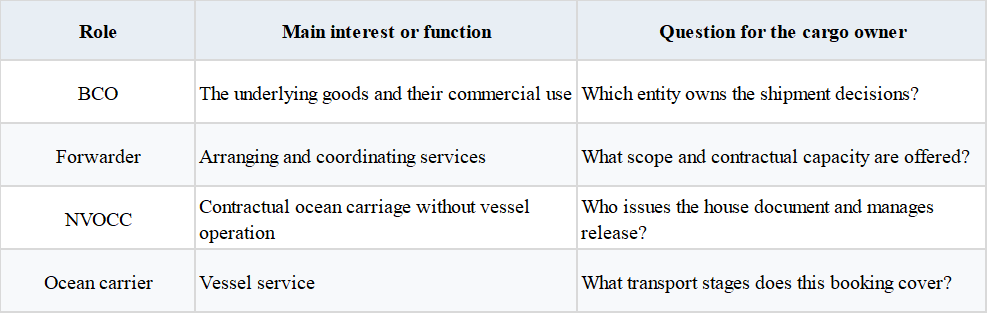
How Does a BCO Differ From Shipping Service Providers?
These roles describe different interests and services. One business may perform multiple functions, so identify its capacity in the specific contract rather than relying on its trading name.
BCO: The Party With an Interest in the Cargo
The BCO’s business depends on the goods: selling, using, or distributing them. Its priorities may include inventory availability, product condition, and the final delivered cost. It needs service information that supports those outcomes rather than only a vessel booking reference.
Record the purchasing entity, consignee, importer, and shipment contact separately if they differ. Group companies and trading arrangements can involve several legal entities, and an operational nickname does not settle their respective responsibilities.
Freight Forwarder: Coordinating Shipment Services
A forwarder can arrange services and coordinate information across transport stages. Ask which activities are included, which are subcontracted, and whether the company acts as agent or undertakes a separate contractual responsibility.
The FMC’s definition of a US ocean freight forwarder concerns dispatching exports, arranging space, and associated documentation. It is jurisdiction-specific, so do not treat that definition as a universal description of every business called a forwarder worldwide.
NVOCC: Providing Carriage Without Operating the Vessel
The FMC explains that an NVOCC provides ocean transportation without operating the vessels and issues its own house bill or equivalent document. In its relationship with the vessel operator, it is a shipper.
For the cargo owner, this makes the document chain important. Establish who issues your transport document and handles release and claims. The NVOCC’s carrier booking is a different contractual relationship from the one it has with its customer.
Ocean Carrier: Operating the Vessel Service
A vessel-operating ocean carrier provides the ship service. Its sailing network, equipment availability, and published or contracted terms help determine the options available for the ocean leg.
A direct carrier booking does not automatically cover export paperwork, destination brokerage, or delivery to the warehouse. Compare what the offer actually includes with the coordination you would otherwise buy from an intermediary.
What Does a BCO Need to Coordinate for a Shipment?
The cargo interest needs a joined-up shipment plan even when several providers carry it out. Assign ownership of the decisions that can interrupt movement or increase the final bill.
· Cargo readiness and accurate specifications. Supply packed dimensions, gross weight, commodity details, and special handling needs. If packaging changes after quotation, update the provider before booking; equipment and charges may need revision.
· The purchased service scope. Identify collection and delivery endpoints and any terminal or warehouse handoffs. A consignee expecting warehouse delivery needs to know if the booked service stops at the destination port.
· Trade and customs information. Agree which party provides classification, origin, value, and supporting product documents, and which authorized representative files them. Separate commercial allocation of tasks from legal responsibility.
· Booking and acceptance deadlines. Name the owner of cargo delivery, shipping instructions, and any required mass or advance filing information. Confirm acceptance rather than assuming that sending an email completes the obligation.
· Commercial and payment controls. Reconcile the quotation, invoice entity, bank beneficiary, and agreed credit terms. Independently verify a changed bank account using an established contact method before transferring money.
· Exceptions and recovery. Obtain a named contact for missed connections, holds, damage, or release problems. Agree what information the provider will supply and which decisions require your approval.
The BCO does not need to perform every task itself. It does need visibility of who is doing it and which dependency remains unresolved. A shared record of readiness, documentation, release, and delivery is more useful than several disconnected promises that the shipment is “being handled.”
When Does the BCO Model Apply?
Use the term to understand the cargo interest’s relationship with providers. The practical booking model depends on shipment patterns and the organization’s ability to manage transport work.
· Regular, predictable shipping. A business with repeat lanes can assess a direct carrier relationship against intermediary services. Compare realistic volumes and booking patterns, not only the total annual container count.
· Smaller or irregular consignments. A cargo owner may prefer consolidation and coordination through an intermediary. The BCO identity remains relevant even without a direct ocean contract.
· Several suppliers or destinations. The main requirement may be coordinating pickups, documents, and delivery contacts. Determine whether your team can manage those handoffs or needs a provider to do so.
· Specialized cargo or service needs. Temperature control, unusual dimensions, or regulated goods make capability and acceptance critical. Cargo ownership does not create the operational expertise or permission needed to move them.
Compare the organizational workload as well as freight. A direct rate that excludes services your team cannot perform may be less useful than a broader offer. Conversely, a business with capable internal operations may not need to purchase the same coordination twice.
How Can a BCO Assess Freight Partners?
When choosing a freight partner, look for experience with your shipping route, cargo type, and delivery requirements. Ask who handles pickup, customs coordination, and destination delivery. Request a detailed quotation showing the included services, possible extra charges, and how shipment delays are handled.
You can compare freight forwarding partners through JCtrans to explore available providers and shortlist companies that match your needs. Check their business registration, service experience, and customer references. For US ocean shipments, verify applicable licensing or registration through the Federal Maritime Commission (FMC).
Before booking, review payment terms, liability coverage, and dispute procedures. Confirm that the company receiving payment matches the contracting entity, and ask how unexpected charges or cargo release issues are resolved.
You can also check freight partner risk alerts through JCtrans to identify reported concerns worth investigating. For a new partnership, consider arranging a smaller trial shipment to evaluate communication, charge transparency, and delivery coordination before committing to regular shipments.
Conclusion
BCO identifies the cargo interest, while the booking and document chain show how transport responsibilities are actually arranged. Choosing a provider starts with understanding that separation and the work your own team needs covered.
Compare partners against a written service brief, then verify the contracting entity, relevant qualifications, release arrangements, and payment instructions. Select the model that supports your shipment pattern and internal capability, with a named owner for the handoffs that could stop delivery.
Frequently Asked Questions
Is a BCO Always the Importer of Record?
No. Cargo interest and importer-of-record status describe different roles. They may belong to the same entity, but a sales arrangement or group structure can separate them. Identify the importer under the applicable customs rules and confirm the entry arrangements instead of inferring responsibility from the BCO label.
Can a BCO Use a Freight Forwarder?
Yes. A beneficial cargo owner can hire a forwarder for the services it needs while remaining the cargo interest. Agree whether the provider acts as agent, contractual carrier, or in another stated capacity for each service. The scope and documents determine the arrangement, not the BCO abbreviation alone.
Does Being a BCO Guarantee Lower Freight Rates?
No. Price depends on the lane, volume, timing, equipment, service scope, and commercial terms. Compare complete offers using the same shipment assumptions. A lower ocean rate may exclude coordination or destination services that your business still needs, so evaluate the delivered cost and workload together.

Last
Container Shipping to the USA From the UK: Options, Costs, and Planning
Container shipping from the UK to the USA requires a transport choice, a comparable cost estimate, and clear export and import res
Next
What Is Tare Weight? Meaning, Calculation, and Shipping Use
Tare weight is the weight of the empty packaging, container, or equipment included in a defined weighing setup. For matching measu