




What is OWS Overweight Surcharge? OWS Overweight Surcharge refers to a standard terminal and inland trucking supplementary fee imposed by freight carriers and logistics terminals when truck cargo gross weight or axle load metrics exceed locally enforced highway legal thresholds within inland freight forwarding segments. This charge compensates for extra operational inputs and infrastructure compliance risks, with fee standards varying significantly across regional road regulatory frameworks worldwide.
What core definitions shape OWS Overweight Surcharge application?
Unified freight industry terminology defines the applicable scenarios of OWS Overweight Surcharge for global inland trucking operations. Local highway axle load caps, terminal weight verification protocols, and route compliance rules jointly define the scope of this common supplementary freight charge for over-limit cargo shipments.
Forwarders need to clarify three core interrelated metrics to accurately judge OWS surcharge eligibility. Gross Vehicle Weight (GVW) represents the total mass of a truck, trailer, and fully loaded cargo. Single axle load and tandem axle load separately measure pressure exerted by individual axles and paired axles on road surfaces. Regional transportation authorities supervise these metrics to protect public road and bridge infrastructure, forming the basic judgment criteria for OWS charge imposition.
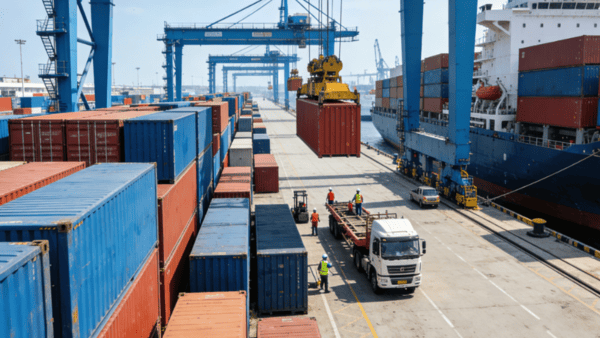
A common mistake is equating government highway overweight penalties with terminal OWS Overweight Surcharge. Roadside overweight fines are administrative penalties issued by traffic management authorities for post-violation supervision. In contrast, OWS Overweight Surcharge is a commercial fee collected by carriers and terminals during pre-delivery inspection and terminal handling, covering incremental operational costs and compliance risks of arranging legal transportation for overweight cargo.
According to Federal Highway Administration (FHWA) 2025 statistical data, approximately 60% of inland trucking overweight-related cost expenditures for cross-border freight come from carrier-initiated commercial surcharges, rather than state-level highway administrative fines. This data reflects the substantial influence of OWS charge rules on current global inland freight cost accounting systems.
How do regional highway axle load limitations differ globally?
Highway axle load regulatory standards show obvious regional differences across global trade zones, forming fragmented compliance requirements that affect the activation of OWS Overweight Surcharge on inland trucking routes. Such differences originate from varying infrastructure construction standards, road service life, and regional traffic management policies.
North American regional axle load rules
North American inland trucking weight management follows a unified federal baseline with prominent state-level differentiated restrictions, affecting cross-state freight routing planning. The United States federal regulation stipulates a 20,000 lbs maximum single axle load, a 34,000 lbs maximum tandem axle load, and an 80,000 lbs total GVW limit for interstate highway transportation (FHWA, 2025).
Many states implement stricter supplementary rules that override federal baseline standards on local roads. According to Texas Department of Transportation (2026) regulatory documents, California and Texas enforce lower fixed axle load thresholds on state and county roads compared with federal interstate standards. Northern states including Michigan and Minnesota launch seasonal spring thaw restrictions, reducing local road axle load limits by 10–15% annually to protect fragile road surfaces, which may trigger OWS surcharges for cargo compliant with usual standards.
European regional axle load rules
European inland freight transportation adopts a unified metric-based axle load system with flexible adjustments among member states. The European Union’s basic road freight specification sets a 11.5-tonne single axle load limit and a 19-tonne tandem axle load limit for standard heavy-duty trucks.
Western European countries such as Germany and the Netherlands maintain strict implementation of EU unified standards on all national highways. Most Eastern European countries adopt relatively flexible weight thresholds for cross-border transit cargo to facilitate regional trade, leading to regulatory differences in cross-border inland routes and potential OWS charge risks.
Asia-Pacific regional axle load rules
The Asia-Pacific region features highly diversified axle load compliance standards across different countries. China’s highway management regulations specify weight caps of 18 tonnes for two-axle trucks and 25 tonnes for three-axle trucks on national highways.
Southeast Asian nations including Vietnam and Thailand have relatively aging road infrastructure with generally lower axle load tolerance. Most heavy industrial cargo shipments in these regions fail to meet local road compliance standards, resulting in frequent OWS Overweight Surcharge imposition in terminal operations.
Forwarders should note that regional axle load discrepancies serve as a major source of unplanned OWS surcharges in multi-region inland trucking businesses. Many global forwarding teams only refer to international baseline standards while ignoring local road restrictions, which easily cause extra cost expenditures and shipment schedule delays.
What inland trucking routes commonly trigger terminal OWS surcharges?
Several types of inland trucking routes are prone to triggering terminal OWS Overweight Surcharge due to strict local axle load rules, seasonal traffic control policies, or insufficient infrastructure bearing capacity. Identifying these high-risk routes helps forwarding enterprises optimize routing schemes and formulate accurate cost budgets.
Cross-state secondary highway routes in North America: Forwarders commonly select interstate highways for heavy cargo transportation due to stable federal weight standards. However, last-mile delivery via state and county secondary roads often violates local axle load regulations. Lower single-axle limits on these local routes may trigger terminal OWS surcharges, even if the cargo meets federal interstate compliance requirements.
Seasonal northern hemisphere inland transit routes: Rural inland roads in Canada and the northern United States implement spring thaw weight control measures from March to May each year. Carriers generally apply OWS Overweight Surcharge to all heavy cargo passing through these restricted zones during the policy implementation period, with few exemption channels for conventional commercial freight.
EU peripheral cross-border inland routes: Cargo transported between Western EU core regions and Eastern EU peripheral areas faces mismatched axle load standards. Border roads in Eastern European regions have lower infrastructure weight tolerance, requiring terminal teams to assess overweight fees for standard EU-spec heavy truck cargo before cross-border dispatch.
Asia-Pacific rural port feeder routes: Inland feeder roads connecting major Asian ports and inland industrial hubs lack comprehensive reinforcement upgrades in many rural sections. These road segments implement reduced axle load limits, leading to regular OWS surcharge collection for containerized and breakbulk freight in terminal transit links.
According to Drewry 2024 global inland freight industry analysis data, route-specific overweight surcharges account for 8.2% of total inland trucking costs in intercontinental freight businesses. High-risk routes recorded relatively higher surcharge ratios compared with ordinary transportation corridors in industry statistics.
What operational risks do unplanned OWS surcharges bring to forwarders?
Unverified regional axle load restrictions and unexpected OWS Overweight Surcharges bring measurable financial and operational risks to global forwarding enterprises engaged in end-to-end freight logistics services. Small and medium-sized forwarding institutions are more vulnerable to these risks due to limited professional route compliance monitoring resources.
Unbudgeted cost increment risks
Most forwarding enterprises quote client freight prices based on standard basic trucking service fees, without fully reserving space for route-specific OWS surcharge costs. When terminals issue retroactive overweight service fees after shipment completion, enterprises face narrowed profit margins or repeated billing communication disputes with clients, affecting operational profitability and customer relationships.
Compliance and schedule delay risks
A common mistake is regarding terminal total weight inspection results as full compliance evidence for roadside highway supervision. Terminals mainly verify total GVW for booking confirmation, while systematic auditing of single axle and tandem axle weight distribution is often absent. Cargo with compliant total weight may have unbalanced axle load distribution that violates local road rules, causing unexpected OWS charges.
Overweight non-compliance issues may lead to temporary shipment detention at terminal checkpoints for cargo weight redistribution and compliance adjustment, extending overall transit time by 1–3 business days. Long-term irregular overweight routing operations may also trigger penalty clauses in carrier cooperation contracts and limit enterprises’ available routing resources.
What is the optimized workflow to avoid unnecessary OWS surcharges?
A standardized pre-shipment compliance verification workflow can effectively reduce unnecessary OWS Overweight Surcharge occurrences by matching cargo routing schemes, weight distribution status, and regional axle load regulations. This workflow is adaptable to most inland trucking freight types and forwarding enterprise operation modes.

The recommended approach is to adopt a four-step pre-shipment inspection process for all inland trucking cargo before terminal dispatch. This proactive working mechanism integrates regulatory inquiry, weight auditing, route optimization, and policy confirmation to mitigate overweight surcharge risks in advance.
Conduct real-time regional axle limit research: Before confirming transportation routes, query the latest highway axle load standards, seasonal restriction policies, and local road weight limit rules for each transit segment through official transportation authority databases. Give priority to updated regional regulatory bulletins rather than general baseline standards.
Perform precise axle weight distribution auditing: On the basis of total GVW inspection, calculate the weight bearing status of each single axle and tandem axle of loaded trucks. Adjust cargo stacking and placement modes to balance axle load distribution and meet the strictest weight limit requirements along the entire transit route.
Optimize routing to avoid high-risk segments: Replace rural secondary roads and seasonally restricted road sections with certified heavy-duty highway corridors whenever feasible. For mandatory last-mile restricted routing scenarios, apply for official overweight transportation permits in advance to qualify for terminal surcharge exemptions.
Confirm terminal surcharge policies in advance: Communicate with carrier terminal operation teams to confirm current OWS assessment standards, permit exemption scopes, and retroactive charging rules. Keep written records of all communication confirmations to resolve potential billing differences after cargo delivery.
Forwarders should note that proactive overweight permit application is one of the cost-effective solutions for unavoidable overweight cargo transportation. According to Freightos Baltic Index 2025 inland freight statistical data, legally approved overweight permits can reduce extra OWS-related cost expenditures by a notable margin compared with unplanned terminal surcharge assessments.
Why do terminals impose dedicated OWS overweight surcharges for route violations?
Freight terminals collect route-based OWS Overweight Surcharges to cover increased operational costs and potential liability risks brought by non-compliant overweight inland trucking shipments. This fee collection mechanism serves as a practical risk control and compliance supervision measure in the logistics industry.
Liability risk compensation needs
Terminals bear joint indirect liability for dispatching non-compliant overweight trucks on restricted routes. If roadside law enforcement inspections identify axle load violations after cargo departure, both cooperating carriers and dispatching terminals may face administrative penalties, road damage compensation fees, and negative regulatory filing records. OWS surcharges partially offset these potential liability losses.
Operational cost compensation needs
Overweight cargo handling increases terminal operational workload and equipment consumption. Processing over-limit cargo requires extended inspection time, professional loading and reinforcing equipment, and manual weight adjustment operations, which raise terminal labor cost and equipment maintenance expenditure. The OWS fee system provides reasonable compensation for these incremental operational inputs.
Industry compliance supervision needs
Different from government post-violation penalty measures for highway overweight acts, terminal OWS surcharge management realizes pre-emptive compliance supervision before cargo enters inland transit networks. This mechanism helps standardize overweight cargo transportation behaviors and optimize the overall safety level of inland freight operations.
In summary, proficiency in regional maximum highway axle load limitations is the key to screening high-risk inland trucking routes. A clear understanding of What is OWS Overweight Surcharge supports global forwarders in optimizing routing layouts, stabilizing logistics cost control, and maintaining reliable end-to-end service quality in cross-border inland freight transportation businesses.

Last
Optimizing tight packaging stuffing layouts by cross checking factory crate specs with actual usable 45hq container internal dimensions
Precision cargo stowage serves as a core profit optimization lever for global freight forwarders, and verifying factory packaging
Next
Standardizing title handover operational steps for triangular trade offshore document setups using a secure hbl vs ocean mbl switching guide
A secure HBL vs ocean MBL switching guide supports global freight forwarders in standardizing title handover workflows for triangu

