



Precision cargo stowage serves as a core profit optimization lever for global freight forwarders, and verifying factory packaging specifications against accurate 45hq container internal dimensions eliminates loading gaps, calculation discrepancies, and avoidable container space wastage in cross-border ocean freight operations.
What Are the Standard Usable 45HQ Container Internal Dimensions for Commercial Shipping?
Standard 45HQ container internal dimensions represent ISO-standardized inner linear measurements that define the practical cargo-bearing space for mainstream ocean freight FCL shipments. According to UNCTAD 2025 maritime container specification data, conventional 45-foot high cube containers feature certified internal dimensions of 13.556 meters in length, 2.352 meters in width, and 2.698 meters in height, with a nominal volumetric capacity of 86 cubic meters.

Why internal and external container measurements differ
Many entry-level logistics practitioners confuse external container overall dimensions with practical internal stowage space, which results in inaccurate stowage calculation models. The external dimensional footprint of a standard 45HQ container measures 13.716m × 2.438m × 2.896m, while structural components including corner castings, interior wall liners, roof bracing frames, and door sealing structures occupy non-cargo usable space inside the unit.
This dimensional discrepancy carries practical operational value for forwarders handling dimension-sensitive cargo, including industrial machinery crates, assembled furniture units, and multi-layer palletized commodities. Ignoring such structural spatial limitations often leads to overestimated stowage volumes and on-site loading adjustments.
Forwarders should note that marginal dimensional deviations of 1–3 centimeters may occur across container manufacturers and aging fleet assets. Such minor variations rarely affect conventional commercial stowage layouts. Custom-modified or refrigerated 45HQ containers feature adjusted internal clearances and require separate dimensional validation prior to cargo planning cycles.
Why Cross-Checking Factory Crate Specs With 45HQ Internal Dimensions Reduces Shipping Losses?
Cross-verifying factory crate technical specifications with official 45HQ container internal dimensions establishes a proactive risk control mechanism that mitigates spatial mismatches between manufacturing-oriented packaging designs and containerized stowage constraints in global logistics.
Industry data on packaging-related logistics inefficiencies
According to WTO 2025 global supply chain efficiency reports, roughly 30 percent of FCL space wastage and partial LCL consolidation delays stem from unvalidated factory packaging dimensional data. Most original equipment manufacturers design export crates prioritizing product structural protection and transit durability, rather than compatibility with standard container spatial parameters.
This design orientation commonly generates oversized crate widths, inconsistent stacking heights, and irregular edge protrusions that consume usable container space and reduce stowage density. For high-volume batch shipments, cumulative spatial waste gradually elevates unit ocean freight costs and lowers overall logistics operational efficiency.
Common operational errors in crate dimension adoption
A common mistake is relying exclusively on factory theoretical crate dimensions listed in design drawings, without accounting for on-site packaging variables such as corrugated bulging, metal strapping thickness, and protective foam cushion margins. Official factory spec sheets typically record rigid core product frame dimensions, while finished packaged crates usually gain 2–5 cm of outer thickness from external protective accessories.
Applying unadjusted theoretical measurements to 45HQ container stowage planning frequently causes on-site stowage mismatches. These discrepancies may lead to last-minute cargo offloading, supplementary container booking arrangements, and emergency on-site repackaging expenditures, all of which erode project profit margins.
Practical benefits of dimensional cross-verification
The recommended approach is to conduct random dimensional sampling of finished export crates per production batch and cross-reference measured data with verified 45HQ container internal dimensions before finalizing stowage manifests and shipping plans. Industry operational data indicates that this verification workflow can reduce controllable container space wastage by 8–12 percent on conventional FCL shipments and lower emergency repackaging expenses by approximately 20 percent for high-value industrial cargo.
For forwarders maintaining long-term cooperative relationships with manufacturing clients, standardized dimensional verification improves service stability and client stickiness. Optimized stowage layouts maximize effective cargo load per container, reducing clients’ average unit shipping costs and strengthening market competitiveness for collaborative logistics solutions.
What Key Crate Spec Parameters Must Forwarders Verify for 45HQ Container Stuffing?
Effective stowage layout optimization relies on six core factory crate specification metrics that interact with 45HQ container internal dimensions to determine overall container space utilization rates in FCL shipping scenarios.
Individual crate outer dimensional parameters: External length, width, and height of finished crates form the foundational data for all stowage layout calculations. Forwarders must validate maximum outer dimensions inclusive of wooden bracing frames, plastic protective casings, and metal securing strapping, instead of referencing internal product dimensions. Minor inaccuracies in this data can disrupt the overall stowage layout calibrated to 45HQ container internal spatial boundaries.
Crate stacking tolerance and structural load capacity: Export crates feature differentiated stacking adaptability based on material strength and structural design. Factory technical documents should specify permissible stacking layers and safety gap standards between stacked units. Excessive reserved gaps waste the 2.698m vertical internal height of 45HQ containers, while over-stacking may trigger crate structural deformation and in-transit cargo damage during ocean voyages.
Irregular protrusion and edge offset measurements: Industrial export crates often integrate functional structures such as lifting lugs, wiring ports, and protective anti-collision brackets. These irregular components are frequently omitted from simplified factory spec summaries yet hinder compact side-by-side stowage within the 2.352m narrow internal width of standard 45HQ containers.
Batch-wise crate dimensional consistency: Mass-produced export packaging units present minor dimensional deviations across production batches. Forwarders should implement spot checks covering 3–5 percent of each cargo batch to confirm dimensional uniformity, as inconsistent crate sizes generate unavoidable interstitial gaps in horizontal and vertical stowage arrangements.
Variable thickness of moisture-proof packaging layers: Export shipments destined for humid maritime environments require additional moisture-proof films, cushioning pads, and waterproof wrapping materials, which increase overall crate outer dimensions. Factories rarely update spec sheets for such auxiliary packaging adjustments, so forwarders must account for these variations to prevent dimensional overruns of 45HQ container spatial limits.
Pallet base overall dimensional specs: Most FCL cargo relies on standard wooden or plastic pallets for mechanical loading and stable stowage. Pallet length, width, and supporting leg height alter the effective floor area and vertical usable height of 45HQ containers, making pallet specification verification a necessary step for accurate stowage planning.
How to Build a High-Efficiency Tight Stuffing Layout for 45HQ Containers?
Optimized compact stowage layout design is a standardized, multi-step workflow that integrates validated crate dimensional data, official 45HQ container internal dimensions, and industry-recognized ocean freight stowage principles to boost container space utilization.
Standardize and unify all valid dimensional data: Consolidate on-site sampled crate dimensions, pallet specification data, and authoritative 45HQ container internal parameters, while excluding outdated theoretical factory design data that fails to reflect finished cargo conditions. Unified, field-verified data provides reliable support for stowage layout modeling.
Classify cargo units by stacking compatibility: Categorize cargo into rigid stackable heavy units and fragile non-stackable light units based on packaging structural performance. Arrange high-density rigid crates at the container bottom to stabilize cargo center of gravity and fully utilize base floor space, while allocating lightweight cargo to upper residual spatial areas.
Calculate horizontal stowage density and row spacing: Calculate feasible single-row crate quantities and total stowage rows based on the 13.556m internal length and 2.352m internal width of 45HQ containers. Reserve minimal essential gaps for cargo ventilation and fixed lashing, and avoid uniformly redundant spacing that accumulates into substantial spatial waste.
Stratify vertical stowage height optimization: Match stacked cargo height combinations with the 2.698m vertical internal clearance of 45HQ containers, designing two to three layered stowage structures for structurally qualified cargo batches. Control total stacked height within container limits to prevent roof structural extrusion and cargo compression damage.
Simulate stowage and adjust marginal spatial gaps: Adopt conventional logistics stowage simulation tools to preview full-container loading effects. Fine-tune individual crate placement positions to eliminate scattered small gaps, and fill residual marginal spaces with small auxiliary packaged cargo to improve overall space utilization.
Formulate standardized on-site stowage guidelines: Convert finalized layout schemes into structured operational guidelines for loading teams, clarifying standardized stacking sequences, gap control standards, and cargo lashing methods to reduce arbitrary on-site adjustments that compromise layout efficiency.
According to Freightos Baltic Index 2025 quarterly logistics operational analysis, stowage layouts optimized through dimensional cross-verification can lift 45HQ container space utilization from the prevailing industry average of 78 percent to above 85 percent in regular FCL scenarios. For forwarders with stable batch shipping volumes, this efficiency improvement generates additional usable cargo volume per container and reduces average unit freight costs.
Forwarders should note that compact stowage optimization adheres strictly to international container gross weight limits and cargo safety compliance standards. Layout adjustments prioritize balanced spatial utilization and transit safety to avoid overweight penalties, cargo shifting, or in-transit damage risks.
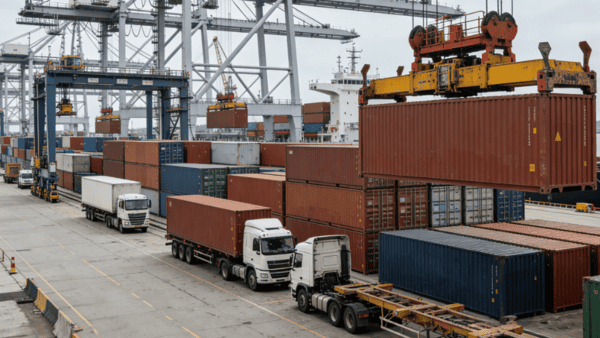
What Common Pitfalls Ruin 45HQ Container Stuffing Layout Accuracy?
Multiple routine operational errors in freight forwarding practices compromise the precision of 45HQ container stowage layouts, creating controllable efficiency losses and cost risks for FCL shipping projects.
Over-reliance on factory theoretical dimensional data: Many practitioners adopt design drawing parameters without field sampling, ignoring practical packaging tolerances and on-site assembly deviations. This disconnect leads to layout schemes that cannot be fully executed during physical loading.
Neglect of container structural dead space: Junior operators often calculate stowage volume based on external container dimensions, failing to reserve clearance for door frames, inner wall protrusions, and corner structural dead space inherent to 45HQ container internal dimensions.
Oversimplification of batch cargo dimensional differences: Treating all crates in a single batch as dimensionally uniform ignores minor production deviations. Accumulated small discrepancies result in uneven stowage gaps or local overcrowding within container spaces.
Improper stacking sequence arrangement: Misplacing non-stackable fragile cargo on lower layers or heavy rigid cargo on upper layers creates transit safety hazards and forces disruptive revisions to pre-designed compact stowage layouts.
Absence of standardized on-site supervision: Pre-formulated scientific layout schemes are often adjusted arbitrarily by on-site loading staff for operational convenience, weakening the space utilization gains from professional dimensional planning.
The recommended approach is to deploy a standardized pre-loading inspection checklist for all 45HQ FCL shipments. The checklist covers crate dimensional sampling verification, container spatial condition confirmation, stowage layout scheme review, and full-process on-site loading supervision. This closed-loop management mode mitigates most human-induced stowage layout errors in daily operations.
Amid intensifying global freight market competition, incremental operational efficiency improvements play a vital role in stabilizing corporate profitability. For global forwarders focusing on full-container-load shipping services, proficiently aligning factory crate specifications with verified 45hq container internal dimensions supports standardized stowage optimization, effective cost control, and sustainable long-term client partnership maintenance in cross-border logistics businesses.

Last
How high volume apparel consolidation forwarders utilize maximum vertical clearance data matching 45hq high cube container internal dimensions standards
High-volume apparel consolidation relies heavily on precise vertical space planning, and professional forwarders consistently refe

Next
Checking regional maximum highway axle load limitations to determine what inland trucking routes trigger an ows terminal overweight surcharge
What is OWS Overweight Surcharge? OWS Overweight Surcharge refers to a standard terminal and inland trucking supplementary fee imp