






Effective May 1, 2026, Article 93 of the newly amended Maritime Code of the People’s Republic of China will come into force. The long-standing principle of “consignee liability” will shift to a “shipper-first liability” regime, marking a fundamental risk allocation change for the international freight forwarding industry.
Seasoned practitioners know that unclaimed cargo at destination is not uncommon. Market volatility, buyer insolvency, and other uncertainties can easily result in cargo abandonment. Only robust risk management can ensure resilience. This guide breaks down the key changes and sets out practical risk control strategies.
I. Why the Change? Long-Standing Pain Points Under the Old Regime
Former Article 86 of the Maritime Code had been in force for over 30 years. While it appeared to define liability, in practice it often left carriers without an effective recourse, and frequently entangled freight forwarders. Key issues included:
1. Difficulty Identifying the Consignee
Under straight bills of lading, the consignee is identifiable. However, under order bills or bearer bills, the actual cargo receiver is often unclear. When cargo is abandoned, carriers may not even identify a proper defendant, stalling enforcement at the outset.
2. Challenges in Pursuing Overseas Consignees
Even when the consignee is identified, cross-border litigation is costly and enforcement uncertain. Carriers often resort to negotiating with domestic shippers or forwarders, forcing the latter to absorb communication costs or even partial losses.
3. Liability Vacuum under FOB Terms
In many FOB transactions, the overseas buyer nominates the forwarder and carrier. Although the domestic seller is merely the delivery party, it is often drawn into disputes as the cargo originator or booking-related party, leading to a “no-fault yet liable” situation.
The revised law aims to clarify liability allocation and enable carriers to identify a responsible party more efficiently.
II. Old vs. New Provisions: Key Differences at a Glance
Former Article 86 (Before Amendment)
Where cargo is not collected at the port of discharge, or the consignee delays or refuses to take delivery, the master may discharge the cargo into a warehouse or other appropriate place. The resulting costs and risks shall be borne by the consignee.
New Article 93 (After Amendment)
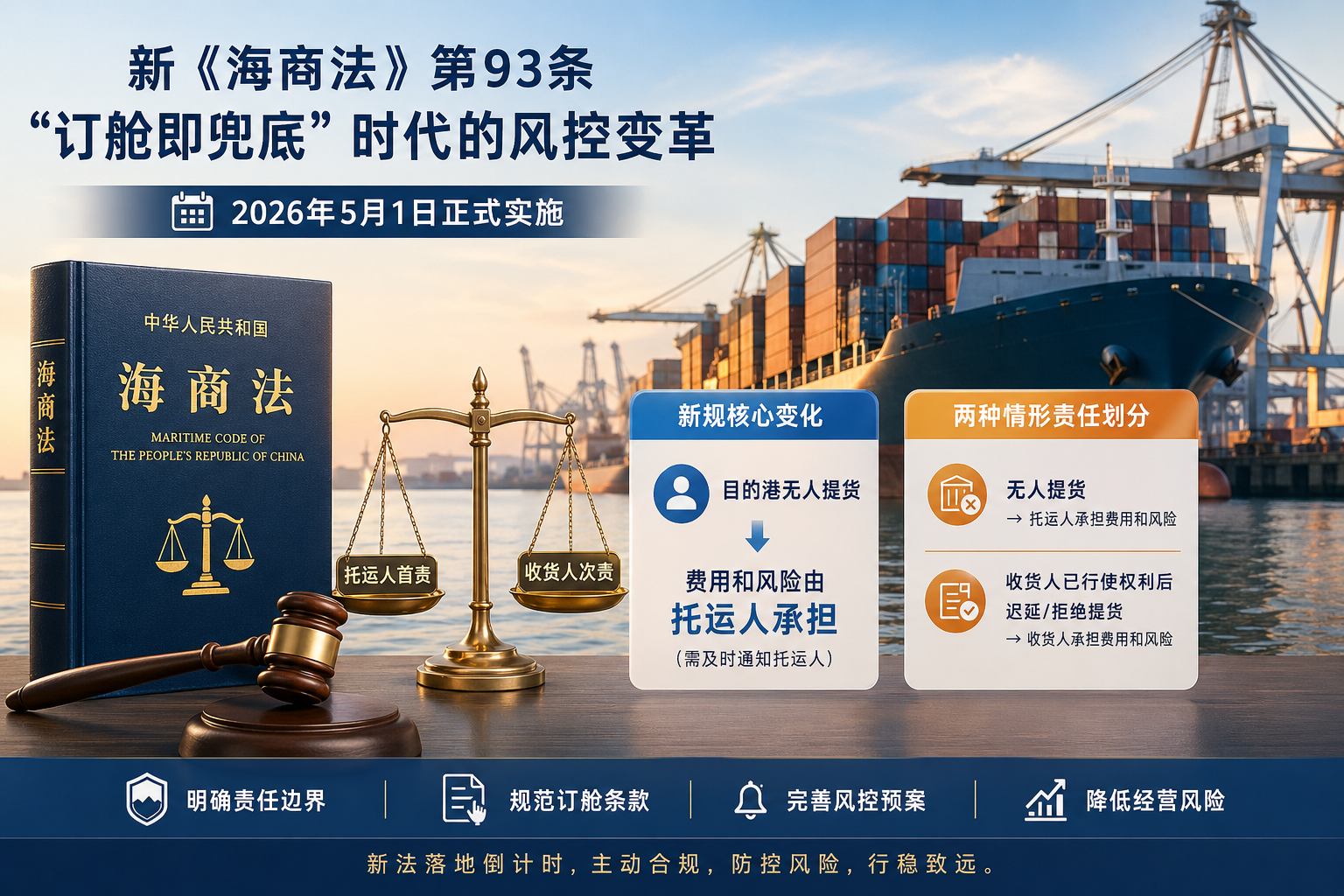
Where cargo is not collected at the port of discharge, the master may discharge it into a warehouse or other appropriate place. The resulting costs and risks shall be borne by the shipper, provided that the shipper is notified in a timely manner.
Where the consignee has exercised rights under the contract of carriage but delays or refuses to take delivery, the costs and risks shall be borne by the consignee.
III. Two Typical Scenarios Explained
Scenario 1: Buyer Disappears — No One Takes Delivery
A Chinese forwarder E, acting under a CIF contract, arranges shipment of garments to the U.S. The consignee F becomes insolvent and disappears, leaving the cargo unclaimed.
ØUnder the old regime:
The carrier must pursue the overseas consignee F, facing high litigation costs and enforcement barriers. In practice, carriers may auction the cargo and negotiate with forwarder E to cover any shortfall, creating prolonged disputes.
ØUnder the new regime:
The carrier may store the cargo at destination and directly claim storage, demurrage, and disposal costs from the shipper (including forwarder E as the contractual shipper), provided timely notice is given.
Upon notification, the forwarder can take prompt mitigation measures.
Scenario 2: Buyer Clears Customs but Refuses to Take Delivery
A Chinese forwarder G ships electronics to Europe. The consignee H presents the bill of lading and completes customs clearance, but refuses delivery due to a price collapse.
ØUnder the old regime:
The carrier must still pursue consignee H, but enforcement remains difficult. Pressure may shift to forwarder G, placing it in a passive position.
ØUnder the new regime:
Since H has exercised contractual rights, all subsequent costs and risks (storage, demurrage, etc.) are borne solely by consignee H.
Forwarder G bears no additional liability.
IV. Core Shift: The Shipper Becomes the Primary Liable Party
Article 93 clearly establishes that:
lIf cargo is unclaimed, liability lies with the shipper;
lOnly when the consignee has exercised contractual rights does liability shift to the consignee.
Importantly, under Article 42, “shipper” includes:
lContractual shipper — the party contracting with the carrier (including forwarders booking in their own name);
lActual shipper — the cargo owner delivering goods to the carrier.
This means that if a freight forwarder books space in its own name, it will likely be deemed the contractual shipper and become the primary target for carrier recourse in abandonment cases.
V. Practical Risk Control Strategies for Freight Forwarders
In light of the new regime, forwarders must clearly define their role and safeguard their liability boundaries. Three actionable measures are recommended:
1. Clearly Communicate Risk Allocation to Clients
Proactively explain the legal changes to shippers, especially under FOB terms. Correct the misconception that cargo abandonment is solely the buyer’s responsibility.
2. Standardize Booking Agreements
When contracting with carriers, clearly define notification obligations, including method (e.g., written notice, email) and timing. Maintain complete records to support future claims or defenses.
3. Establish Cargo Abandonment Contingency Plans
For high-risk cargo (e.g., perishable or rapidly depreciating goods) or high-risk counterparties, agree in advance on disposal procedures and cost allocation to mitigate losses at source.
Conclusion: Risk Management Is No Longer Optional
The revision of the new Maritime Code is not a “constraint” on the freight forwarding industry, but a catalyst driving its standardization and disciplined development. The industry has now moved beyond an era of extensive, loosely managed operations and entered a new phase where risk control is paramount.
With the implementation of the new rules fast approaching, freight forwarders must take proactive steps—understand the legal framework, clearly define responsibility boundaries, and strengthen risk prevention—in order to ensure stable and sustainable operations.

Last
One Booking Mistake, €130,000 Lost: Egypt’s ACID Rules Are a Red Line Freight Forwarders Cannot Afford to Cross
In cross-border logistics, compliance is never optional. Details determine outcomes, and nowhere is this more evident than in expo

Next
The Freight “Rashomon”: 3 Invoices, 6 Parties — A Must-Read Risk Control Case for Logistics Professionals | JCtrans Credit Risk Awareness Month – Risk Control Case Study
In cross-border logistics, the biggest nightmare isn’t customs inspections or transit delays — it’s when cargo arrives, but the bi

