




In cross-border logistics, compliance is never optional. Details determine outcomes, and nowhere is this more evident than in exports to Egypt. Under Egypt’s ACID regime, compliance requirements run through the entire logistics chain—from booking and documentation to customs clearance. Once the red line is crossed, the consequences can escalate rapidly: cargo detention, mounting storage costs, project delays, contractual penalties, and even the loss of financial protection mechanisms.
A recent dispute handled by the platform serves as a stark warning to the industry. A single booking error, caused by a freight forwarder’s disregard for ACID requirements and written shipping instructions, ultimately resulted in the loss of the protection coverage.
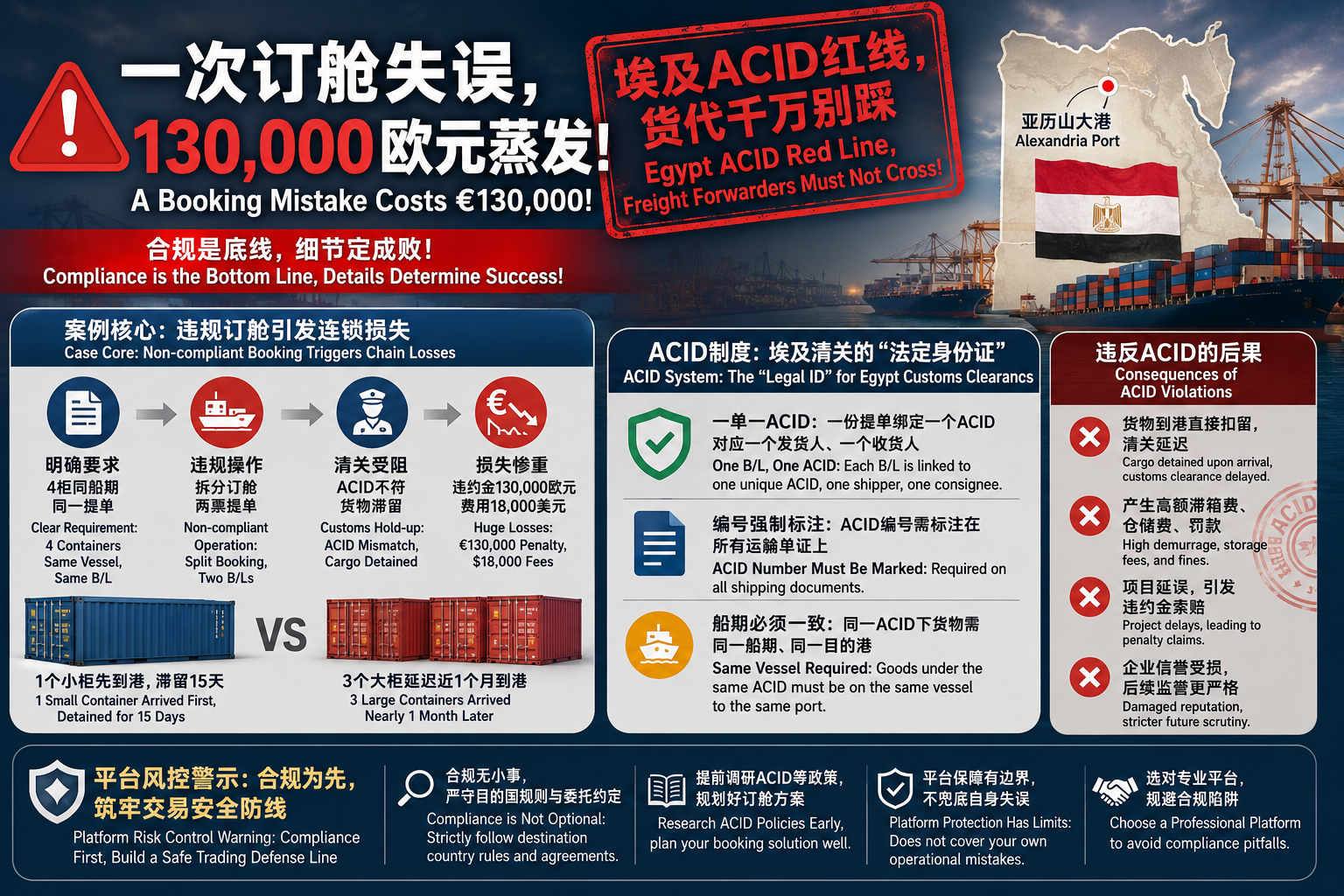
I. Case Review: A Compliance Failure That Triggered a Chain Reaction
An Egyptian destination agent (the debtor) was tasked with handling an urgent import shipment for a national railway infrastructure project. The shipment consisted of four containers of precision equipment destined for the Port of Alexandria.
The shipping requirement was explicitly stated from the outset: all four containers had to move on the same vessel voyage and under a single Bill of Lading.
This requirement was not merely operational preference—it was a direct consequence of Egypt’s ACID (Advance Cargo Information Declaration) system, fully enforced through the NAFEZA single-window customs platform since October 2021. Under the ACID framework, one ACID number corresponds to one Bill of Lading, one shipper, and one consignee. Splitting shipments into multiple Bills of Lading can immediately disrupt customs clearance procedures.
The debtor appointed a German freight forwarder (the creditor) to handle the shipment and repeatedly emphasized in writing that the cargo must move “as one shipment, under one B/L, on one vessel.” The freight forwarder explicitly confirmed this requirement in its quotation, establishing a clear compliance understanding between both parties.
However, when booking space with Maersk, the freight forwarder unilaterally split the shipment into two separate bookings—one 20’DC container and three 40’HC containers.
This decision directly violated multiple operational and regulatory requirements:
Maersk’s booking rules, under which independently booked shipments cannot later be merged into a single Bill of Lading;
The impossibility of consolidating cargo loaded on different sailings into one shipping document;
Most critically, the core ACID principle of “one shipment, one ACID, one B/L.”
The consequences unfolded quickly.
In October 2025, the single 20’ container arrived in Alexandria ahead of the remaining cargo. Due to incomplete and inconsistent documentation, Egyptian Customs refused release on the grounds of cargo manifest discrepancies. The container remained detained for 15 days, generating substantial storage and demurrage charges.
The remaining three containers arrived nearly one month later, in late November 2025. Because the shipment had effectively been divided into two separate cargo movements, customs clearance became entirely blocked.
The debtor repeatedly urged the freight forwarder to coordinate with the carrier and issue a “short shipment” remark to facilitate release of the first container. The freight forwarder failed to resolve the issue, forcing the debtor to negotiate directly with the carrier and customs authorities. The documentation problem was not resolved until mid-November, and all containers were finally returned only at the end of December.
The final financial impact was severe:
Approximately USD 18,000 in detention, demurrage, and storage charges;
Project delays that triggered contractual penalties totaling approximately EUR 130,000.
What began as a booking “adjustment” evolved into a full-scale commercial and compliance crisis.
II. Liability Determination: Protection Coverage Is Not a Safety Net for Operational Negligence
The German freight forwarder later filed a claim under the platform’s cooperation risk protection program, seeking compensation for EUR 7,000 in unpaid freight charges, arguing that the Egyptian agent had failed to settle payment obligations.
After expert review, The platform rejected the claim on the grounds that the losses fell outside the scope of protection coverage.
The decision was based on four key findings:
1. Clear Written Instructions Were Ignored
The German freight forwarder had full knowledge of the explicit requirement for “one B/L, one sailing,” yet proceeded with split bookings regardless.
2. The Operational Error Was the Direct Cause of Loss
The booking split violated ACID compliance requirements and was identified as the sole direct cause of the resulting customs and financial consequences.
3. Failure to Fulfill Core Responsibilities
The German freight forwarder failed to take the lead in resolving the Bill of Lading and customs issues, leaving the consignee’s agent to manage the crisis independently.
4. Protection Coverage Has Defined Boundaries
The platform’s protection mechanism is designed to cover losses arising from dishonest or defaulting counterparties—not losses caused by a member’s own operational negligence or compliance failures.
III. ACID Explained: Egypt’s Non-Negotiable Compliance Framework
At the heart of this dispute was a fundamental misunderstanding—or disregard—of Egypt’s ACID system. Any company exporting to Egypt must fully understand the following compliance essentials.
What Is ACID?
ACID (Advance Cargo Information Declaration) is Egypt’s mandatory pre-arrival cargo registration system, implemented by Egyptian Customs in 2021.
Under the system, importers in Egypt must submit shipment information through the NAFEZA platform before cargo is loaded at origin and obtain a unique 19-digit ACID number. Without a valid ACID number, customs clearance cannot proceed.
Core ACID Requirements
1. One Bill of Lading = One ACID Number
Each Bill of Lading must correspond to a single ACID number tied to one shipper and one consignee. Shipment splitting and inconsistent documentation create immediate compliance risks.
2. Mandatory ACID Number Display
The ACID number must appear consistently on all shipping and customs documents. Missing or mismatched numbers can result in cargo holds or rejection.
3. Same Voyage Requirement
Cargo associated with the same ACID number must move on the same vessel voyage and arrive at the same destination port. Cross-voyage consolidation is not permitted.
Consequences of Non-Compliance
Failure to comply with ACID requirements may result in:
- Immediate cargo detention upon arrival;Customs clearance delays;
- Heavy demurrage, detention, storage fees, and penalties;
- Project disruption and contractual claims;
- Increased regulatory scrutiny and reputational damage.
IV. Platform Risk Control Alert: Compliance Must Always Come First
This case highlights the platform’s core principles of proactive risk control, clear liability allocation, and limited-but-defined protection mechanisms.
The platform therefore reminds all logistics professionals:
1. Compliance Is Non-Negotiable
Always comply strictly with destination-country regulations and written customer instructions. Unauthorized operational changes can create catastrophic downstream consequences.
2. Understand Destination-Country Rules in Advance
Special compliance systems such as Egypt’s ACID framework must be thoroughly reviewed before booking. Operational planning should align with local customs requirements from the beginning.
3. Protection Programs Have Limits
Commercial protection mechanisms are designed to support good-faith cooperation—not to absorb losses arising from avoidable operational mistakes.
4. Choose Professional Platforms and Risk-Control Systems
Strong platforms provide value not only through dispute resolution, but through pre-risk warnings, operational oversight, and professional liability assessment that help prevent compliance failures before they occur.
A preventable booking mistake in this case ultimately caused losses exceeding EUR 130,000 and deprived the freight forwarder of platform protection support. The lesson is clear:
In Egypt-bound shipments, ACID is not a flexible guideline—it is a strict compliance red line.
Any attempt to cut corners, overlook documentation requirements, or “adjust later” can trigger irreversible operational, financial, and legal consequences.
Last
Cross-Border Freight Forwarding “Triangle Debt” Disaster: When a USD 100,000 Bill Lands, Who Should Really Pay?
��Z�
Next
Countdown to the New PRC Maritime Code: A Must-Read Risk Control Guide for Freight Forwarders — When Cargo Is Unclaimed at Destination, the “Booking Party Bears the Risk” Era Begins
��Z�

