




On September 8, Yemen’s Houthis launched drone and missile attacks against multiple targets in southern Saudi Arabia, including Abha, Khamis Mushait, Jizan, and Najran. Saudi authorities confirmed that several energy facilities were hit, causing fires and temporary operational disruptions. The attacks have renewed market concerns over the security of Saudi energy infrastructure and shipping risks in the Red Sea and Bab el-Mandeb.
Key Highlights
• Multiple targets hit: The Houthis attacked several locations in southern Saudi Arabia, causing fires at energy facilities.
• Operational disruptions: Operations at some energy facilities were temporarily disrupted, while 73 civilian injuries were reported.
• Shipping risks: Security risks in the Red Sea and Bab el-Mandeb are once again drawing attention.
Multiple Locations in Southern Saudi Arabia Attacked as Fires Break Out at Energy Facilities
The attacks affected several cities in southern Saudi Arabia. Saudi authorities confirmed that multiple targets in Abha, Khamis Mushait, Jizan, and Najran were hit. Saudi Arabia’s Ministry of Energy said fires had broken out at some energy facilities and that response teams were working to contain them, assess the damage, and maintain the safety and operation of the facilities. Saudi authorities also reported 73 civilian injuries.
The Houthis said they had carried out a large-scale operation against multiple targets in Saudi Arabia. The group claimed to have targeted Saudi Aramco facilities in Abha, Jizan, and Najran, as well as military targets in Khamis Mushait.
Saudi authorities have not yet disclosed the extent of the damage at each facility or provided figures on any resulting reduction in crude oil production or exports. At this stage, the incident is more accurately described as attacks on individual energy facilities that caused localized operational disruptions. There is not yet sufficient information to conclude that Saudi Arabia’s overall oil production or exports have been significantly affected.
Saudi Energy Facilities Hit as Status of Jizan Refinery Remains Unclear
Jizan, on Saudi Arabia’s southwestern Red Sea coast, is an important regional energy and port hub. Following the attacks, fires and smoke were observed near energy facilities in the area, while satellite and on-site images also showed unusual activity at certain locations. Jizan is home to a Saudi Aramco refinery with a processing capacity of approximately 400,000 barrels per day, making developments there a focus for both energy and shipping markets.
However, publicly available information has so far confirmed only that facilities were hit, fires broke out, and some operations were affected. Saudi authorities have not yet provided further confirmation of the specific damage to the Jizan refinery, the extent of any shutdown, or the expected recovery timeline. Some media reports have indicated that the attacks disrupted refinery operations, but it would be premature to describe the facility as fully shut down before the authorities release further findings. For energy transportation markets, the key issues will be the pace of the facility’s recovery and whether there is any measurable impact on production capacity or exports.
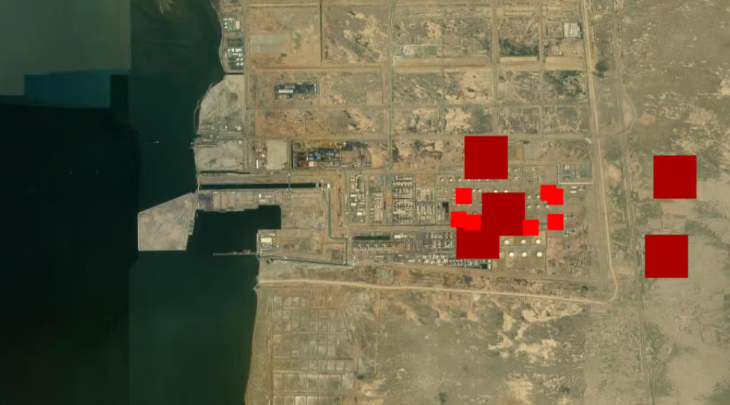
△ Infrared heat signatures detected at the Jizan refinery by NASA FIRMS
Monday (bright red) and Tuesday (dark red)
Red Sea Risks Rise Again, Putting Schedules and Routing Under Closer Scrutiny
The attacks come as shipping in the Red Sea is already operating in a high-risk security environment. As the Houthis expand their attacks to include Saudi energy and economic targets, the market will need to watch for any further action against energy transportation, port infrastructure, or commercial vessels. There is currently no authoritative information indicating that Red Sea shipping routes have been completely disrupted. However, any further escalation in the regional conflict could affect vessel insurance, route selection, transit times, and related surcharges.
Companies arranging shipments on Middle East, Red Sea, and European trades should closely monitor carrier security advisories, transit conditions in the Bab el-Mandeb, and any temporary diversions, surcharges, or schedule adjustments. For cargo that has already been booked or is currently in transit, companies should check whether routing arrangements have changed and allow additional time for potential delays.
The key developments to watch will be the recovery of Saudi energy facilities and whether the Houthis further expand their attacks against Saudi energy and maritime targets.
Sources and Disclaimer
Sources include Reuters, the Saudi Ministry of Energy, the Saudi Ministry of Foreign Affairs, and other publicly available industry information. This article is provided solely for reference by the international logistics and freight forwarding sectors. Specific operational arrangements remain subject to the latest notices from the relevant authorities and carriers.
Last
Russian-Flagged Tanker Carrying Nearly 100,000 Tonnes of China-Bound Crude Loses Propulsion in Turkish Waters
On September 5, the Russian-flagged crude oil tanker Pioneer 1 suffered an engine failure and began drifting near the Sea of Marma

Next
U.S. Spot Rates Near USD 10,000 While Schedule Reliability Drops to 29.4%
Container spot rates on U.S. trades have continued to climb since the beginning of September, with the Shanghai–New York rate reac

