




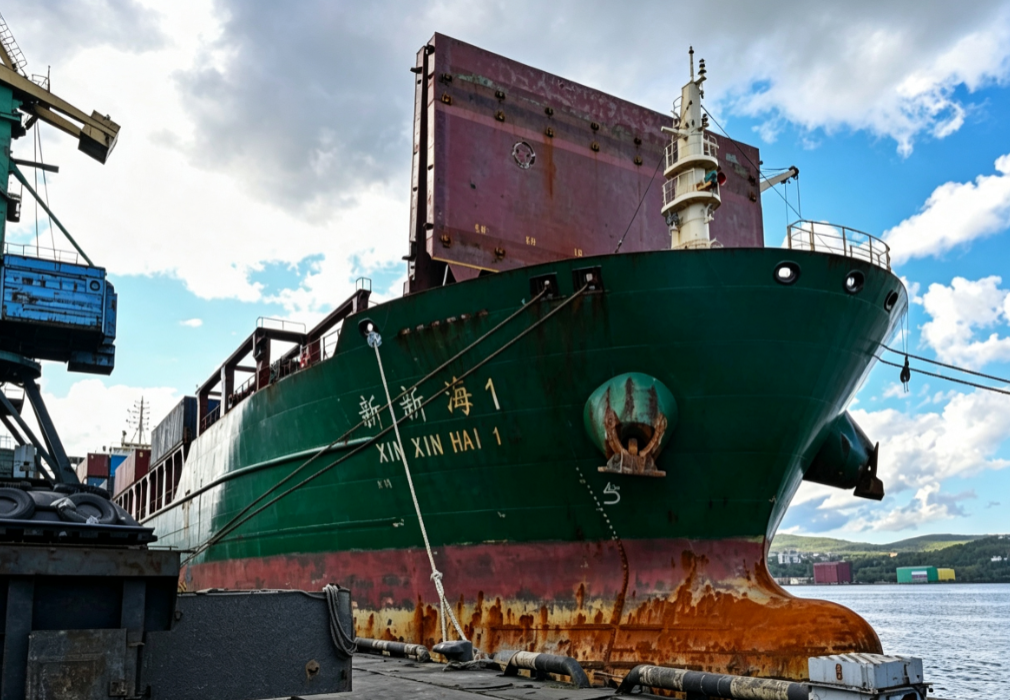
A Chinese container ship has reached Murmansk, Russia, via the Northern Sea Route. According to Xinhua News Agency, NewNew Shipping’s Xin Xin Hai 1 called at the Murmansk Commercial Seaport on August 20, where a welcoming ceremony was held. Carrying approximately 500 containers, it became the first Chinese container ship to reach Murmansk via the Arctic route, marking a new development in China–Russia Arctic container shipping.
Key Highlights
• Murmansk call: Xin Xin Hai 1 arrived in Murmansk on August 20 carrying approximately 500 containers.
• First Chinese container ship: It is the first Chinese container ship to reach Murmansk via the Northern Sea Route.
• Future operations: NewNew Shipping plans to develop related services and is considering an expansion of its Arctic fleet.
• Additional logistics option: The Arctic route is unlikely to replace the Suez route in the near term, but it is adding to the available transportation options between China and Russia.
Chinese Container Ship Makes First Call at Murmansk
Xin Xin Hai 1 departed from the Port of Tianjin and sailed along the Northern Sea Route before reaching Murmansk, an important Russian port within the Arctic Circle. Publicly available information indicates that the vessel has a capacity of approximately 1,220 TEUs and carried around 500 containers on this voyage, including automotive parts and other cargo.
Located on the Barents Sea, Murmansk is an important hub on Russia’s Northern Sea Route. It offers deepwater port facilities, year-round navigation, and transport connections to inland Russia and Europe. These conditions position the port to handle more container traffic and develop as a regional logistics hub. For Chinese shipping companies, the call also shows that Chinese containerized cargo is beginning to enter the port network of Russia’s Arctic region.
Arctic Container Transportation Moves from Trial Voyages Toward Long-Term Operations
Attention is now turning to NewNew Shipping’s plans for future operations. According to the company, it is considering the inclusion of Murmansk in a more stable Arctic container transportation network and plans to develop related services further.
NewNew Shipping plans to begin an Arc7 ice-class container shipbuilding program in 2027 and is considering Murmansk as the main home port for the vessels. If these plans proceed, Arctic container transportation could develop from seasonal trials toward regular services, fleet upgrades, and port network development.
The Northern Sea Route has traditionally handled bulk commodities such as energy products and minerals. Industrial cargo, including automotive parts and machinery, is now also being tested on the route, indicating a gradual change in its cargo mix.
Arctic Route Adds Another Option for China–Russia Logistics
The Arctic route is still unlikely to replace the established Suez route directly. Seasonal constraints, ice conditions, navigation windows, icebreaker support, and vessel ice-class requirements continue to present significant operational barriers to Arctic container shipping.
However, the route is emerging as an additional option outside traditional transportation networks for some China–Russia and Northeast Asia–Russia cargo. The arrival of Xin Xin Hai 1 signals that the focus is gradually shifting from whether services can be operated on the Arctic route to whether stable operations can be maintained. If regular services, Arc7 ice-class vessels, and port network development proceed as planned, Chinese container shipping on the Arctic route may move from one-off trials toward long-term operations.
For freight forwarders and exporters, the immediate considerations remain sailing frequency, vessel capacity, port operations, and actual transportation costs. If service frequency and reliability improve, the Arctic route could become a supplementary corridor within the China–Russia logistics network and provide an additional transportation option for certain cargo.
Sources
Xinhua News Agency, NewNew Shipping, and other publicly available industry information.
Disclaimer
This article is provided solely for industry reference. Please refer to the latest official and company announcements for current information.
Last
Iran Tightens Strait of Hormuz Transit Rules and Publishes List of Non-Compliant Vessels
Transit controls in the Strait of Hormuz have been tightened further. On August 23, local time, the Persian Gulf Strait Authority
Next
Panama Canal to Restrict Transits in September as Asia-U.S. Freight Rates Rise; Schedules and Costs May Be Affected
The Panama Canal’s latest transit restrictions have yet to be fully implemented, but the container shipping market has already beg

