




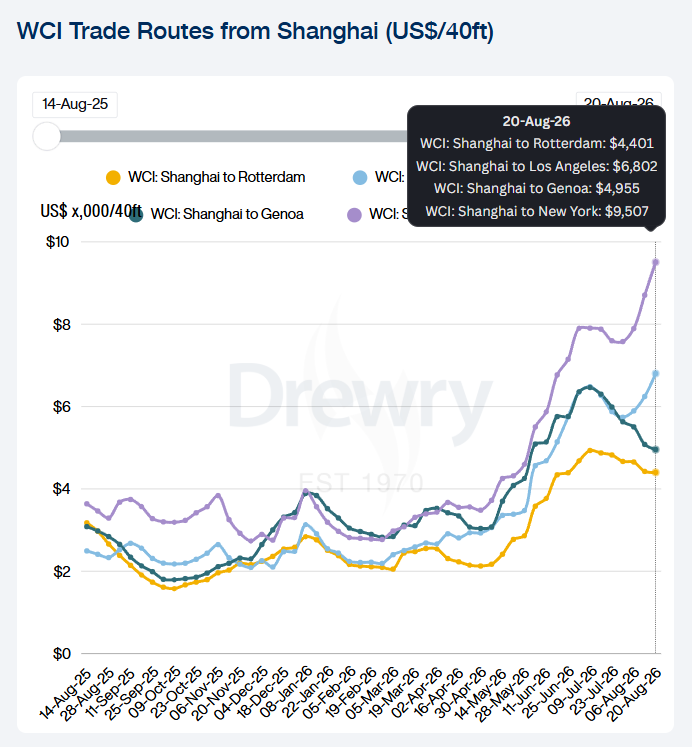
The Panama Canal’s latest transit restrictions have yet to be fully implemented, but the container shipping market has already begun to react. According to Drewry, spot rates for a 40-foot container from Shanghai to Los Angeles rose 9% week on week to $6,802 as of August 20, while Shanghai–New York rates increased 9% to $9,507. Meanwhile, the Panama Canal Authority has announced further adjustments to vessel transit arrangements beginning in September due to insufficient rainfall across the canal watershed.
Key Highlights
• Shanghai–Los Angeles rates: Spot rates rose 9% week on week to $6,802 per FEU.
• Transit restrictions: The Panama Canal will further tighten daily transit slots beginning in September.
• Higher costs: Draft restrictions and canal surcharges are increasing transportation costs on some routes.
• Asia–North America shipments: Freight forwarders and exporters should monitor sailing schedules, space availability, and freight rate movements.
Why Is the Panama Canal Restricting Transits in September?
The restrictions are being introduced because of insufficient rainfall and continued pressure on water levels, rather than port congestion. The Panama Canal relies on freshwater to operate its locks, meaning that rainfall across the watershed and reservoir levels directly affect transit capacity. Under the Panama Canal Authority’s latest arrangements, daily slots at the Neopanamax locks will be set at nine from September 3, while the Panamax locks will accommodate 25 transits per day. From September 15, daily slots at the Panamax locks will be further adjusted to 23.
Vessel draft restrictions also require attention. Some previously announced measures have recently been adjusted in response to changes in water levels and weather conditions and forecasts. Specific implementation dates remain subject to the Panama Canal Authority’s latest notices. For carriers, fewer transit slots may increase waiting times, while draft restrictions could reduce the amount of cargo some vessels can carry.
Why Are U.S. Freight Rates Rising Before the Restrictions Take Effect?
According to Drewry, spot rates for a 40-foot container from Shanghai to Los Angeles rose 9% week on week to $6,802 as of August 20. Shanghai–New York rates also increased 9% to $9,507, while Drewry’s World Container Index (WCI) rose 4% to $4,526 per FEU. By comparison, Shanghai–Rotterdam rates declined 1% during the same week, making the increase in the Asia–North America market more pronounced.
However, the Panama Canal is not a primary route for Asia–U.S. West Coast services, so the increase in West Coast rates cannot be attributed solely to the transit restrictions. The main issue is how changes in fleet deployment could affect the global service network. If some vessels are redeployed because of Panama Canal restrictions, carriers may reallocate capacity on other routes. At the same time, shippers bringing cargo forward could increase short-term booking demand, adding further pressure on freight rates and space availability on some routes.
The cost impact of the restrictions is also being reflected in carrier surcharge policies. MSC has announced that it will adjust its Panama Canal surcharge for services from Asia to the U.S. East Coast and U.S. Gulf Coast beginning September 12, with a charge of $297 per 40-foot container.
How Could the Restrictions Affect Asia–North America Transportation Costs?
At this stage, the latest restrictions should not be equated directly with the severe congestion seen in 2023 and 2024. However, companies handling Asia–North America cargo should monitor sailing schedules, space availability, and transportation costs. Shipments from Asia to the U.S. East Coast and U.S. Gulf Coast are more directly linked to the Panama Canal and may be affected by carrier adjustments to sailings, routing, or surcharges. Although Asia–U.S. West Coast services do not directly depend on the canal, they may still face knock-on effects on capacity if vessels are redeployed across the global network.
Shanghai–Los Angeles rates have already reached $6,802 per FEU, while Shanghai–New York rates are approaching $9,500. If rainfall recovers, the transit restrictions may be eased. If water levels remain under pressure, the canal’s transit capacity could be adjusted further. Freight forwarders and exporters should compare sailing schedules, space availability, and the total cost of different transportation options in advance, rather than waiting until significant congestion develops at the canal.
Sources
The Panama Canal Authority, Drewry, and other publicly available industry information.
Disclaimer
This article is provided solely for industry reference. Please refer to the latest official notices for current transit arrangements, schedules, and charges.
Last
Chinese Container Ship Reaches Murmansk for the First Time, Marking New Progress on the Arctic Route
A Chinese container ship has reached Murmansk, Russia, via the Northern Sea Route. According to Xinhua News Agency, NewNew Shippin
Next
Saudi Crude Shipping Routes Shift North to Avoid the Bab el-Mandeb as Red Sea Shipping Routes Change
Shipping risks in the Red Sea continue to have wider effects, driving a major shift in Saudi crude transportation routes. Tankers

