




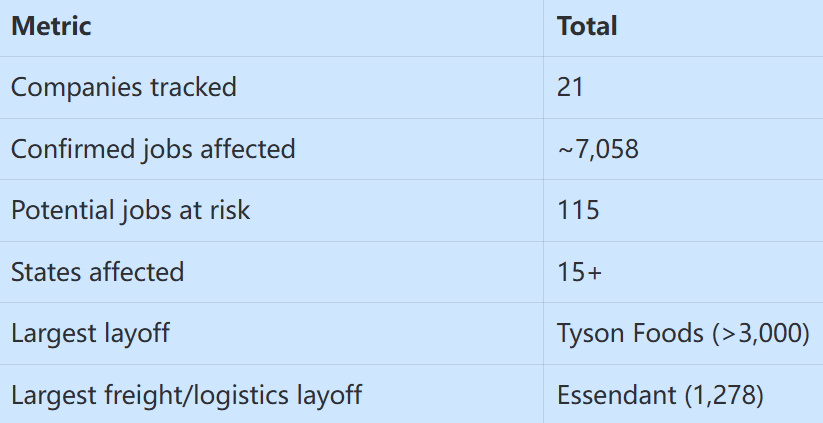
The U.S. freight and logistics market is undergoing another round of adjustments. The latest Freight Distress Report shows that approximately 7,058 jobs across 21 companies have been affected in at least 15 states. The impact extends beyond layoffs to warehouse closures, distribution center consolidation, production relocations, and the transfer of logistics operations. From logistics companies such as FedEx and Ryder to businesses in the food, manufacturing, and wholesale distribution sectors, parts of the U.S. supply chain are being reconfigured. For the logistics industry, the key issue is not simply the impact on more than 7,000 jobs, but the changes taking place across the factories, warehouses, and distribution nodes behind those figures.
Key Highlights
• More than 7,000 jobs affected: Twenty-one companies across at least 15 states are implementing layoffs or operational changes affecting 7,058 positions.
• FedEx and Ryder adjust operations: Some logistics facilities are closing, while certain operations are being transferred to other companies.
• Warehouse networks consolidate: HelloFresh, Staples, United Natural Foods, and other companies are adjusting their distribution facilities.
• Cargo volumes could shift: Factory and warehouse relocations could create new transportation nodes rather than simply eliminating cargo volumes.
7,058 Jobs Affected Across 21 Companies as Logistics Operators Also Scale Back
Tyson Foods and wholesale distributor Essendant account for a large share of the affected jobs. Tyson Foods plans to close facilities in Joslin, Illinois, and Eagle Mountain, Utah, while adjusting its beef business operations, affecting more than 3,000 positions. Essendant is facing financial pressure and is seeking financing or a potential buyer. According to WARN notices filed across several U.S. states, approximately 1,278 positions are affected. If the company is unable to secure financing or complete a sale, it could cease operations and enter liquidation.
For the logistics industry, however, changes to facilities and operating networks are particularly important. FedEx plans to permanently close its facility in Victorville, California, and adjust operations in Palm Springs and San Diego, affecting approximately 173 positions. Ryder plans to close an operation in Fayetteville, North Carolina, affecting around 73 positions, although another logistics provider will take over the local business. These developments show that a company scaling back does not necessarily mean that the underlying cargo and logistics activity will disappear. In some cases, the logistics node is simply changing.
FedEx and Ryder Close Operations as Warehouse and Fulfillment Networks Are Reconfigured
Changes to warehouse and fulfillment networks are among the clearest signs of the current adjustment across the U.S. supply chain. HelloFresh has filed a WARN notice in New Jersey regarding the planned closure of a distribution center in Logan Township that uses a Swedesboro mailing address. The closure will affect 374 positions, with the layoffs scheduled to take effect on November 17. The associated operations will be consolidated into a larger fulfillment network. Staples plans to close its fulfillment center in La Mirada, California, affecting 109 employees. United Natural Foods will also close a distribution center in Northeast Philadelphia and transfer its operations to other regional facilities.
The closure of a distribution center affects more than jobs within the warehouse. Inbound freight, line-haul trucking, short-haul trucking, warehousing, and last-mile delivery may all be reallocated. If a company consolidates cargo volumes at other large distribution nodes, transportation distances and routes will also change. For carriers, third-party logistics providers (3PLs), and freight forwarders, previously established cargo flows could therefore shift. When assessing changes in the U.S. logistics network, these operational changes provide a broader picture than layoff figures alone.
Factory Relocations Are Reshaping U.S. Supply Chain Nodes
Similar changes are taking place in manufacturing. Daimler Truck plans to transfer some truck manufacturing operations from Portland, Oregon, to North Carolina and South Carolina, affecting approximately 375 positions. Carlex Glass America plans to close its plant in Vonore, Tennessee, affecting 325 employees, and transfer some production to Nashville. When production locations change, the effects extend beyond factory employees. Transportation distances for raw materials, components, and finished goods will also change. Ports, warehouses, trucking routes, and supplier networks may therefore need to be adjusted.
Job losses do not necessarily mean that cargo volumes will disappear. When a warehouse closes, its cargo may be transferred to another regional distribution center. When a factory relocates, new transportation requirements for raw materials and finished goods may emerge in other states. For freight forwarders and logistics companies serving the U.S. market, the key factors to track are the locations of customers’ factories and warehouses and where existing cargo volumes are ultimately redirected. As the U.S. supply chain continues to adjust, some established transportation routes may see lower volumes, while new demand for warehousing, line-haul transportation, and short-haul services could emerge around other regional nodes.
Sources
The Freight Distress Report, WARN notices filed across U.S. states, and publicly available information from the companies concerned. This article is provided solely for reference within the international logistics, freight forwarding, and supply chain industries. Specific operating arrangements are subject to the latest announcements from the relevant companies.
Last
MSC Starts Construction of Another 21,700 TEU Containership as Changhong International Continues Work on Large Containership Orders
MSC is continuing to expand and renew its fleet of ultra-large containerships. On August 18, Zhoushan Changhong International Ship
Next
91% of Reported Tanker Transits 'Go Dark' as 150 Vessels Gather in the Gulf of Oman: Shipping Continues Through the Strait of Hormuz as Operating Patterns Change
Risks to commercial shipping through the Strait of Hormuz continue to rise, but crude oil transportation has not stopped completel

