




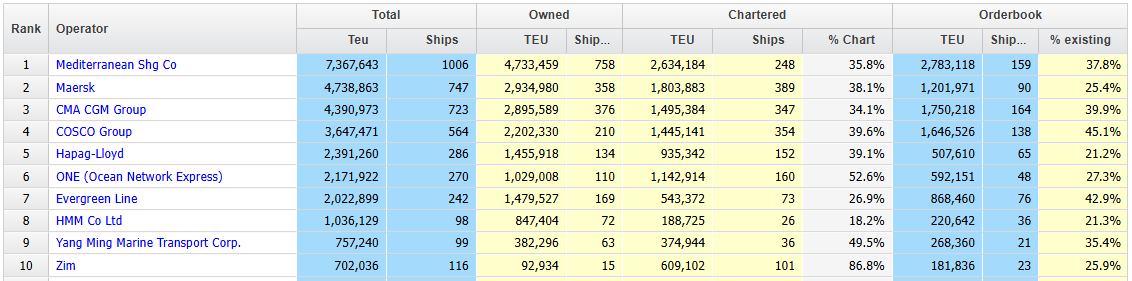
MSC has reached another milestone in its fleet expansion. According to the latest Alphaliner data, the carrier has acquired 500 secondhand containerships since it began expanding rapidly in the secondhand market in August 2020. Over the same period, its fleet has grown from approximately 3.8 million TEU to nearly 7.4 million TEU, accounting for more than 21% of global liner capacity. MSC has nearly doubled its fleet in less than six years, and its capacity expansion is continuing.
Key Highlights
• Secondhand acquisitions: MSC has acquired 500 secondhand containerships.
• Fleet capacity: MSC’s fleet is approaching 7.4 million TEU.
• Global market share: The carrier accounts for more than 21% of global liner capacity.
• Newbuilding orderbook: MSC currently has more than 2 million TEU of capacity on order.
• Independent operations: MSC has further strengthened its ability to operate independently following the end of the 2M Alliance.
How Did MSC’s Fleet Grow So Quickly After Acquiring 500 Vessels in Six Years?
MSC’s 500th secondhand containership was the 2,796 TEU Calandra, reportedly acquired for approximately USD 27 million. MSC also acquired the 1,732 TEU Fitz Roy. The two transactions brought the carrier’s total number of secondhand containership acquisitions to the 500-vessel mark. In 2020, MSC operated a fleet of approximately 3.8 million TEU. That figure has now risen to nearly 7.4 million TEU. Acquiring secondhand vessels has developed from a way to add capacity quickly into an important part of MSC’s owned-fleet expansion.
MSC’s fleet growth, however, has not relied solely on secondhand vessels. Unlike newbuildings, which require longer construction periods, secondhand containerships can enter service more quickly, allowing carriers to add capacity faster. At the same time, MSC has continued to expand through newbuildings. Data show that MSC increased its fleet from 6 million TEU to 7 million TEU in approximately 15 months, with around 799,000 TEU coming from the delivery of 68 new vessels. MSC currently has more than 2 million TEU of newbuilding capacity on order. The combination of secondhand acquisitions and newbuildings has supported its continued capacity expansion in recent years.
Why Is MSC Becoming Less Reliant on Alliances as Its Fleet Approaches 7.4 Million TEU?
MSC’s continued fleet expansion is also changing the competitive landscape of the global liner shipping market. In early 2022, MSC’s fleet surpassed Maersk’s for the first time, and the capacity gap between the two carriers has continued to widen. MSC now operates a fleet of nearly 7.4 million TEU, giving it a clear scale advantage in the global liner market. For a container carrier, a larger owned fleet provides greater flexibility in service deployment, vessel allocation, and capacity management.
This shift has become more evident since the end of the 2M Alliance. MSC and Maersk formally ended the alliance in February 2025, after which MSC further strengthened its independent operations on major global east–west trades. Although it continues to cooperate with some carriers through slot swaps and other arrangements, its large owned fleet has reduced its reliance on alliance partners for core capacity. MSC’s continued acquisition of secondhand containerships is therefore not simply increasing the number of vessels in its fleet. It is also helping the carrier build its own global fleet and capacity system.
Will MSC Continue to Expand, and Where Will the Additional Capacity Be Deployed?
MSC’s fleet has grown from approximately 3.8 million TEU to almost 7.4 million TEU over nearly six years. During this period, it has acquired 500 secondhand containerships and accumulated a newbuilding orderbook of more than 2 million TEU. As these new vessels are delivered, MSC’s fleet could expand further. Other major container carriers are also continuing to add capacity, and the global container shipping market could face significant pressure from additional vessel supply over the next several years.
The key question for MSC’s next stage is not simply how many more vessels it will acquire, but which services will receive the additional capacity and how this deployment will affect competition across global trade lanes. For freight forwarders, MSC’s continued fleet expansion could lead to changes in service networks, increased slot availability, and stronger freight rate competition among carriers. As MSC further strengthens its independent operating capabilities, the future deployment of its fleet of nearly 7.4 million TEU will remain a key issue for freight forwarders.
Sources and Disclaimer
Alphaliner, MSC, and relevant publicly available industry information. This article is provided solely for reference within the international logistics and shipping industries. Specific fleet capacity, vessel transactions, orders, and service arrangements are subject to the latest disclosures from the relevant organizations and carriers.
Last
Indian Ports Accelerate Clearance of Long-Dwell Containers, with October 31 Reported as Target Date
Indian ports are stepping up efforts to clear long-dwell containers. According to an August 19 report by Indian industry publicati
Next
Maersk Fleet Tops 4.7 Million TEU as Newbuildings and Chartering Take on Greater Importance
The latest industry data show that Maersk’s operated fleet has exceeded 4.7 million TEU, moving beyond the capacity range it had m

