




Compliance and risk control for cross-border logistics in Southeast Asia have entered a critical new phase. In recent years, routing goods through Thailand, changing their declared origin, and relabeling them to avoid tariffs have become common practices in parts of the industry. Thai authorities have now launched a broad crackdown on such operations.
Many exporters and freight forwarders are still using these old methods, unaware that destination-country origin verification requirements have already tightened significantly. According to reports from Thai Headline News, Thai PBS NEWS, and other local media outlets, the Thai Customs Department and the Department of Foreign Trade conducted a special inspection at Laem Chabang Port on July 20, 2026.
The inspection focused on transit, warehousing, and processing activities involving goods in the port’s duty-free area and IEAT free zones. Two major false origin cases were uncovered in a single operation, involving a combined value of more than THB 100 million. The cases serve as a serious compliance warning for logistics companies operating Southeast Asia services.
Key Highlights (Quick Read)
• Two major cases involving over THB 100 million: Two large-scale false origin cases were uncovered in one day, with a combined value exceeding THB 100 million.
• Ten months of enforcement data: A total of 177 violations were investigated over ten months, involving goods worth THB 1.378 billion.
• Higher penalties for violations: Thailand plans to raise fines, while goods involving false origin declarations may be seized, resulting in losses of both cargo and funds
• Stricter checks on US-bound shipments: Certificates of origin for goods transshipped through Thailand will face closer scrutiny, together with on-site factory verification.
Major False Origin Cases Uncovered: Common Methods Used to Relabel Goods as Thai-Made
Key conclusion: Simple processing will no longer qualify goods for Thai origin status. Low-cost operations involving only repackaging, manual relabeling, or basic assembly will not be recognized as substantial processing in Thailand.
The two cases involved highly similar methods, reflecting a common grey-area practice in Southeast Asian transit trade.
Some companies take advantage of the relatively flexible movement of goods within Thailand’s free zones, duty-free warehousing arrangements, and comparatively low operating thresholds. Fully manufactured goods from China are brought into the zones without substantial processing or any change to their essential characteristics. They are then repackaged, manually relabeled, or simply assembled before being marked as “Made in Thailand.”
The purpose of these operations is to use claimed Thai origin to avoid anti-dumping duties and trade restrictions imposed by countries in Europe and North America, while benefiting from tariff differences.
In one case, 5.37 million TWOMOON-branded cigarettes manufactured in China were stored and transferred through the Thai port area without undergoing any processing. The goods were relabeled and re-exported, causing an estimated economic loss of THB 17 million.
In another case, 202,000 finished utility knives were deliberately underdeclared as “semi-finished products” upon entry. They underwent only basic assembly in the free zone before being relabeled for export. The case involved goods worth THB 84.27 million and was a typical example of false origin practices.
Enforcement Continues to Tighten as Transit-Based Tariff Avoidance Becomes Unworkable
Key conclusion: Grey-area arbitrage channels are being closed, and inspections are becoming routine. Thailand Customs is strengthening controls across relevant ports and zones, leaving little room for origin fraud through transit operations.
The cases involving more than THB 100 million were not isolated inspections. They were part of Thailand’s long-term and increasingly routine enforcement campaign. The practice of using transit operations to change the declared origin of goods is becoming increasingly difficult to sustain.
Official figures show the scale of the tighter enforcement. From October 2025 to July 2026, Laem Chabang Port alone confirmed 41 cases involving false origin declarations and origin fraud, with a combined value exceeding THB 440 million.
According to figures reported by Thai media, similar violations identified at the port over the past ten months involved goods worth more than THB 1.3 billion.
Thailand Customs began tightening controls at the beginning of 2026. Within six months, it intercepted more than THB 500 million in goods involving tariff evasion and false transshipment declarations. These figures show that transit operations in Southeast Asia are now subject to significantly stricter enforcement.
Thailand Introduces New Rules to Close Free-Zone Arbitrage Loopholes
Key conclusion: The consequences of non-compliance are being expanded from fines to cargo seizure. The new measures aim to close regulatory loopholes and strengthen checks on US-bound transshipment cargo.
To prevent origin relabeling and improper use of free-zone arrangements, Thailand has recently introduced a series of measures targeting regulatory loopholes and changing the compliance requirements for transit logistics in Southeast Asia.
The main changes focus on three areas.
First, Thailand is raising the standards used to determine local content and origin. Goods that undergo only relabeling, basic assembly, or repackaging will no longer qualify as originating in Thailand.
Second, the penalty mechanism is being strengthened. Thailand plans to raise fines for false origin declarations and allow non-compliant goods to be seized.
Third, checks on US-bound transshipment cargo are being tightened. Goods exported to the United States through Thailand will face stricter certificate-of-origin reviews and on-site factory verification to prevent origin fraud.
Operational Alerts and Recommended Actions for Freight Forwarders: Compliance Is Now Essential for Southeast Asia Transit Shipments
Thailand Free-Zone Shipments: Comparison of Compliant and Non-Compliant Procedures
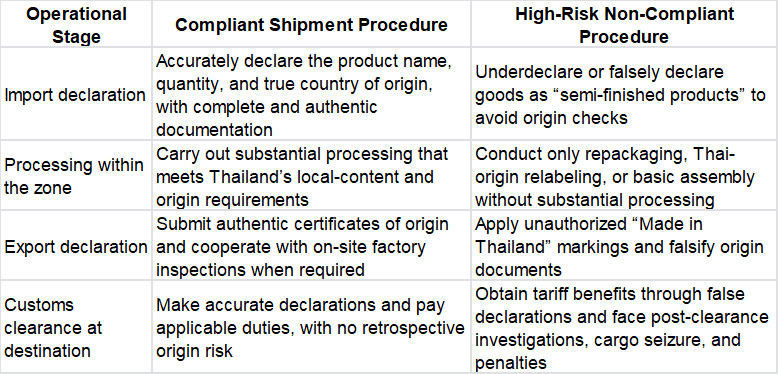
The cases involving more than THB 100 million, the extensive enforcement data, and Thailand’s newly introduced measures show that the traditional transit arbitrage model in Southeast Asia is no longer workable. Compliance requirements have increased significantly.
Operations involving simple relabeling or basic assembly to falsely claim Thai origin are now a major focus of customs enforcement. Once a violation is confirmed, companies may face cargo seizure, substantial fines, and adverse customs compliance records, directly affecting their import and export activities in Southeast Asia.
Many exporters and trading companies still have limited awareness of Thailand’s latest compliance requirements and continue to use outdated shipment practices, creating significant compliance risks.
Freight forwarders should conduct risk checks in advance and explain the relevant requirements to customers. Shipping documents, cargo details, and origin information must remain fully consistent.
Many origin-related violations also involve high-risk agents. Industry practitioners may use the platform’s agent blacklist feature to screen local Thai logistics agents and avoid service providers with records of origin fraud, false declarations, or customs penalties, reducing risks before cooperation begins.
Three Operational Checks for Freight Forwarders
• Are all documents consistent? Review the certificate of origin, factory invoice, and key bill of lading information to ensure that the product name, country of origin, quantity, and other key details are fully consistent. Any discrepancy may trigger a customs inspection.
• Does the service provider have a record of violations? Verify the qualifications and previous records of local Thai agents before cooperation. Avoid high-risk service providers with records involving false origin declarations, improper arbitrage operations, or customs penalties.
• Does the contract include liability and recourse clauses? Clearly define the responsibilities of each party when signing the agreement. Specify liability for cargo seizure, fines, demurrage, and other losses caused by an agent’s non-compliant operations to avoid related financial losses.
Industry Summary
As global origin traceability and anti-circumvention investigations continue to tighten, there is no longer room for non-compliant operations based on regulatory loopholes.
Freight forwarders should use the operational checklist below to standardize shipment procedures and routinely review cooperation risks, strengthening compliance controls for Southeast Asia services.
Sources: Public Relations Department of the Government of Thailand; Thai Headline News
Disclaimer: The information and data in this article are collected from publicly available sources and are provided for industry reference only. They do not constitute commercial or logistics operational guidance.
Last
La Guaira Port Begins Phased Reopening After 28-Day Shutdown: Venezuela Service Schedules, Shipping Rules, and Port Change Costs Explained
La Guaira Port, Venezuela’s main port, has officially announced a phased reopening after being fully shut down for nearly a month
Next
LMA Issues Major New Clause: Payment of Strait of Hormuz Transit Fees Will Immediately Terminate Vessel Insurance Coverage
Shipping risks in the Middle East have reached another critical turning point. According to an official announcement issued by the

