




Shipping risks in the Middle East have reached another critical turning point. According to an official announcement issued by the Lloyd’s Market Association (LMA) on July 23 and reports from multiple shipping media outlets, the LMA has formally introduced a new model hull insurance clause and accompanying guidance. The clause clearly defines insurers’ and insured parties’ rights and liabilities when vessels pay transit fees while passing through the Strait of Hormuz.
The introduction of the new clause directly changes how shipowners assess passage options and brings renewed uncertainty to freight rates and route planning for Middle East services.
Key Highlights (Quick Read)
• Immediate termination of coverage once triggered: Payment of Strait of Hormuz transit fees will terminate hull insurance coverage, and related losses will not be indemnified.
• Non-mandatory but potentially far-reaching: Once an insurer incorporates the clause into a policy, shipowners will face a difficult choice over whether to transit the Strait.
• Sanctions exposure is the primary concern: The clause is intended to prevent insurers from facing liability under US, UK, and EU sanctions and counterterrorism regulations due to the destination of the payments.
• Cost structures for Middle East services may change: The trade-off among rerouting, fee payment, and insurance coverage may increase freight costs, which could ultimately be passed on to cargo owners.
Key Provisions of the New Clause: Payment of Transit Fees Means Loss of Insurance Coverage
Key conclusion: Any form of transit fee payment may trigger the exclusion clause. The restriction is not limited to cash transfers and also covers other forms of consideration. The model clause applies to vessel hull insurance and sets out three key rules.
First, the scope of non-indemnifiable payments is clearly defined. If a vessel is confirmed to have paid transit-related fees, whether through a financial payment or another form of consideration, in order to pass through the Strait of Hormuz or enter Iranian territorial waters, the insurer will not be liable for those payments.
Second, the policy will terminate immediately. Once such a payment is made, the insurance coverage for the vessel concerned will cease with immediate effect. The insurer will no longer be liable for losses arising during the remainder of the voyage.
Third, the basis for determination is clearly defined. The clause may take effect if the insurer knows, or could have discovered through reasonable due diligence, that the payment was made. Lack of actual knowledge does not provide an exemption.
Implementation and Market Impact: Non-Mandatory Clause, but Significantly Higher Shipping Risks
Key conclusion: The model clause serves as industry guidance, leaving insurers to decide whether to adopt it, while shipowners may face a difficult choice.
At present, the model clause is provided only as a market reference and is not mandatory. However, once an insurer formally incorporates it into a policy, the shipowner must decide between two difficult options.
On the one hand, shipowners may choose to pay the transit fee, shorten the voyage, and reduce the fuel and time costs of rerouting via the Cape of Good Hope. The consequence is the loss of insurance coverage, leaving the vessel uninsured for the remainder of the voyage.
On the other hand, refusing to pay the transit fee would preserve the insurance coverage, but the shipowner would have to bear the higher operating costs and slower vessel turnaround caused by the longer route.
From the insurance industry’s perspective, the clause is essentially a risk isolation measure. By defining the rights and liabilities in advance, insurers aim to prevent shipowners’ payments from triggering US, UK, and EU sanctions and counterterrorism compliance risks and to avoid related legal liability.
Background to the Clause: Strait Transit Fee Dispute Adds to Rising War Risk Insurance Pressure
Key conclusion: Iran’s proposed Strait transit fee arrangement has created compliance concerns, prompting the London insurance market to strengthen its risk controls in advance.
The LMA introduced the new clause in response to Iran’s reported plan to establish a transit fee system for vessels passing through the Strait of Hormuz. The proposed charging mechanism itself has raised questions under international law. However, the main concern for the London marine insurance market is the potential chain of sanctions exposure.
The LMA’s Joint War Committee has already designated the Strait of Hormuz as a high-risk area. Continued regional tensions have pushed war risk insurance premiums from 0.1%–0.2% of a vessel’s value before the conflict to 5%–10%.
For tankers, the war risk premium for a single voyage once rose from USD 250,000 to USD 1 million, while some vessels have even struggled to find insurers willing to provide coverage.
The industry is widely concerned that if transit fee payments ultimately flow to sanctioned entities such as Iran’s Islamic Revolutionary Guard Corps, insurers involved in the transactions could breach sanctions restrictions and face substantial penalties. This is also a key reason behind the LMA’s rapid introduction of the model clause.
Freight Forwarders Must Pay Close Attention: Major Changes Expected in Middle East Route Operations
Risk Comparison Between Two Strait of Hormuz Route Options
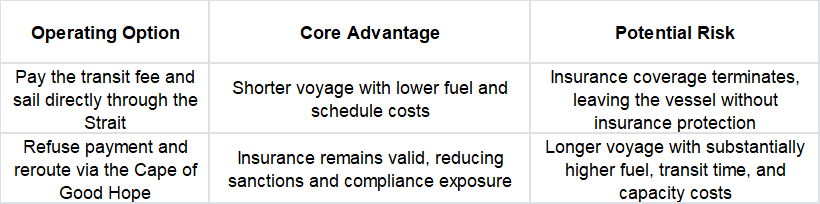
Following the introduction of the new clause, shipping lines will no longer assess route decisions solely based on safety and cost. Insurance compliance has become an additional consideration.
This complex risk assessment may slow the pace at which major shipping lines resume large-scale operations through the Strait of Hormuz. Whichever option shipowners choose, the additional costs are likely to be passed on through freight rates and various surcharges, exposing cargo owners to further rate volatility.
Freight forwarders with long-term involvement in Middle East services should take the initiative in managing customer expectations. They should explain the potential knock-on effects of the new LMA clause to cargo owners and closely monitor route planning and insurance policy updates from their partner shipping lines.
They should also screen shipowners and carriers with stable and reliable operating records. Industry practitioners may use the platform’s agent blacklist feature to avoid shipping service providers that frequently engage in high-risk operations or operate close to geopolitical and regulatory red lines, thereby reducing potential cooperation risks in advance.
Three Operational Checks for Freight Forwarders
• Have the risks of each route option been fully disclosed? Clearly explain to shippers the insurance exposure and cost differences between direct passage through the Strait of Hormuz and rerouting via the Cape of Good Hope.
• Have the shipping line’s insurance terms been verified? Confirm whether the carrier’s insurance policy incorporates the LMA model clause relating to transit fee payments and clarify the allocation of liability in the event of a loss.
• Are the risk clauses in the booking instructions and contracts complete? Agree in advance on the rights and liabilities relating to route changes and freight rate adjustments to avoid disputes arising from changes in geopolitical policies.
Industry Summary
The LMA model clause effectively combines geopolitical conflict risks with international financial sanctions exposure.
For shipowners operating through the Strait of Hormuz, the decision has shifted from choosing between safety and cost to balancing safety, cost, and compliance.
With tensions in the Red Sea remaining high and the outlook for passage through the Strait still uncertain, instability surrounding this critical global energy corridor is likely to continue affecting the entire international shipping chain.
Sources: Official announcement by the Lloyd’s Market Association; World Ports
Disclaimer: The information in this article is collected from publicly available sources and is provided for industry reference only. It does not constitute commercial or logistics operational guidance.
Last
Thailand Customs Intensifies Crackdown: Over THB 100 Million in False Origin Cases Uncovered as Risks of Relabeling Chinese Goods as Thai-Made Escalate
Compliance and risk control for cross-border logistics in Southeast Asia have entered a critical new phase. In recent years, routi
Next
Black Sea Shipping Risks Escalate: Maersk Suspends Services at Ukrainian Fishing Port and Reroutes Cargo to Romania
Introduction:Commercial shipping risks in the Black Sea have continued to rise following a series of attacks in the region. In res

