




Introduction:New global shipping surcharge rates will take effect in August 2026. Ocean Network Express (ONE) has revised its Emergency Fuel Surcharge (EFS) across its global network, lowering overall rates while widening the difference between dry and reefer container charges.
The revised rates cover global long-haul and short-haul routes, including FMC-regulated and non-FMC-regulated trades involving the United States, Canada and other specified regions. The adjustment will be an important reference for freight forwarders calculating rates and managing space and freight costs in the second half of the year.
The new rate structure reflects recent movements in international fuel prices. Freight forwarders should update their quotation methods according to container type and trade lane to reduce cost risks.
Official Announcement: ONE Revises Global EFS Rates Effective August 15
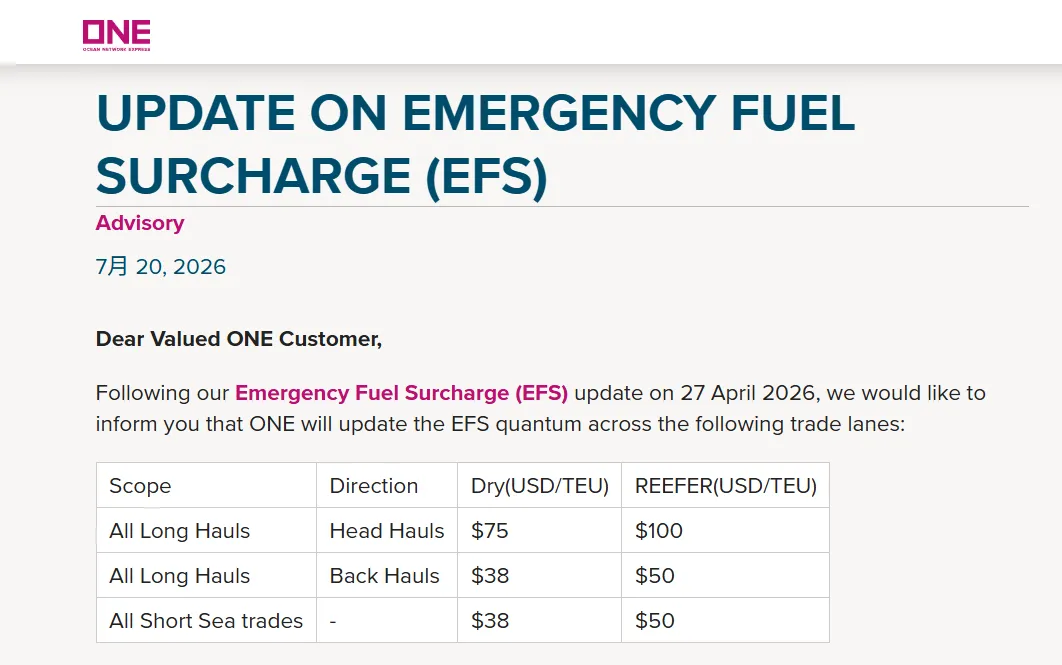
According to ONE’s latest official announcement, the carrier will revise its Emergency Fuel Surcharge across its global network. The new rates will take effect on August 15, 2026, and will remain valid until further notice. Any subsequent adjustments will be announced according to market conditions.
The revised surcharge applies to all long-haul and intra-regional routes, covering both FMC-regulated and non-FMC-regulated trades. It includes import and export shipments involving the United States, American Samoa, Puerto Rico, Guam, Saipan, Hawaii and Canada.
The new rate structure introduces a clear difference between dry and reefer container charges. The rate for dry containers is USD 75/TEU, while the rate for reefer containers is USD 100/TEU. Depending on the trade category, the difference between the two container types remains approximately 32% to 33%.
This represents a clear change from the previous structure, under which the two container types were charged at the same rate or with only a limited difference.
Rate Adjustment Reflects Fuel Market Movements and Competition
Carriers regularly adjust Emergency Fuel Surcharges to offset fluctuations in fuel costs.
According to public data from Ship & Bunker, fuel prices at major global ports fluctuated significantly during the first half of 2026. Major liner carriers have adjusted their surcharges to balance operating costs and market pricing.
Compared with several major carriers, ONE’s revised rate is relatively low. Hapag-Lloyd’s fuel surcharge on Far East–North Europe routes currently ranges from USD 150 to USD 250/TEU, while Maersk’s corresponding rates range from USD 100 to USD 200/TEU.
ONE’s revised long-haul headhaul EFS of USD 75/TEU for dry containers is in the lower-middle range of the market. It is also considerably lower than ONE’s previous long-haul headhaul rate of USD 120/TEU.
The adjustment reflects the recent decline in fuel prices and ONE’s efforts to maintain competitive rates across its global network.
EFS Quotation Alerts and Recommended Actions for Freight Forwarders
Although ONE has lowered its overall EFS rates, the differentiated charges for dry and reefer containers, as well as for long-haul, backhaul and short-haul routes, require freight forwarders to update their quotation and cost-control methods.
1. Long-Haul Headhaul EFS Must Be Listed Separately
The EFS of USD 75/TEU for dry containers on long-haul headhaul routes is a fixed additional charge applicable to global long-haul shipments.
For bookings effective from August 15, 2026, freight forwarders should separate the Emergency Fuel Surcharge from the basic ocean freight rate and list it clearly in quotations.
Using an all-in rate without identifying the surcharge may result in cost discrepancies and reconciliation disputes with overseas customers.
2. Backhaul and Intra-Regional Routes Have Lower EFS Costs
Backhaul and intra-regional routes carry lower EFS rates than long-haul headhaul routes.
The official dry-container rate for these routes is USD 38/TEU, approximately half the long-haul headhaul rate.
Freight forwarders handling short-sea shipments, regional transshipment cargo and multinational backhaul business may take this rate difference into account when preparing quotations and customer arrangements.
3. Reefer Surcharges Must Be Calculated Separately
For long-haul headhaul routes, the reefer-container EFS is approximately 33% higher than the dry-container rate.
Freight forwarders handling international cold-chain shipments should establish a separate surcharge calculation method for reefer containers.
Dry-container rates should not be used to estimate reefer shipment costs, as this may lead to quotation errors and margin losses.
Industry Outlook: Further Carrier Rate Adjustments May Follow
ONE is the first major liner carrier to lower its global EFS rates for August 2026. Under common industry practice, other major carriers, including Maersk and Hapag-Lloyd, may also adjust their global fuel surcharges.
Freight forwarders should continue to monitor carrier rate announcements and changes in global capacity when preparing quotations and booking plans.
Industry participants may use the platform’s vessel schedule inquiry function to check global sailing schedules, port-call times and capacity changes, align quotation validity periods with shipment schedules, and reduce discrepancies caused by schedule changes or rate updates.
Sources
ONE official announcement and Ship & Bunker industry data
Disclaimer
The information and data contained in this article are sourced from publicly available authoritative channels and are provided solely for industry reference. They do not constitute commercial advice or logistics operating guidance.
Last
CMA CGM's Emergency Fuel Surcharge to Take Effect August 1,with Headhaul Rates Twice ONE's
Introduction:Global ocean freight surcharges will see a major adjustment in August 2026. Following ONE’s announcement of new Emerg
Next
Three Boarding Robberies in 18 Days: Anchorage Security Concerns Persist as Chittagong Port Improves Efficiency
Introduction:Chittagong Port is seeing two contrasting developments. New terminal capacity and improved operating efficiency are e

