




Introduction:A major shipping incident has occurred at a key transport hub on the middle reaches of the Yangtze River.
In the early hours of July 22, an LNG-fuelled hybrid containership suffered an engine-room explosion and fire while berthing at Wuhan Yangluo Port. The force of the explosion displaced a tank at the stern and sent containers into the river. One crew member was reported missing, and operations in the affected port area were temporarily suspended.
The incident has disrupted local shipping operations on the Yangtze River and raised concerns over the operation of LNG-powered vessels and the safety of port berthing operations. It has also had an immediate impact on inland shipment arrangements and port scheduling.
Explosion During Berthing Damages Vessel and Sends Containers into the River
According to Xinhua News Agency, citing crew members at the scene, a powerful explosion occurred while the vessel was berthing and cargo-handling operations were underway.
The force of the explosion caused serious damage to the stern. Seven empty containers fell into the Yangtze River, while the LNG tank secured at the stern was dislodged and thrown into the water.
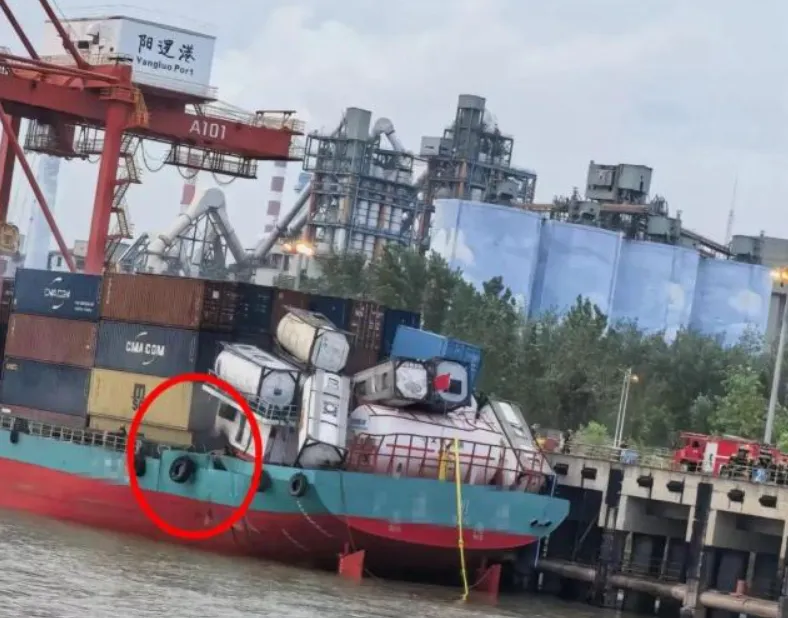
One crew member was reported missing. The tank did not explode again after falling into the river, and no fire on the water, gas leakage or water pollution was reported.
Following the incident, the terminal control centre immediately activated its emergency response plan, suspended operations and evacuated the crew of the vessel and personnel working in the affected port area to prevent further incidents.
Emergency Response and Joint Investigation Underway
Emergency response teams were deployed immediately after the incident. Fire and rescue personnel arrived at the terminal at 5:39 a.m. and carried out firefighting, cooling and safety inspections.
The fire was quickly brought under control, preventing it from spreading to port facilities and nearby vessels.
The open flames have now been fully extinguished. However, the search for the missing crew member, recovery of the empty containers and inspections for navigation hazards are continuing.
The Wuhan Maritime Safety Administration, the Yangtze New Area Emergency Management Bureau, the Yangtze River Shipping Public Security Bureau and Hubei Port Group have formed a joint investigation team.
The team has secured the vessel’s navigation logs, equipment maintenance records and LNG propulsion system operation and maintenance records. Investigators are examining the cause of the incident, possible equipment defects and compliance with operating procedures.
The final cause of the incident and further response details will be announced by the relevant authorities.
Preliminary Assessment: Safety Risks of LNG-Fuelled Hybrid Vessels
Authorities have not yet released a final conclusion on the cause of the incident.
Based on the damage, vessel type and operating conditions, preliminary industry assessments suggest that the explosion originated in the engine-room area.
Compared with conventional fuel-powered vessels, LNG-fuelled hybrid vessels have more complex systems and require stricter safety controls.
Their engine rooms integrate conventional fuel systems, LNG gas supply systems and high-voltage electrical control systems. Pipeline leaks, valve failures, abnormal pressure or ageing electrical systems may cause a fire or explosion.
In this incident, the LNG tank secured at the stern was dislodged and thrown into the river, indicating the force of the engine-room explosion.
As maritime emission-reduction policies continue to be implemented, the number of LNG-powered vessels operating on China’s inland waterways has continued to increase, and green vessels have become an important part of the industry’s development.
However, the incident has exposed potential weaknesses in the routine maintenance, berthing controls and safety inspections of LNG-fuelled hybrid vessels. Maritime authorities may tighten routine inspection standards, berthing requirements and maintenance review requirements for such vessels.
Yangtze River Operational Alerts and Recommended Actions for Freight Forwarders
The incident has had a direct impact on inland shipping and logistics operations in Wuhan. The main effects involve port operations, navigation controls, vessel schedules and safety requirements.
Freight forwarders and foreign trade professionals handling Yangtze River shipments should adjust their shipment arrangements accordingly.
1. Temporary Berth Closure Restricts Port Operations
Following the incident, Berth A101 at Yangluo Port and nearby operating areas were closed for site clearance, equipment inspections and accident investigation.
Loading, unloading and berthing operations at the affected berth have been suspended. Scheduling at nearby berths may also be tightened, resulting in a temporary decline in overall port operating efficiency.
2. Channel Clearance May Result in Temporary Navigation Controls
Although the seven containers that fell into the river were empty and did not contain dangerous goods, they may obstruct the navigation channel and create collision or grounding risks.
Container recovery, channel clearance and underwater hazard inspections are continuing. Temporary navigation controls have been introduced in the affected waters.
Passing vessels may be required to reduce speed and adjust their transit times, which may increase waiting times around the port.
Industry participants may use the end-to-end tracking tool to monitor navigation conditions on the Yangtze River and vessel berthing movements and provide customers with timely updates on expected delivery times.
3. Local Schedule Disruptions Require Additional Buffer Time
The combined effects of the berth closure and navigation controls may require some inland vessels calling at Yangluo Port to adjust their berthing sequence, be reassigned to other berths or delay their calls.
Local vessel schedule delays are therefore difficult to avoid in the short term.
Freight forwarders handling import or export cargo through Wuhan should contact carriers to confirm the latest berthing arrangements and allow additional buffer time in their shipment schedules to reduce the risk of delays and customer complaints.
4. Tighter Safety Inspections May Increase Risk-Control Costs
An explosion involving an LNG-fuelled hybrid vessel during berthing is uncommon in inland shipping.
The incident may become an important point for industry safety reviews. Maritime authorities may introduce stricter requirements for berthing inspections, equipment maintenance and operational supervision involving LNG-powered and dual-fuel vessels.
Compliance and risk-control costs for these vessels may therefore increase slightly, with longer-term implications for the inland green shipping system.
Industry Summary
The explosion at Wuhan Yangluo Port has raised concerns over safety controls for the rapidly developing green inland shipping sector.
LNG-powered vessels offer environmental benefits but also involve specific operational and safety risks. As these vessels become more widely used, equipment maintenance, berthing controls, emergency response and safety inspections must be strengthened accordingly.
In the short term, logistics operators should closely monitor the reopening of the affected berth, channel clearance and vessel schedule changes.
Over the longer term, they should follow the official investigation report and any new vessel inspection requirements and adjust booking and transportation risk-control arrangements for LNG-powered vessels accordingly.
Sources
Xinhua News Agency, CCTV News and public announcements issued by Hubei Port Group
Disclaimer
The information and data contained in this article are sourced from publicly available authoritative channels and are provided solely for industry reference. They do not constitute commercial advice or logistics operating guidance.
Last
Three Boarding Robberies in 18 Days: Anchorage Security Concerns Persist as Chittagong Port Improves Efficiency
Introduction:Chittagong Port is seeing two contrasting developments. New terminal capacity and improved operating efficiency are e
Next
From Logistics Journalist to Downing Street: New UK Prime Minister Andy Burnham May Reshape Freight and Supply Chain Policy
Introduction:A politician with a background in specialist logistics journalism has formally taken office as Prime Minister of the

