




In 2026, the global freight forwarding industry is navigating an unprecedentedly complex landscape—geopolitical tensions, port congestion, volatile freight rates, and evolving customer demands for diverse cargo handling have become the new normal. To remain competitive, freight forwarders must prioritize digital transformation, and a robust International Sea Freight Solution is no longer an option but a strategic necessity to streamline operations, cut costs, and deliver reliable services.
What Is an International Sea Freight Solution for Complex Logistics?
An International Sea Freight Solution is a comprehensive, integrated system designed to manage the end-to-end complexities of global ocean shipping for freight forwarders. It combines advanced digital technologies, carrier networks, and compliance expertise to address the unique challenges of complex sea freight, including route optimization, documentation management, real-time visibility, and cost control. This solution acts as a central hub that unifies fragmented processes, enabling forwarders to deliver efficient, transparent, and reliable services to their clients.
Why Do Freight Forwarders Need a Tailored International Sea Freight Solution?
Complex sea freight logistics present unique challenges that generic logistics tools cannot address, making a specialized International Sea Freight Solution essential for forwarders. According to the World Trade Organization (WTO) Q1 2026 update, global trade is projected to grow by 1.1%, while the United Nations Conference on Trade and Development (UNCTAD) 2026 Maritime Transport Report notes that digitalized sea freight operations reduce operational costs by 18-25% compared to traditional manual processes.
Why Are Outdated Workflows No Longer Effective for Modern Freight Forwarders?
Freight forwarders need to note that outdated paper-based workflows and manual processes are no longer viable in a market where speed, visibility, and cost control are core competitive advantages. Manual tasks—such as handwritten documentation, manual rate comparisons, and disconnected communication—slow down operations, increase error risks, and lead to costly delays, customer dissatisfaction, and lost business opportunities. In an era where clients expect real-time updates and predictable timelines, relying on outdated methods puts forwarders at a significant disadvantage.
How Do Complex Sea Freight Challenges Impact Forwarders’ Bottom Lines?
The recommended practice is to proactively address the three core pain points of complex sea freight: poor visibility, inefficient workflows, and unpredictable costs. Without a dedicated International Sea Freight Solution, forwarders struggle to track cargo in real time, leading to missed deadlines, increased demurrage and detention fees, and strained client relationships. According to Freightos Q1 2026 Report, 38% of customs delays stem from manual data entry errors, with an average additional cost of $800 per container due to these mistakes.
What Role Does Data Play in Justifying an International Sea Freight Solution?
A common misconception is that investing in an International Sea Freight Solution is too costly for mid-sized forwarders. However, data proves otherwise: according to APT Logistics 2026 Industry Survey, forwarders using digital sea freight solutions reduced documentation processing time by 40% and customs-related delays by 30%. Additionally, UNCTAD 2026 data shows that real-time route optimization— a key feature of modern International Sea Freight Solutions—cuts fuel costs and demurrage fees by 15%, with a typical return on investment (ROI) achieved within 6-8 months.
How Do Volatile Freight Rates Affect Forwarders Without a Digital Solution?
Freight forwarders need to note that volatile freight rates are a major threat to profitability in 2026. According to the Freightos Baltic Index (FBX) Q1 2026 data, spot rates on major trade routes fluctuated by up to 22% month-over-month, with the Shanghai-Rotterdam route seeing a 19% increase in March 2026 alone. Without an International Sea Freight Solution with real-time rate tracking and data-driven carrier negotiation tools, forwarders cannot capitalize on favorable rates or mitigate losses from sudden spikes, putting their profit margins at risk.
How Can Freight Forwarders Craft an Effective International Sea Freight Solution?
Crafting the ultimate International Sea Freight Solution requires a strategic, phased approach that prioritizes high-value areas, integrates advanced technologies, and aligns with the unique needs of a forwarder’s client base. Below are actionable steps, supported by industry data and best practices, to build a solution that drives efficiency and profitability.
• Leverage AI-Powered Visibility and Predictive Analytics: Real-time cargo visibility is non-negotiable in complex sea freight logistics. An effective International Sea Freight Solution should include AI-driven tracking tools that provide end-to-end visibility from origin to destination. According to Freightos Q1 2026 Platform Data, forwarders using AI-powered predictive analytics can forecast delays (e.g., port congestion, weather disruptions) up to 7 days in advance, reducing disruption costs by 18%. The recommended practice is to select a solution that integrates with carrier tracking APIs and allows for customizable alerts for critical events, such as container arrival, customs clearance, and delivery.
• Automate Documentation and Compliance Processes: Manual documentation is time-consuming and error-prone, leading to costly delays and fines. A robust International Sea Freight Solution should automate key documents, including bills of lading, commercial invoices, and customs declarations. According to the International Trade Centre (ITC) Trade Map 2026 data, automated documentation reduces errors by 42% and shortens customs clearance time by 30-40%. Freight forwarders need to note that compliance automation is critical for cross-border shipping, as non-compliance can result in fines of up to $10,000 per incident, per Oceanside Logistics 2026 Customs Compliance Report.
• Adopt Cloud-Based Collaboration Platforms: Cloud technology enables seamless collaboration between forwarders, carriers, and clients, regardless of geographic location. An International Sea Freight Solution built on cloud infrastructure allows forwarders to manage bookings, share documents, and update clients in real time, eliminating communication silos. According to APT Logistics 2026 Research, forwarders using cloud-based solutions saw a 25% increase in operational efficiency and a 15% boost in customer satisfaction. The recommended practice is to choose a solution with secure cloud storage and role-based access control to protect sensitive cargo and client information.
• Integrate Blockchain for Transparency and Security: Blockchain technology is transforming sea freight by providing immutable records of cargo movement and transactions, reducing fraud and dispute risks. An International Sea Freight Solution with blockchain integration ensures all stakeholders have access to real-time, consistent data, eliminating discrepancies and delays. According to UNCTAD 2026 Digital Maritime Report, blockchain-based solutions reduce dispute resolution time by 60% and administrative costs by 20%. Freight forwarders need to note that this feature is particularly valuable for high-value or sensitive cargo, as it enhances transparency and builds client trust.
• Utilize Data-Driven Carrier Selection and Rate Management: Digital International Sea Freight Solutions provide real-time rate data and carrier performance metrics, enabling forwarders to make informed decisions. According to Drewry’s March 2026 Container Capacity Insight, forwarders using data-driven carrier selection tools reduced freight costs by 10-15% and improved on-time delivery rates by 25%. The recommended practice is to select a solution that integrates with the Freightos Baltic Index (FBX) and other rate databases, allowing for dynamic rate comparison and more effective carrier negotiations—critical in 2026’s volatile rate environment.
How Does a Digital International Sea Freight Solution Compare to Traditional Methods?
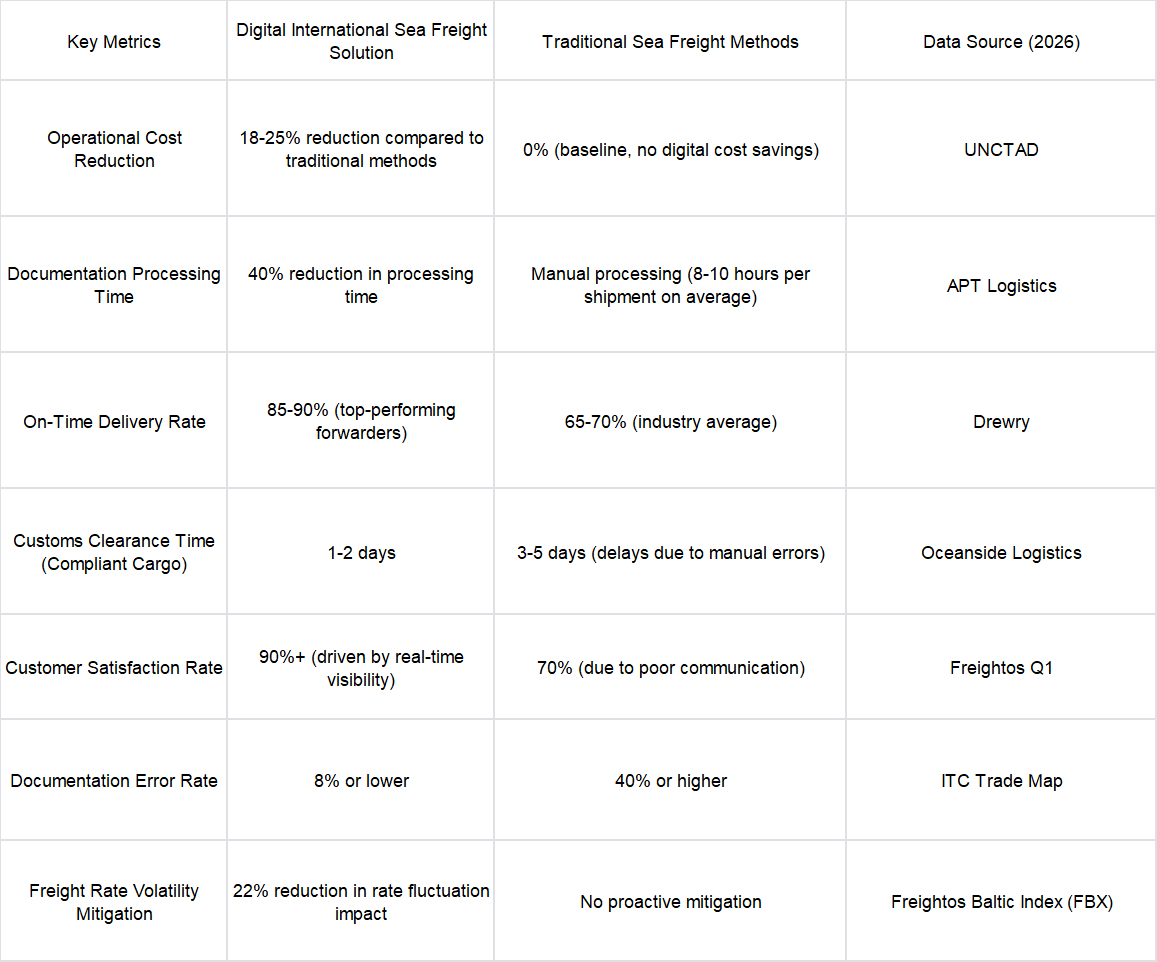
To fully understand the value of a tailored International Sea Freight Solution, it is essential to compare its performance against traditional manual processes across key metrics. The table below, based on 2026 industry data from authoritative sources, highlights the stark differences between digital and traditional approaches.
What Are Common Misconceptions About International Sea Freight Solutions?
Despite the clear benefits, many freight forwarders hesitate to adopt a digital International Sea Freight Solution due to common misconceptions. Below are the most prevalent myths, along with factual corrections to help forwarders make informed decisions.
• Misconception 1: Digital Solutions Are Too Difficult to Implement: A common misconception is that an International Sea Freight Solution requires advanced technical expertise and will severely disrupt existing operations. In reality, most modern solutions are user-friendly and can be integrated in phases. According to APT Logistics 2026 Research, 78% of forwarders reported that digital solution implementation took less than 4 weeks, with minimal operational disruption. The recommended practice is to partner with a solution provider that offers training and ongoing support to ensure a smooth transition.
• Misconception 2: Digital Solutions Are Only for Large Forwarders: Many small and mid-sized forwarders believe that an International Sea Freight Solution is too expensive and irrelevant to their needs. However, most providers offer scalable solutions with pay-as-you-go pricing models. According to Freightos Q1 2026 Report, mid-sized forwarders using digital solutions saw a 12% increase in profit margins. Freight forwarders need to note that scalability is a core feature of modern International Sea Freight Solutions, allowing them to grow and adapt as their business expands.
• Misconception 3: Real-Time Visibility Is a Luxury, Not a Necessity: Some forwarders view real-time cargo tracking as an optional add-on rather than a critical feature. But according to UNCTAD 2026 Data, forwarders without real-time visibility experience a 30% increase in delays and a 25% increase in demurrage fees. The recommended practice is to prioritize an International Sea Freight Solution with robust tracking capabilities, as it not only reduces costs but also enhances client trust and retention.
• Misconception 4: Digital Solutions Will Replace Human Expertise: Fear of job losses often deters forwarders from adopting digital tools. In truth, an International Sea Freight Solution is designed to complement, not replace, human expertise. By automating repetitive tasks (e.g., documentation, rate comparisons), forwarders can redirect their teams to high-value activities, such as client relationship management and strategic carrier partnerships. According to Oceanside Logistics 2026 Report, forwarders using digital solutions saw a 20% increase in employee productivity and job satisfaction.
• Misconception 5: All International Sea Freight Solutions Are the Same: A common mistake is choosing a solution based solely on price, ignoring functional differences. Not all solutions offer the same level of integration or customization. The recommended practice is to select an International Sea Freight Solution that seamlessly integrates with existing systems (e.g., TMS, CRM, accounting software) and offers customizable features to match specific cargo types (e.g., refrigerated goods, oversized cargo) and target markets.
What Key Factors Should Freight Forwarders Consider When Choosing an International Sea Freight Solution?
Selecting the right International Sea Freight Solution is critical to maximizing the value of digital transformation. Forwarders should evaluate solutions based on the following key factors, which directly impact operational efficiency, cost savings, and client satisfaction.
• Integration Capabilities: The solution should seamlessly integrate with existing systems, including transportation management systems (TMS), customer relationship management (CRM) software, and accounting tools. According to APT Logistics 2026 Research, forwarders using fully integrated solutions reduced administrative time by 35%. Freight forwarders need to note that API integration is essential for real-time data synchronization between systems, eliminating manual data entry and errors.
• Real-Time Data and Analytics: A high-quality International Sea Freight Solution should provide real-time access to freight rates, carrier performance, port congestion, and cargo status. According to Drewry’s March 2026 Container Freight Insight, forwarders using data-driven analytics for strategic decision-making reduced freight costs by 10-15%. The recommended practice is to choose a solution with customizable dashboards that track key metrics relevant to the forwarder’s business, such as on-time delivery rates and cost per shipment.
• Compliance and Local Expertise: The solution must support global compliance requirements, including customs regulations, trade sanctions, and documentation standards. According to Oceanside Logistics 2026 Customs Compliance Report, solutions with built-in compliance tools reduce non-compliance fines by 60%. Freight forwarders need to note that partnering with a provider with local expertise in target markets ensures the solution stays updated with regional regulatory changes, avoiding costly delays.
• Scalability and Flexibility: As a forwarder’s business grows and client needs evolve, the International Sea Freight Solution should scale accordingly. It should support diverse cargo types (e.g., refrigerated, oversized, hazardous goods) and adapt to new market expansions. According to WTO Q1 2026 Update, forwarders using scalable solutions are twice as likely to successfully expand into new regions. The recommended practice is to select a solution that allows for adding or removing features as needed, without significant downtime or additional costs.
• Customer Support and Reliability: Technical issues can disrupt operations, so reliable customer support is essential. According to Freightos Q1 2026 Platform Data, forwarders with 24/7 customer support resolve issues three times faster than those without. The recommended practice is to test a provider’s support response time before signing a contract and ensure they assign a dedicated account manager to address specific business needs.
How Can Freight Forwarders Measure the Success of Their International Sea Freight Solution?
To ensure an International Sea Freight Solution delivers on its promise, forwarders need to track key performance indicators (KPIs) and compare them against industry benchmarks. Below are the critical metrics to monitor, along with actionable tips for improvement.
Which Operational Efficiency Metrics Should Forwarders Prioritize?
Track documentation processing time, booking time, and administrative labor costs. According to APT Logistics 2026 Research, the industry benchmark for digital solutions is 2-3 hours of documentation processing per shipment, compared to 8-10 hours with traditional methods. The recommended practice is to set monthly efficiency goals, conduct regular reviews, and optimize processes based on feedback from the team.
How to Accurately Measure Cost Savings from a Sea Freight Solution?
Monitor total freight costs, demurrage and detention fees, and compliance fines. According to UNCTAD 2026 Data, forwarders using a digital International Sea Freight Solution reduce operational costs by 18-25% within the first year. Freight forwarders need to note that cost savings should be measured holistically, including direct costs (e.g., freight rates) and indirect costs (e.g., labor, error-related losses), to accurately calculate ROI.
What Service Quality Metrics Reflect Solution Effectiveness?
Track on-time delivery rates, customer satisfaction scores, and dispute resolution time. According to Drewry 2026 Data, top-performing forwarders using digital solutions achieve 85-90% on-time delivery rates and 90%+ customer satisfaction. The recommended practice is to conduct regular client surveys, gather feedback, and adjust the solution’s use to address pain points.
How to Monitor Compliance Performance with a Digital Solution?
Monitor compliance error rates and non-compliance fines. According to Oceanside Logistics 2026 Report, the industry benchmark for digital solutions is a compliance error rate of 8% or lower. If error rates are higher, the recommended practice is to provide additional team training or upgrade the solution’s compliance features to address gaps.
Conclusion: Crafting the Ultimate International Sea Freight Solution for Long-Term Success
In 2026 and beyond, digital transformation is not a choice but a necessity for freight forwarders looking to thrive in complex sea freight logistics. Geopolitical uncertainty, port congestion, volatile rates, and evolving client demands require forwarders to be agile, data-driven, and efficient—and a well-crafted International Sea Freight Solution is the foundation of this agility. By leveraging AI, blockchain, real-time analytics, and automation, forwarders can streamline operations, reduce costs, and deliver the reliable, transparent services that clients demand. The key is to approach solution selection strategically, prioritize integration and scalability, and avoid common misconceptions that hinder progress. Ultimately, the ultimate International Sea Freight Solution is not just a tool—it is a strategic partner that empowers forwarders to navigate complexity, build client trust, and achieve long-term profitability in the global logistics market.
Last
Lowering Landed Costs: Finding a Scalable International Sea-Based Freight Solution for Diverse Cargo Needs
In 2026, global freight forwarders are grappling with relentless pressure to reduce operational costs while meeting the diverse ca
Next
Beyond the Port: Navigating 2026 with a More Resilient International Solution for Your Sea Freight Operations
In 2026, the global freight forwarding industry faces unprecedented uncertainty—geopolitical tensions, port congestion, fluctuatin

