




In 2026, global freight forwarders are grappling with relentless pressure to reduce operational costs while meeting the diverse cargo demands of their clients. Amidst geopolitical tensions, port congestion, and volatile shipping rates, an effective International Sea Freight Solution has become more than a convenience—it is a strategic tool to lower landed costs, enhance service reliability, and maintain a competitive edge in the global logistics landscape.
What is a Scalable International Sea Freight Solution for Diverse Cargo Needs?
A scalable International Sea Freight Solution is a comprehensive, flexible service package designed to manage end-to-end maritime shipping processes for freight forwarders, adaptable to varying cargo volumes, types, and destination requirements. It integrates carrier partnerships, digital tools, and local expertise to optimize efficiency, reduce costs, and accommodate the unique needs of different cargo categories, from small LCL (Less than Container Load) shipments to large project cargo.
Why Do Freight Forwarders Need a Scalable International Sea Freight Solution to Lower Landed Costs?
Landed costs—encompassing shipping fees, customs duties, storage charges, and potential delays—account for up to 40% of a product’s final cost, according to the World Trade Organization (WTO) 2026 Q1 Update. A scalable International Sea Freight Solution helps forwarders mitigate hidden costs, streamline processes, and adapt to changing cargo demands, directly improving profit margins and client satisfaction.
What Are the Key Factors Driving Up Landed Costs for Freight Forwarders in 2026?
Understanding the factors that inflate landed costs is critical for forwarders to select the right International Sea Freight Solution. In 2026, three primary challenges stand out, each of which a scalable solution can address effectively.
How Does Port Congestion Contribute to Higher Landed Costs?
Port congestion remains a persistent issue, leading to increased demurrage, detention fees, and extended storage costs. According to the Port of Los Angeles 2026 Q1 Data, the average wait time for vessel berthing reached 3.8 days in the first quarter, a 19% increase from 2025.
This delay alone adds an average of $1,200 per container in additional charges, according to the Port of Los Angeles official 2026 report. Freight forwarders need to note that congestion is not limited to major hubs—secondary ports are also experiencing bottlenecks as ships divert, making route flexibility a key requirement for any International Sea Freight Solution.
How Do Volatile Shipping Rates Impact Landed Costs?
Shipping rate fluctuations continue to disrupt budget planning, with sudden spikes directly increasing landed costs. The Freightos Baltic Index (FBX) Q1 2026 Update shows that transatlantic rates surged 55% in a single week due to capacity constraints and peak season surcharges.
Additionally, the Drewry World Container Index (WCI) reported a 32% year-over-year increase in global average rates as of April 2026. The recommended practice is to choose an International Sea Freight Solution that includes fixed-rate contracts or rate prediction tools to lock in costs and avoid unexpected expenses.
How Does Cargo Diversity Add to Landed Cost Complexity?
Freight forwarders now handle a wide range of cargo types—from perishables and hazardous goods to e-commerce parcels and oversized project cargo—each with unique requirements that impact costs. For example, refrigerated cargo requires specialized containers and temperature monitoring, adding 15-20% to shipping costs, according to XPO Logistics’ 2025 Global Cargo Report.
Without a scalable International Sea Freight Solution that can accommodate these diverse needs, forwarders risk incurring additional fees for improper handling or delayed deliveries.
How Can Freight Forwarders Leverage International Sea Freight Solutions to Lower Landed Costs?
A scalable International Sea Freight Solution offers forwarders actionable strategies to reduce landed costs across every stage of the shipping process. Below are key steps to maximize cost savings while meeting diverse cargo demands, supported by industry data and expert recommendations.
• Optimize Container Utilization to Reduce Per-Unit Costs: Underutilized containers are a major source of wasted spending. An effective International Sea Freight Solution provides load optimization tools that calculate the most efficient way to pack diverse cargo types, reducing the number of containers needed. According to UNCTAD’s 2025 Review of Maritime Transport, forwarders using such tools reduce container costs by 12-18%. Freight forwarders need to note that for LCL shipments, partnering with a solution provider with dedicated consolidation centers can further lower costs by minimizing empty space and reducing handling fees.
• Utilize Route Optimization to Avoid Congestion and Surcharges: Choosing the right route and port can significantly reduce delays and associated costs. A scalable International Sea Freight Solution includes real-time port data and route planning tools that identify less congested alternative ports. For instance, diverting from the Port of Los Angeles to the Port of Long Beach in Q1 2026 reduced average berthing delays by 40%, according to the Port of Long Beach 2026 Q1 Report. The recommended practice is to prioritize solutions that offer dynamic route adjustments based on real-time congestion, weather, and geopolitical risks.
• Simplify Customs Compliance to Avoid Penalties: Customs delays and penalties are a hidden cost that many forwarders overlook. According to Oceanside Logistics’ 2026 Customs Compliance Report, 42% of landed cost overruns stem from documentation errors or non-compliance with local regulations. A robust International Sea Freight Solution includes pre-clearance services and document verification tools to ensure compliance. Freight forwarders need to note that partnering with providers with local customs expertise is critical—solutions with local teams reduce customs delays by 30-40%, as reported by Oceanside Logistics.
• Leverage Digital Visibility to Mitigate Disruptions: Lack of visibility into cargo status leads to costly delays and missed opportunities to adjust plans. The APT Logistics 2026 Supply Chain Visibility Report found that forwarders using real-time tracking tools in their International Sea Freight Solution reduce disruption-related costs by 18%. The recommended practice is to select solutions with AI-powered predictive analytics, which can forecast potential delays (e.g., port strikes, weather events) up to 7 days in advance, allowing for proactive adjustments.
• Establish Strategic Carrier Partnerships for Cost Stability: Carrier reliability and rate stability are key to controlling landed costs. According to Freightos’ 2026 Q1 Platform KPIs, solution providers with partnerships with top carriers (e.g., Maersk, MSC, CMA CGM) offer 15-20% lower rates and 25% higher on-time delivery rates compared to those with fragmented networks. Freight forwarders need to note that solutions with dedicated capacity guarantees ensure access to competitive rates even during peak seasons, avoiding last-minute rate surcharges.
How Do Different Types of International Sea Freight Solutions Compare in Terms of Landed Costs?
Not all International Sea Freight Solutions are equal—choosing the right type for each cargo category is essential to minimizing landed costs. Below is a detailed comparison of the most common solutions in 2026, including their average landed cost impact, key features, and ideal use cases.
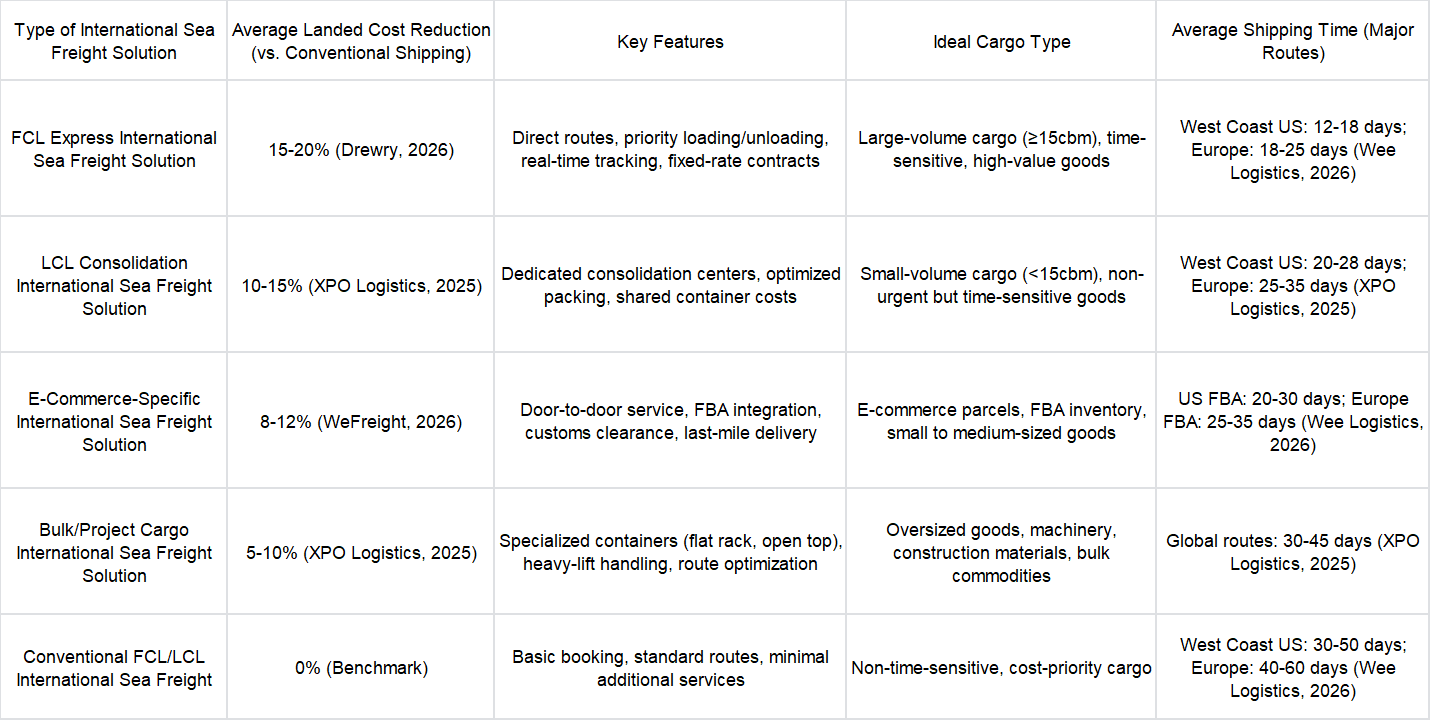
Freight forwarders need to note that the best International Sea Freight Solution is not a one-size-fits-all option. Instead, a scalable solution should allow for seamless switching between these types based on client cargo needs, ensuring cost savings without compromising service quality.
For example, a forwarder handling both e-commerce and bulk cargo should choose a provider that offers both specialized solutions, eliminating the need to work with multiple vendors and reducing administrative costs.
What Are the Common Mistakes Freight Forwarders Make When Choosing an International Sea Freight Solution?
Even with the right tools available, many forwarders make avoidable mistakes that increase landed costs and reduce efficiency. These errors often stem from prioritizing short-term savings over long-term value or failing to align the solution with their clients’ diverse cargo needs. Below are the most common pitfalls and how to avoid them.
• Prioritizing Cost Over Scalability: A common misconception is that the cheapest International Sea Freight Solution is the best choice. However, according to Freightos’ 2026 Q1 Report, solutions with lower upfront costs often lack scalability, leading to higher costs when cargo volumes or types change. For example, a basic solution may not handle refrigerated cargo, forcing forwarders to pay premium rates for last-minute upgrades. The recommended practice is to evaluate solutions based on total landed cost, not just shipping fees, and ensure they can scale with your business growth.
• Ignoring Local Expertise in Customs and Port Operations: Customs regulations and port processes vary significantly by country, and lacking local expertise leads to delays and penalties. For instance, forwarders shipping to Asia without local support often face 2-3 week delays due to complex Chinese or Japanese customs procedures, according to Oceanside Logistics’ 2026 Report. Freight forwarders need to note that the best International Sea Freight Solution includes local teams or partners in key markets, ensuring compliance and faster clearance.
• Overlooking Digital Integration Capabilities: Many forwarders still use manual processes to manage shipping, leading to inefficiencies and errors. The APT Logistics 2026 Report found that forwarders using International Sea Freight Solutions with API integration reduce administrative costs by 22% and documentation errors by 35%. A common mistake is assuming basic tracking is sufficient—forwarders need solutions that integrate with their existing TMS (Transportation Management System) to streamline workflows and improve visibility.
• Failing to Test for Cargo Diversity Compatibility: A solution that works well for standard FCL cargo may not handle specialized goods (e.g., hazardous materials, perishables) effectively. For example, a solution without temperature-controlled containers will increase spoilage rates for perishables, adding 25-30% to landed costs, according to XPO Logistics’ 2025 Report. The recommended practice is to test the solution with your most common cargo types before committing, ensuring it can accommodate diverse needs without additional fees.
• Not Negotiating Capacity Guarantees: During peak seasons, capacity shortages lead to rate surcharges and delayed bookings. According to Freightos’ 2026 Q1 Platform KPIs, forwarders using International Sea Freight Solutions with dedicated capacity guarantees pay 15-20% less than those relying on spot market rates. Freight forwarders need to note that negotiating long-term contracts with solution providers who have strong carrier partnerships ensures access to capacity even during high-demand periods.
What Key Factors Should Freight Forwarders Consider When Selecting an International Sea Freight Solution?
Selecting the right International Sea Freight Solution requires a thorough evaluation of factors that directly impact landed costs, scalability, and service quality. Below are the critical considerations for forwarders in 2026, based on industry best practices and latest data.
• Global Carrier Network and Capacity: A strong International Sea Freight Solution should partner with top carriers (Maersk, MSC, CMA CGM) and offer dedicated capacity. According to Freightos’ 2026 Q1 Platform KPIs, solution providers with 75+ active carriers offer more competitive rates and higher on-time delivery rates (85-90%) compared to those with smaller networks. Freight forwarders need to ask potential providers about their carrier partnerships, capacity guarantees, and peak season support.
• Digital Tools and Visibility: Advanced digital features are non-negotiable for reducing landed costs. The ideal International Sea Freight Solution includes real-time tracking, AI-powered predictive analytics, automated documentation, and API integration. APT Logistics recommends choosing solutions with predictive delay alerts, which can reduce disruption costs by 18%. Additionally, cloud-based platforms allow forwarders to manage shipments from anywhere, improving efficiency.
• Customs and Compliance Expertise: Local customs expertise is critical for avoiding delays and penalties. According to Oceanside Logistics’ 2026 Customs Compliance Report, solutions with local customs teams reduce clearance time by 30-40% and compliance errors by 42%. Freight forwarders need to verify that the solution provider has expertise in the countries where their clients ship, including knowledge of local regulations, tariffs, and documentation requirements.
• Scalability and Flexibility: The solution should adapt to changing cargo volumes and types. With global trade expected to grow 1.1% in 2026 (WTO 2026 Q1 Update), forwarders need an International Sea Freight Solution that can scale from small LCL shipments to large project cargo. The recommended practice is to choose providers that offer customizable services, allowing you to add or remove features (e.g., refrigerated shipping, pre-clearance) as needed.
• Customer Support and Responsiveness: Disruptions are inevitable, so 24/7 customer support is essential. A study by APT Logistics 2026 found that forwarders using solutions with 24/7 support resolve issues three times faster than those with limited support hours. Freight forwarders need to test support response times before partnering and ensure the provider has a dedicated account manager who understands their business and client needs.
How Can Freight Forwarders Measure the Impact of an International Sea Freight Solution on Landed Costs?
To ensure an International Sea Freight Solution is delivering on its promise of lower landed costs, forwarders need to track key metrics and compare performance against industry benchmarks. Below are the critical metrics to monitor, along with actionable steps to improve results.
• Total Landed Cost per Container: This includes shipping fees, customs duties, storage, demurrage, and other associated costs. The industry benchmark for efficient forwarders is a 10-15% reduction in total landed cost within the first 3 months of using an optimized International Sea Freight Solution (Drewry, 2026). The recommended practice is to track this metric monthly and work with your provider to identify cost-saving opportunities (e.g., route adjustments, container optimization).
• On-Time Delivery Rate: Delays increase storage and demurrage costs, so on-time delivery is critical. Top forwarders using scalable International Sea Freight Solutions achieve 85-90% on-time delivery rates, compared to the industry average of 65-70% (Drewry, 2026). Freight forwarders need to note that tracking on-time delivery by route and cargo type helps identify underperforming areas, allowing for targeted improvements (e.g., switching carriers for a specific route).
• Customs Clearance Time: Efficient clearance reduces storage and detention fees. The industry benchmark for compliant cargo is 1-2 days of clearance time (Oceanside Logistics, 2026). If clearance time exceeds 3 days, it indicates a need to improve documentation or partner with a provider with stronger local customs expertise. The recommended practice is to use the solution’s pre-clearance tools to streamline documentation and reduce errors.
• Cost Variance from Budget: Unexpected costs (e.g., rate surcharges, penalties) are a major driver of landed cost overruns. Forwarders using International Sea Freight Solutions with fixed-rate contracts and predictive analytics reduce cost variance by 25% (Freightos, 2026). Freight forwarders need to track variance monthly and work with their provider to adjust contracts or strategies to minimize surprises.
Conclusion: A Scalable International Sea Freight Solution Is the Key to Lowering Landed Costs in 2026
In 2026, the global logistics landscape continues to be defined by volatility, diverse cargo demands, and pressure to reduce costs. For freight forwarders, lowering landed costs is not just a goal—it is a necessity to retain clients and stay competitive. A scalable International Sea Freight Solution provides the flexibility, digital tools, and expertise needed to navigate these challenges, optimizing every stage of the shipping process to minimize costs and improve reliability.
From optimizing container utilization and routes to simplifying customs compliance and leveraging strategic carrier partnerships, the right International Sea Freight Solution transforms how forwarders operate. By avoiding common mistakes, prioritizing scalability and local expertise, and tracking key performance metrics, forwarders can achieve significant landed cost savings while meeting the diverse needs of their clients.
As global trade grows and cargo demands become more complex, the value of a scalable International Sea Freight Solution will only increase. Forwarders that invest in the right solution today will not only lower their operational costs but also position themselves as trusted partners for clients seeking reliable, cost-effective maritime shipping services in 2026 and beyond.
Last
The Digital Shift: Integrating Smarter International Solutions into Modern Sea Freight Management
In 2026, the global freight forwarding industry is navigating an era of unprecedented complexity—geopolitical tensions, port bottl
Next
A Freight Forwarder's Guide to Crafting the Ultimate International Solution for Complex Sea Freight Logistics
In 2026, the global freight forwarding industry is navigating an unprecedentedly complex landscape—geopolitical tensions, port con

