






Case Background
In cross-border logistics cooperation, payment disputes arising from destination charges and liability for container damage are not uncommon.
In July 2025, Agent A and Agent B entered into a cooperation arrangement and signed an Agency Agreement, under which the two parties acted as mutual agents on the United States–South Africa trade lane.
In August 2025, Agent A (the handling party) arranged a shipment of 4×20GP for Agent B (the principal), moving cargo from Miami to Durban under FOB terms.
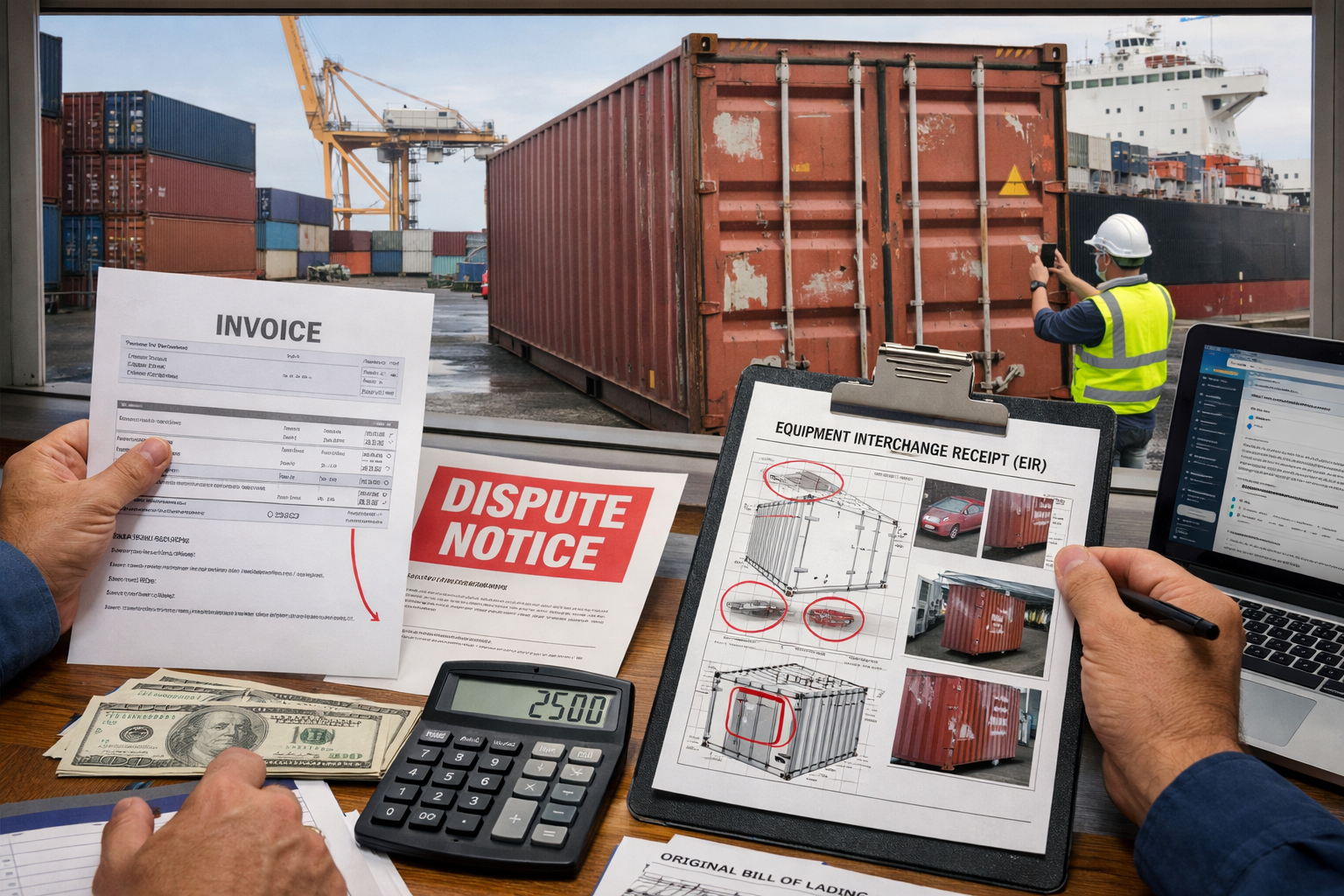
After the cargo arrived smoothly at destination, Agent B paid the relevant charges . However, at the settlement stage, Agent B directly deducted a total of USD 2,500 from the ocean freight payable, without obtaining Agent A’s written approval, on the grounds that two charges had exceeded the original quotation: the difference in destination charges and the container repair charge for damage.
Agent A objected to the deduction and filed a claim with the platform.
Key Issues in Dispute
I. Difference in destination local charges
Agent A argued that:
Any adjustment to the charges should have been notified in writing in advance and confirmed by Agent A;
The difference could be discussed and shared through negotiation, but Agent A objected to any unilateral deduction in full, as such action breached the settlement arrangement agreed between the parties.
Agent B argued that:
The actual D/O fee and container rental were higher than the original quotation;
Agent A had been informed after the charges arose, but no timely resolution was provided.
Under FOB terms, destination charges should be borne by the consignee.
The core issue of the dispute was:
Whether the change in charges had been confirmed by both parties, whether the agent had the right to make a unilateral deduction, and, at the same time, this case exposed the unclear allocation of responsibility for destination local charges under FOB terms.
II. Container damage charges
Agent A (the handling party) argued that:
The condition of the container is determined by the carrier’s destination agent, which is beyond the control of the booking agent.
If the damage had already existed at the time of pick-up, liability should rest with the pick-up party (the shipper or its agent), and the deduction was made without prior authorization.
Agent B (the principal) argued that:
The damage was pre-existing damage, and photos had already been taken at the time of pick-up, but the carrier still imposed the repair charge.
As the consignee refused to bear the charge, the amount could only be deducted from the payable account.
In this case, the core issue of the dispute was:
Whether the evidentiary chain for the damage liability was complete, and whether there was any basis for the deduction.
Platform Intervention and Resolution Process
After receiving the claim, the platform’s risk control team conducted a full review of the case materials.
1.Timeliness review
The bill of lading date in this case was 2025-08-26, and the claim was filed within the prescribed period (90–150 days), meeting the platform’s acceptance criteria under the Cooperation Risk Protection service.
2.Review of evidentiary chain
The platform focused on reviewing the following key materials:
● Original quotation sheet
● Charge receipts and carrier invoices
● Communication records between the parties
● Container photos and Equipment Interchange Receipt (EIR)
The final review findings showed that:
● Neither of the two charges was listed in the original quotation
● Agent A’s written confirmation was not obtained before the charges arose
● For the container damage, complete pick-up EIR records and six-side photos were not provided
Therefore, Agent B was unable to prove that liability for the charges rested with Agent A, and the deduction was made
without the other party’s confirmation.
3.Platform determination
Based on the platform’s transaction rules and international logistics industry practice, the platform determined that:
Agent B had no right to unilaterally deduct the ocean freight, and the evidence supporting the two disputed charges was insufficient.
The platform ultimately ruled that:
Agent B must pay Agent A the deducted amount of USD 2,500.
With the platform’s coordination, Agent A also agreed to bear part of the container damage cost. The parties eventually reached a settlement, Agent B completed the supplementary payment, and the dispute was resolved.
Case Takeaways
1.FOB terms ≠ automatic transfer of cost liability
FOB only defines the point at which cargo risk transfers; it does not automatically allocate liability for all destination charges.
In agency cooperation, it is essential to clearly specify the charging standard or calculation method for items such as D/O fee, container rental, documentation fee, and destination local charges.
2.Any adjustment to charges must be confirmed in writing
Any change in charges should follow this process: prior notice → mutual confirmation → supporting documents.Without a confirmation step, unilateral deductions are highly likely to trigger disputes.
3.For container damage, the three key supporting records must be retained
To clearly establish liability, it is recommended to retain:
At pick-up: six-side container photos with time-and-location watermark
After loading: seal number and container door photos
At return: carrier-issued EIR; where damage exists, a Damage Report (DR) should also be provided
If any one of these elements is missing, the party’s position in a dispute will be weakened.
In cross-border logistics transactions, many disputes do not arise because of the amount involved, but because charges were not clearly confirmed and procedures were not properly followed. A clear charge confirmation process and a complete evidentiary chain are often far more important than arguing after the fact.
Last
One Shipment, Two Debts: How an Innocent Freight Forwarder Got Trapped in a “Debt Substitution” Dispute | JCtrans Credit Risk Awareness Month – Risk Control Case Study
In the course of operating within the cross-border freight forwarding industry, it is not uncommon for innocent parties to be drag
Next
Loss Alert: A Bill of Lading Mistake in Cross-Border Logistics Led to Total Loss of Cargo and Payment | JCtrans Credit Risk Awareness Month – Risk Control Case Study
In international logistics, the Bill of Lading (B/L) is the core document representing cargo ownership. A recent dispute handled b

