






Why did an airfreight service fee agreed as “payment upon receipt of invoice” trigger doubts over the authenticity of the operating party’s corporate identity after successful delivery? In cross-border logistics cooperation, transportation may appear seamless, yet once the “four flows” fall out of alignment, risks often surface at the settlement stage.
This case centers on a real dispute in which the principal challenged inconsistencies in the operating party’s corporate identity.
I. Case Background: Hidden Risks Behind Proper Performance
Principal Company B (registered in Saudi Arabia) entered into cooperation with Operating Company A (headquartered in Qatar with a branch in Oman). A was engaged to handle an air shipment of electronic components from Muscat, Oman to Dammam, Saudi Arabia, covering pickup, air carriage, and documentation processing.
The parties confirmed the total service fee by email. In June 2025, A issued the invoice and stipulated “payment to be made immediately upon receipt of invoice, partial payment not accepted.” The cargo was delivered smoothly with complete documentation, and the operational flow appeared fully closed. However, during B’s internal review prior to payment, irregularities were identified.
II. Dispute Triggered: Principal Questions Inconsistent Corporate Identity
During verification of payment details and corporate credentials, B identified the following discrepancies:
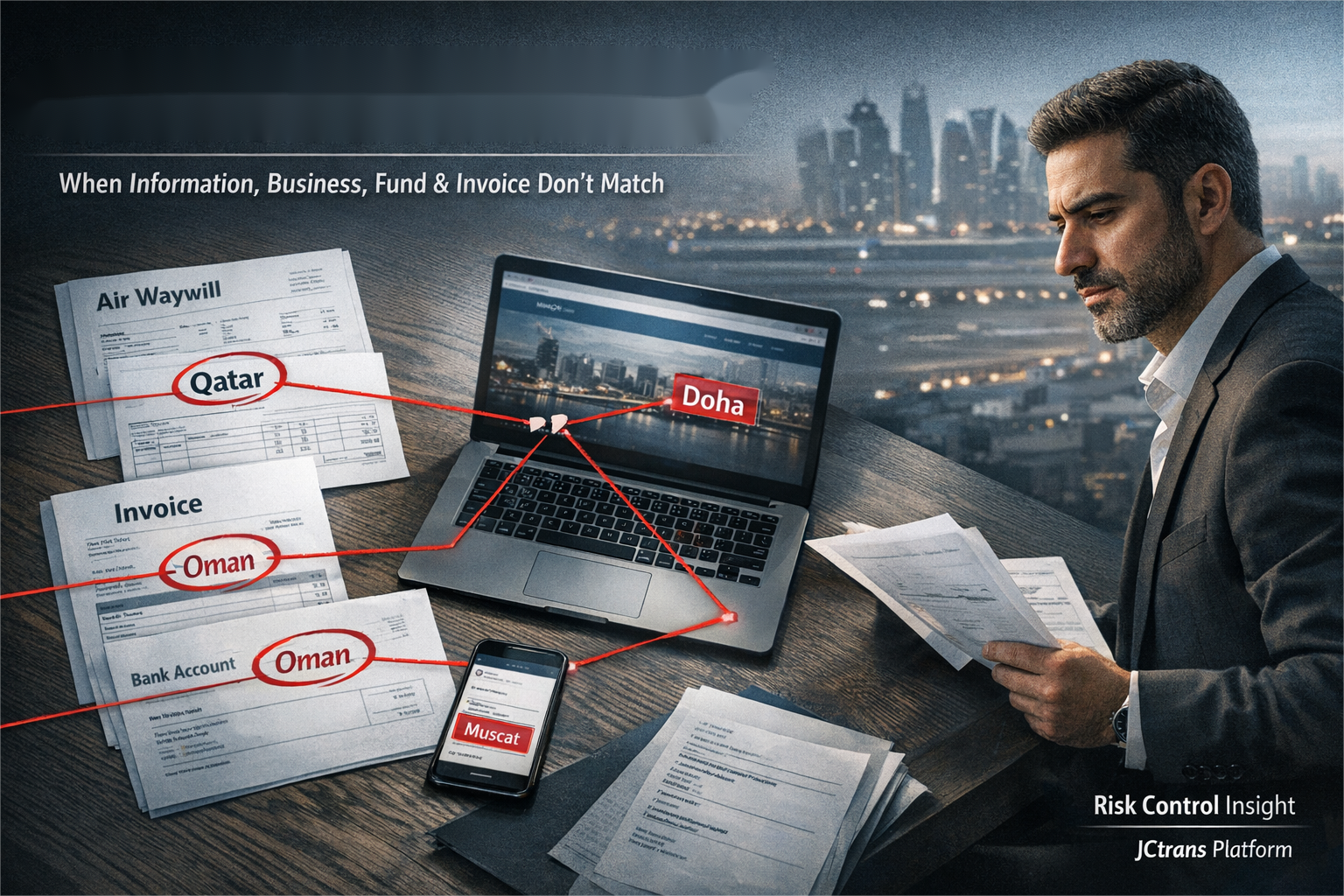
The invoice was issued under A’s Qatar headquarters;
The designated receiving account was maintained with a bank in Oman;
The email signature reflected an office address in Muscat, Oman;
The headquarters address published on the official website was in Doha, Qatar.
B raised concerns as to whether the contracting entity, the payment beneficiary, and the executing entity were legally consistent, and whether funds were being collected through an affiliated company. In multiple rounds of email correspondence, A explained that the Oman account was a “designated affiliated account of the headquarters,” but failed to provide complete supporting documentation, such as proof of parent-subsidiary relationship or an authorized collection letter.
In line with its internal compliance procedures, B suspended payment and, in August 2025, submitted a complaint to the JCtrans platform, alleging potential “collection risk” on the part of the operating party.
III. Platform Review: The Issue Was Not Transportation, but a Break in the “Four Flows”
Upon intervention, the platform conducted verification based on the principle of alignment among the “four flows”:
1.Information Flow Review
A’s official website identified the legal entity as a Qatar company; the registered entity on the platform was also Qatar-based; however, a substantial portion of business correspondence was conducted in the name of the Oman branch, without clear authorization documentation.
2.Business Flow Review
The bill of lading and operational documents indicated execution in Oman;
The contract did not clearly define the legal relationship under which the Oman branch executed the agreement on behalf of the headquarters.
3.Funds Flow Review
The invoice was issued by the Qatar entity, while the receiving account was an Oman bank account;
Although the account name was similar to the company name, no supporting corporate registration documents were provided.
4.Invoice Flow Review
The invoicing entity and the location of the receiving account were inconsistent, with no documentation establishing legal linkage.
Platform Conclusion
The platform determined that performance of carriage had been duly completed; however, the operating party failed to provide sufficient documentation to establish consistency of corporate identity;Inconsistencies were identified between the funds flow and information flow;
The platform therefore recommended that settlement proceed only after supplementary documentation confirming corporate affiliation is provided, and reminded the principal to exercise caution regarding fund security. The case did not enter the compensation process, but the complained party was recorded under Risk Alerts observation.
IV.Case Insights: When the “Four Flows” Are Misaligned, Risk Remains Critical
1.Alignment of the “Four Flows” Is a Settlement Safeguard, Not a Formality
Information flow: consistency among official website disclosure, platform registration, and contractual entity;
Business flow: clarity between contracting entity and actual executing entity;
Funds flow: alignment between receiving account and the registered corporate entity;
Invoice flow: consistency between invoice title and payment beneficiary.
Any break in this chain creates exposure.
2.“One Entity, Three Locations” Is a Frequent Risk Control Red Flag
Where a counterparty presents a structure such as:
Headquarters in one country;
Operational execution in another;
Funds received in a third jurisdiction;
and is unable to provide complete legal affiliation documentation,
this should be treated as a high-risk indicator.
3.Corporate Identity Verification Is Essential Before Payment
In cross-border transactions, payment is not merely procedural; it is a critical risk node.
It is recommended to request proof of parent-subsidiary relationship;
Require an authorized collection statement;
Verify consistency between the bank account and the business license;
Where necessary, conduct compliance review through the platform’s Risk Mitigation mechanism.
Conclusion
This case serves as a reminder:
Cross-border logistics disputes do not necessarily arise from cargo issues; many emerge at the settlement stage.When the “four flows” are inconsistent, even successfully delivered cargo does not guarantee financial security.
For all cross-border logistics practitioners—completion of transportation does not equal transaction safety; only a fully aligned four-flow structure marks the true end of risk.
Last
Core Risk in Cross-border Logistics: No Cargo Pickup at Destination, Escalating Charges and Liability Exposure — A Risk Control Guide for the Industry
In cross-border ocean freight and air freight, unclaimed cargo at destination is a high-risk scenario. Consignee disappearance, ca
Next
Beware: The Real Risks Behind FOB Misuse in Rail Transport
How can a single “FOB Shanghai” mismatch derail cooperation on the spot? In non-ocean transport scenarios, casually applying FOB i

