






In the international freight forwarding industry, accidents caused by the misdeclaration of dangerous goods often result in huge losses and complex liability disputes. Recently, a maritime transport fire case triggered by “whitening agents” resulted in a court ruling that the Shipper must bear compensation liability of nearly RMB 1.8 million. This typical case serves as a serious warning to freight forwarding companies — Risk Mitigation in the declaration of dangerous goods is far more important than imagined.
I. Case Background: Garlic Shipment Hit by Sudden Disaster
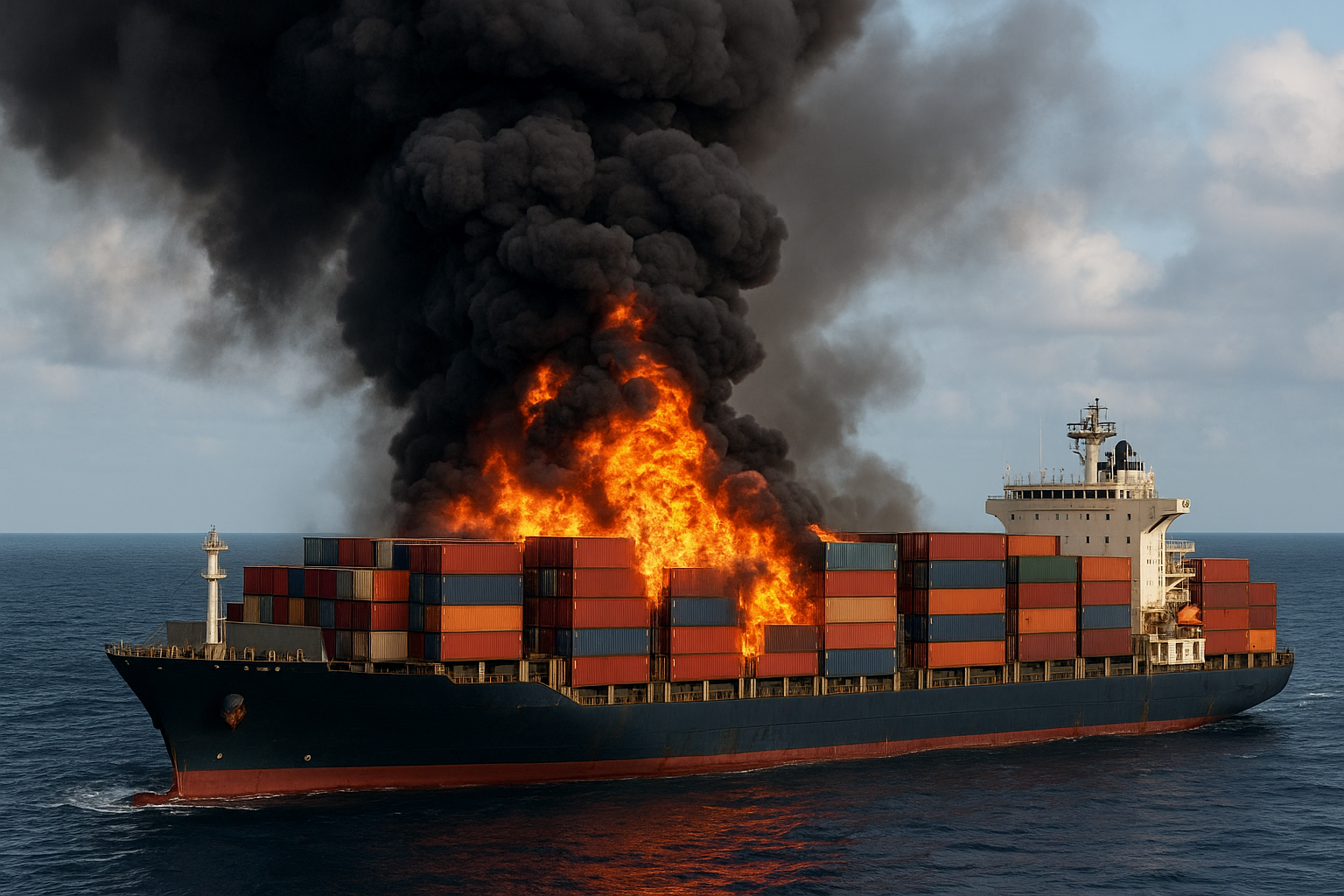
A food company entrusted a shipping line with the transportation of 15 refrigerated containers of garlic to Indonesia. What was originally a routine agricultural export shipment turned into an accident during the voyage: one container, labeled by a trading company as “whitening agents,” suddenly caught fire. The blaze quickly spread, damaging multiple containers including those carrying garlic, causing direct economic losses of more than RMB 2 million.
Subsequent investigations revealed a shocking truth: the cargo inside the burning container was not ordinary “whitening agents,” but undeclared dangerous goods — Calcium Hypochlorite. This substance decomposes easily upon contact with water, releasing chlorine gas, and is strictly controlled under international maritime transport regulations. As the Shipper concealed the true nature of the goods and failed to complete the required dangerous goods transport procedures, the misdeclaration ultimately led to the cargo damage incident.
II. Multi-Party Dispute: Key Issues in Liability Determination
1. Identification of the Shipper: The trading company denied being the Shipper of the incident container, claiming it was unrelated to the cargo in question. However, the court found that the company had indeed shipped goods labeled as “whitening agents” on the same voyage and failed to provide evidence proving that its shipment was unrelated to the container involved in the fire. Based on the principle of high probability under the Civil Procedure Law, the court identified the trading company as the Shipper of the incident container.
2. Carrier’s Defense of Exemption: The shipping line, acting as the Carrier, argued that under the provisions of the Maritime Law, it was exempt from liability for cargo damage caused by fire. After examination, the court held that since the fire in this case was caused by the misdeclaration of dangerous goods, and the Carrier had fulfilled its duty of formal inspection regarding the cargo declaration, the Carrier was not at fault. Therefore, the court upheld the Carrier’s claim for exemption.
3. Liability Boundaries of Freight Forwarding Companies: A logistics company (Company A), another logistics company (Company B), and a shipping agency were involved as Agents. They argued that they only handled Booking and related agency services, and were not aware of the true nature of the cargo. The court pointed out that since the cargo was not declared as dangerous goods, the freight forwarding companies were not required to perform special duties related to dangerous goods transportation. As there was no evidence proving fault on their part, the court ruled that they did not bear liability for compensation.
III. Court Ruling: Shipper Liable, Others Exempt
The final judgment was as follows:
· The trading company, as the Shipper of the incident container, concealed the dangerous goods nature of the cargo and caused the damage. It is required to compensate the food company RMB 1.797 million for cargo losses and RMB 9,375 for inspection fees.
· The shipping line, as the Carrier, was exempt from liability for the cargo damage caused by fire.
· The three freight forwarding companies, due to lack of evidence proving their fault, were not held liable for compensation.
The court clearly stated: the Shipper bears the statutory duty to disclose the true nature of the cargo. If the Shipper conceals the dangerous goods attributes of the cargo, leading to an accident, it shall bear full compensation liability. The liability of freight forwarding companies depends on whether they were aware of the true nature of the goods; under the premise of non-dangerous goods declaration, they cannot be required to perform special inspection obligations beyond the norm.
IV. Risk Insights: Three Key Risk Mitigation Measures for Freight Forwarders
This case provides an important Cooperation Risk Alert for the freight forwarding industry. Based on the court’s ruling, freight forwarding companies should pay particular attention to the following three aspects:
1. Strengthen Shipper Qualification Review: When accepting Booking instructions, always require the Shipper to provide complete cargo information, including material, composition, and dangerous goods classification. For sensitive categories such as “chemicals” and “additives,” require professional non-dangerous goods identification reports and retain written records.
2. Improve Business Process Documentation: From booking instructions to the issuance of the Bill of Lading, standardized documentation and filing procedures should be established. Critical documents such as Non-Dangerous Goods Guarantees and Cargo Description Confirmation Letters must be signed and sealed by the Shipper to clearly define liability. In this case, the freight forwarding companies were exempted from liability because they were able to provide complete evidence of their agency processes.
3. Establish Dangerous Goods Identification Mechanisms: For cargo suspected to be dangerous goods, it is proactive to verify with the Shipper and request the documents required under the IMDG Code. If misdeclaration is suspected, immediately suspend agency services and report to the relevant regulatory authorities to avoid being implicated in joint liability disputes.
Conclusion: Proactive Risk Mitigation is the True Cost Control
This “whitening agent” misdeclaration case clearly demonstrates that even if freight forwarding companies are exempt from legal liability, they cannot fully escape the reputational risks, business interruptions, and client concerns caused by such incidents. To avoid becoming an innocent victim, the only effective approach is to implement Risk Mitigation in advance.
In daily operations, in addition to strictly enforcing Shipper qualification reviews, documentation and archiving, and dangerous goods identification mechanisms, freight forwarding companies are also encouraged to proactively adopt digital Risk Alerts tools provided by JCtrans. Features such as blacklists and information suspension on non-compliant Agents can help freight forwarders promptly identify potential risks and receive early warnings about partner companies.


Last
Freight Forwarder Risk Alert: Fake Invoices Lead to Membership Suspension
In the international freight forwarding industry, timeliness and cost are at the core of operations — and also the most common sou

Next
MBL Telex Release Delayed by 4 Days – Who Bears the Extra Cost? Platform Ruling
In cross-border logistics, the MBL (Master Bill of Lading) telex release is a critical step to ensure cargo delivery. Any delay ma

