




RCL has announced another adjustment to its environmental surcharge. On August 17, the carrier issued its Low Sulphur Green Recovery (LGGR) rates for September 2026. The charges apply to dry cargo, dangerous goods, special cargo, and reefer cargo across all RCL routes.
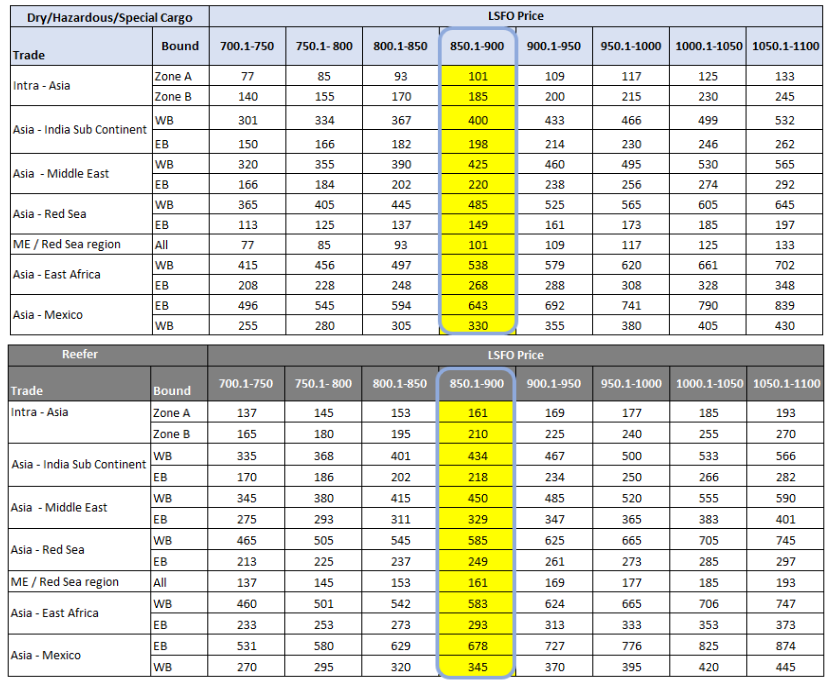
Under the latest rates, LGGR charges on some long-haul routes have reached several hundred dollars per container. The highest rate is USD 643 per container for non-reefer cargo and USD 678 per container for reefer cargo. On the Asia–Red Sea route, the charge is USD 485 per container for non-reefer cargo and USD 585 per container for reefer cargo. For freight forwarders and trading companies, environmental compliance costs are increasingly being reflected in actual shipping quotations.
Key Highlights
• September LGGR rates: RCL has announced its LGGR rates for September 2026.
• Highest rates: Charges reach USD 678 per container for reefer cargo and USD 643 per container for non-reefer cargo.
• Asia–Red Sea route: The charge is USD 485 per container for non-reefer cargo and USD 585 per container for reefer cargo.
• Higher long-haul charges: Rates are relatively high on routes including Asia–East Africa and Asia–Mexico.
• Rates remain subject to change: LGGR is adjusted in line with changes in low-sulphur fuel costs.
RCL’s September LGGR Rates Are Higher on Several Long-Haul Routes
According to RCL’s notice, the September 2026 LGGR rates were calculated based on the average low-sulphur fuel cost over the preceding three months. The applicable charges correspond to a low-sulphur fuel price range of USD 850.1–900 per tonne.
For dry cargo, dangerous goods, and special cargo, the highest LGGR is USD 643 per container on the eastbound Asia–Mexico route. The charge is USD 538 per container westbound from Asia to East Africa, USD 485 westbound from Asia to the Red Sea, USD 425 westbound from Asia to the Middle East, and USD 400 westbound from Asia to the Indian Subcontinent.
Charges on intra-Asia routes are significantly lower, at USD 101 per container for Zone A and USD 185 per container for Zone B. Overall, LGGR rates on long-haul routes are notably higher than those on regional services, with distance, voyage duration, and fuel consumption among the key factors affecting the charge.
Reefer Cargo Charges Are Higher, Reaching USD 585 per Container on the Asia–Red Sea Route
The LGGR rates announced by RCL for reefer cargo are generally higher than those for non-reefer cargo. The eastbound Asia–Mexico rate reaches USD 678 per container, the highest rate announced. The charge is USD 585 per container westbound from Asia to the Red Sea, USD 583 westbound from Asia to East Africa, USD 450 westbound from Asia to the Middle East, and USD 434 westbound from Asia to the Indian Subcontinent.
On the Asia–Mexico route, for example, the LGGR is USD 643 per container for non-reefer cargo and USD 678 for reefer cargo, a difference of USD 35 per container. For food, agricultural products, and other temperature-controlled cargo, these changes directly increase transportation costs and need to be calculated separately when preparing quotations.
Why Does RCL Charge LGGR?
LGGR reflects the additional fuel costs incurred by carriers in meeting international environmental requirements. Under relevant IMO requirements, the sulphur limit for marine fuel oil has been reduced from 3.5% to 0.5%. RCL stated that it will use compliant low-sulphur fuel and recover part of the resulting costs through LGGR.
LGGR is not a fixed charge. RCL stated that the surcharge is adjusted in line with changes in the market price of low-sulphur fuel oil (LSFO). Changes in fuel prices could therefore affect LGGR rates in subsequent months.
LGGR Adds Another Cost Variable to Freight Quotations
Following RCL’s announcement of its September LGGR rates, freight forwarders need to consider more than the base ocean freight when preparing quotations. Environmental surcharges have reached several hundred dollars per container, particularly on long-haul routes such as Asia–Red Sea, Asia–East Africa, and Asia–Mexico, as well as for reefer cargo.
Customers planning shipments in the near term should confirm the applicable LGGR rate, effective date, and cargo category before booking. This can prevent unexpected increases in the final logistics cost even when the base ocean freight remains relatively stable.
As the shipping industry continues its green transition, costs associated with low-sulphur fuel, alternative fuels, and other environmental requirements may continue to be reflected in carrier charges in different forms. Freight forwarders therefore need to calculate environmental surcharges separately when preparing ocean freight quotations.
Sources
RCL’s official notice, the International Maritime Organization, and publicly available industry information
Disclaimer
This article has been compiled from publicly available information and is provided solely for industry reference. Please refer to the carrier’s latest notice for the applicable charges.
Last
Series of Incidents at Chattogram Port Involve Five Vessels and Leave Nine Dead as Navigation Risks Rise
Several vessel and ship recycling incidents have recently occurred in and around Chattogram Port, Bangladesh. Between August 14 an
Next
Sanctioned Tankers Exit the Market at a Faster Pace as 22 Are Sold for Recycling in 2026
A notable shift is emerging in the global tanker market: more sanctioned vessels are entering the recycling market. According to C

