



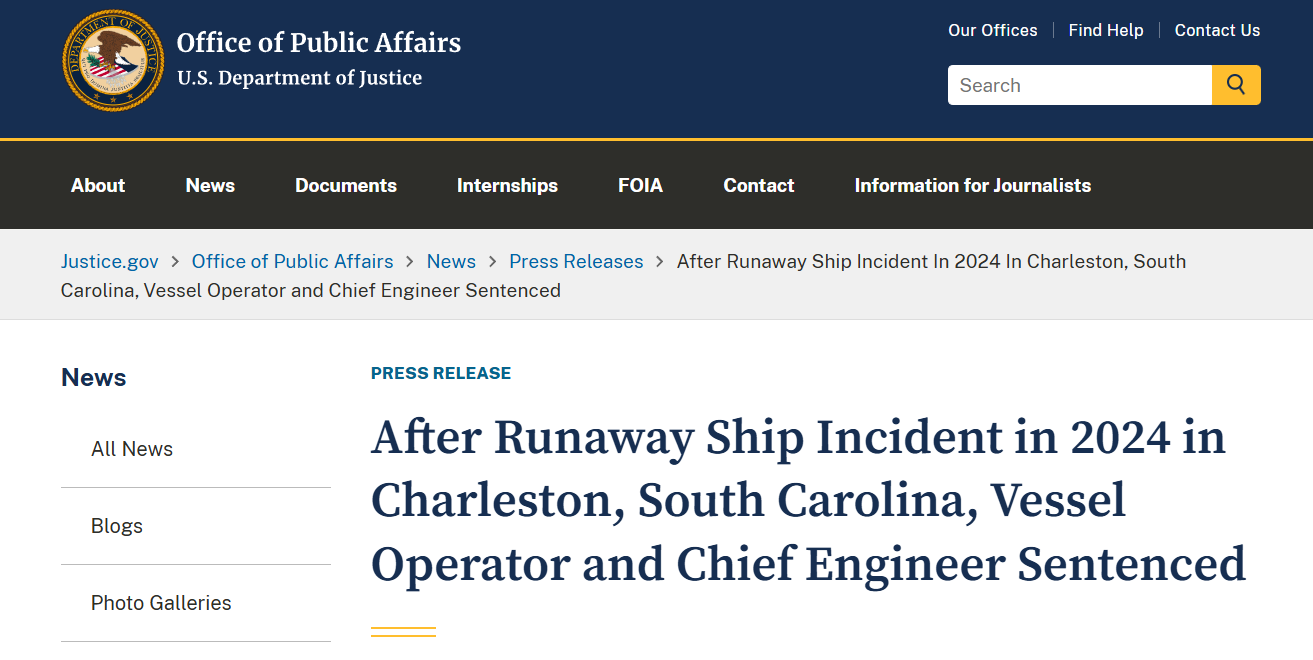
In June 2024, an MSC container ship lost speed control while departing the Port of Charleston in the United States and proceeded through the harbor at 16 to 17 knots, with the Arthur Ravenel Jr. Bridge ahead. The crew eventually regained control of the vessel, preventing a more serious accident. Two years later, the case has resulted in criminal penalties.
On August 10, local time, the U.S. Department of Justice announced that MSC Shipmanagement had pleaded guilty in federal court to failing to report a hazardous condition on board and obstructing the subsequent investigation. The company was sentenced to pay a USD 6 million criminal fine and serve four years of probation. The vessel’s chief engineer also pleaded guilty to related offences and was fined USD 2,000.
Key Highlights
• Speed control lost at 16 to 17 knots: MSC Michigan VII was unable to control its speed normally while departing the Port of Charleston.
• Bridge narrowly avoided: The vessel was heading toward the Arthur Ravenel Jr. Bridge, prompting authorities to take emergency evacuation measures.
• Technical cause identified: A main engine governor linkage became disconnected, preventing the crew from controlling the engine speed normally.
• Previous engine problems: The vessel had experienced earlier problems with main engine response, and personnel on board had manually adjusted the governor linkage.
• USD 6 million fine: The case involved both the failure to report a hazardous condition and obstruction of the accident investigation.
Why Did the 6,648 TEU Container Ship Lose Speed Control?
In June 2024, MSC Michigan VII departed the Port of Charleston after completing cargo operations. As the vessel turned to proceed along the Cooper River, the crew on the bridge found that they could no longer control the vessel’s speed normally. The approximately 304-metre-long container ship, with a capacity of around 6,648 TEU, then proceeded through the harbor at 16 to 17 knots as the situation rapidly escalated.
With the Arthur Ravenel Jr. Bridge ahead, local authorities closed and evacuated the bridge and cleared nearby beaches. The vessel’s wake also injured people ashore and damaged vessels and dock facilities along the river. The crew eventually regained control of the ship.
Was the Main Engine Governor System the Cause?
Investigations by the U.S. Coast Guard (USCG) and the National Transportation Safety Board (NTSB) found that the governor linkage connecting the main engine governor to the fuel rack had become disconnected. With the linkage detached, the engine continued running at a high speed, and the crew was unable to reduce the vessel’s speed through normal controls. This was identified as the direct technical cause of the incident.
The investigation also found that the failure had not occurred without warning. MSC Michigan VII had previously experienced problems with the main engine failing to respond accurately to speed commands from the bridge. In response, personnel on board had manually adjusted the length of the governor linkage, a practice that involved clear safety risks.
How Did a Minor Adjustment Lead to a Major Incident?
Investigators further found that locking washers designed to prevent the governor linkage from coming loose had been removed from both ends. One of the washers was later found by the U.S. Coast Guard on the deck beneath the governor.
The combination of equipment problems, manual adjustments, and missing safety components ultimately left the large container ship without normal speed control.
Viewed in isolation, the disconnected governor linkage may appear to have been an equipment failure. However, the full investigation identified broader issues in the vessel’s safety management, including how equipment problems were repaired, who was authorized to make adjustments, and whether the associated risks were reported promptly.
Why Did the Case Expand to Include Obstruction of the Investigation?
After the incident, U.S. investigators examined its causes. According to the U.S. Department of Justice, investigators asked the chief engineer whether the governor linkage had been manually adjusted, but he initially denied that any such adjustment had taken place. He later admitted that he knew the linkage had previously been adjusted manually.
The investigation also found that the chief engineer had instructed other crew members to provide answers consistent with the account previously given to investigators. The scope of the case therefore expanded from equipment and operational issues to the failure to report a hazardous condition and obstruction of the investigation. This was one of the reasons MSC ultimately faced criminal penalties.
Who Was Held Responsible for the USD 6 Million Fine?
According to the U.S. Department of Justice, MSC Shipmanagement was sentenced to pay a USD 6 million criminal fine and serve four years of probation. The company is also required to conduct a Root Cause Analysis of the hazardous condition aboard MSC Michigan VII to further assess the management issues behind the incident.
Chief engineer Fernando San Diego San Juan was fined USD 2,000 and subsequently returned to the Philippines. The judgment shows that U.S. regulators examined not only the marine incident itself, but also whether the company promptly reported the hazardous condition and cooperated truthfully with the subsequent investigation.
What Does the Incident Show About Maritime Safety Management?
For the global ocean shipping supply chain, a large container ship losing speed control within a port can quickly affect wider port operations. Bridges, terminals, other vessels, and subsequent sailing schedules may all be affected. A more serious collision could also lead to port congestion and cargo delays.
The case also shows that equipment failure is not the only source of risk. If abnormal conditions are not properly addressed, hazardous situations are not reported promptly, and investigators are not given accurate information, a technical problem can develop into corporate compliance and legal risks.
The USD 6 million fine further demonstrates that vessel safety management extends beyond shipboard operations. Failures in equipment maintenance, risk reporting, accident investigation, or corporate management can result in consequences far exceeding the original repair costs.
Sources
U.S. Department of Justice, U.S. Coast Guard (USCG), and National Transportation Safety Board (NTSB)
Disclaimer
This article is based on publicly available information and is provided solely for reference within the international logistics industry. It does not represent a final determination of responsibility concerning any company or individual mentioned.
Last
Strait of Hormuz Reopening Remains Uncertain as United States Claims Control and Iran Says Waterway Is Still Closed
Whether commercial shipping can resume through the Strait of Hormuz remains a key concern for the global shipping market. On Augus
Next
Maersk and Hapag-Lloyd Resume Red Sea Transits:AE19 Rerouted via the Suez Canal, Potentially Shortening Asia-Europe Transit Times
After more than a year of diversions around the Cape of Good Hope, routing on Asia–Europe services is beginning to change. On Augu