




Security risks in the Black Sea continue to worsen, prompting major liner companies to scale back their shipping operations in Ukraine. Hapag-Lloyd has officially announced that, due to the regional security situation, its feeder services to Ukrainian Black Sea ports have been fully suspended until further notice.
Following Maersk’s adjustment to its Ukraine logistics arrangements, Hapag-Lloyd has become another major carrier to suspend direct services to Ukrainian Black Sea ports. This signals a restructuring of Ukraine’s Black Sea shipping network, placing increasing pressure on regional logistics costs and transit times.
Key Highlights
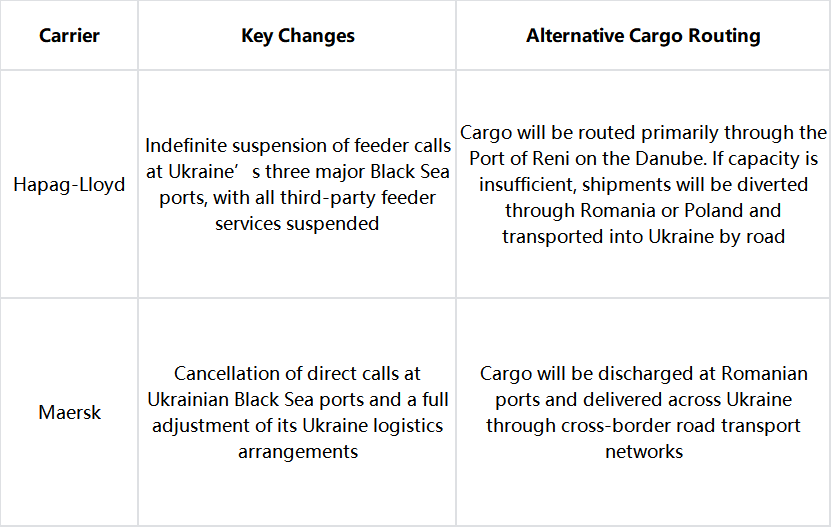
• Service suspension: Hapag-Lloyd has suspended feeder calls at the three major Ukrainian ports of Odesa, Chornomorsk and Pivdennyi
• Alternative arrangements: Cargo will be discharged primarily at the Port of Reni on the Danube, with Romania and Poland serving as alternative gateways for onward road transport into Ukraine
• Industry trend: Maersk and Hapag-Lloyd have both scaled back their operations, and direct Black Sea services to Ukraine are gradually being withdrawn
• Market impact: Longer transit routes, higher inland logistics costs, rising war risk surcharges and recurring shipment delays
Summary of Black Sea Service Adjustments by Two Major Carriers
Hapag-Lloyd Suspends All Feeder Services to Ukrainian Black Sea Ports
Introduction: Frequent air strikes on Black Sea ports and rising navigation risks have prompted Hapag-Lloyd to suspend its direct feeder services to Ukrainian Black Sea ports.
According to Hapag-Lloyd’s official announcement, the suspension covers the three major Ukrainian Black Sea ports of Chornomorsk, Odesa and Pivdennyi. All direct feeder services have been suspended, and the carrier is no longer accepting direct bookings to these ports.
The carrier will implement alternative cargo routing arrangements in stages. Cargo will be handled primarily through the Port of Reni on the Danube. If navigation conditions or handling capacity at the port are insufficient, shipments will be diverted through ports in Romania or Poland and transported into Ukraine by cross-border road transport for final delivery.
This is the second reduction in Hapag-Lloyd’s Ukraine operations. After the conflict began in 2022, the carrier suspended all Ukrainian Black Sea services. In May 2024, it resumed feeder services between Romania and Ukraine, mainly handling exports of agricultural products such as grain and sunflower oil.
Recently, attacks on merchant vessels and air strikes on Black Sea ports have occurred frequently, making it difficult to ensure the safety of terminal facilities and vessels. Based on risk control considerations, the carrier has therefore suspended all direct services.
Two Major Carriers Scale Back Operations as Ukraine’s Shipping Network Is Restructured
Introduction: Two major liner companies have rapidly scaled back their operations, bringing significant changes to Ukraine’s traditional direct Black Sea shipping model.
The latest adjustments are a significant indicator of the direction of the industry. One week earlier, Maersk had already adjusted its Ukraine logistics network by cancelling direct Black Sea port calls and routing all cargo through Romanian ports.
The simultaneous withdrawal of direct services by the two major carriers is reshaping Ukraine’s maritime transport system. The previous model of direct ocean services to Black Sea ports is being replaced by a multimodal transport network linking Romanian hubs, Danube river ports and overland routes through Poland.
Although Ukrainian authorities have stated that Black Sea ports remain open, navigation risks in the region remain high. Carriers continue to take a cautious approach, while international merchant vessels are actively avoiding the affected waters. As a result, the actual operating efficiency of Ukrainian Black Sea ports has declined significantly.
Regional Logistics Under Pressure as Costs and Transit Times Rise
Introduction: The suspension of direct services is forcing logistics arrangements to be restructured, increasing both transit costs and transport times.
The adjustment applies only to feeder services serving Ukrainian Black Sea ports and does not affect the main Asia-Europe ocean routes. However, it will have a significant impact on Ukraine’s import and export supply chains.
First, transport routes will become longer as additional transshipment and cross-border road transport stages are introduced, making schedule delays more common.
Second, overall logistics costs will increase. Inland transport and warehousing expenses, together with Black Sea war risk surcharges, will continue to push up shipping costs.
Third, capacity will tighten. Following the withdrawal of direct services, alternative routes have limited capacity, and shortages of vessel space and cross-border trucks may occur during peak periods.
In the longer term, as geopolitical risks in the Black Sea persist, multimodal transit arrangements are expected to become the main logistics option for cargo moving to and from Ukraine.
Operational Self-Check List for Freight Forwarders
• Review all in-transit cargo and pending bookings involving Ukrainian Black Sea ports, and promptly inform customers of service changes and additional transit costs
• Prepare alternative routing options through Romania, the Port of Reni on the Danube and border crossings in Poland to reduce reliance on direct services
• Closely monitor service and surcharge adjustment notices issued by major carriers and update quotations for Ukraine routes accordingly
• Secure cross-border trucking and transit warehouse capacity in advance, assess potential transit-time risks and allow sufficient contingency time for service fulfillment
Action Summary
Hapag-Lloyd and Maersk have both significantly scaled back their Ukrainian Black Sea services, leaving direct maritime services to Ukrainian Black Sea ports largely suspended. Regional logistics risks and transit costs continue to rise.
Freight forwarders should promptly switch to multimodal transit arrangements and keep customers informed of changes in costs and schedules. They may use the Inquiry Board to identify suitable capacity and transit solutions, use alternative logistics routes to mitigate the risks caused by service reductions, and maintain stable cargo delivery to Ukraine.
Sources: Official Hapag-Lloyd customer notice, Maersk service adjustment announcement and publicly available maritime industry reports
Disclaimer: All information is obtained from publicly available sources and is provided for industry reference only. It does not constitute commercial or logistics operational advice.
Last
August 2026 Update on the Strait of Hormuz and Red Sea Routes: Limited Resumption, but Risks Remain
Ship-to-ship transfer activity near the Strait of Hormuz has increased sharply, while two Saudi oil tankers have transited the Bab
Next
Strait of Hormuz Shipping Alert! Successive Security Incidents Raise Risks to LNG and Energy Shipping
Security concerns have again emerged along a key global energy shipping route. On July 31 local time, two vessel security incident

