



A new development has emerged in Middle East cross-border shipping. On July 28, The Wall Street Journal reported that Iran had formally rejected an Oman-led proposal for the joint management of the Strait of Hormuz, overturning industry expectations that navigation would resume once a ceasefire was reached. The decision means that even if military tensions in the Middle East gradually ease, navigation through the Strait of Hormuz will not return to the pre-conflict system of unrestricted passage. New control rules for the strait are expected to be introduced, directly affecting daily shipment arrangements and cost calculations for cross-border freight forwarders and foreign trade companies handling Middle East energy routes.
Key Highlights
• Major Policy Change: Iran rejects the proposed joint management mechanism for the Strait of Hormuz, bringing the pre-conflict navigation model to an end
• Stronger Sovereign Control: Iran retains control over the strait and rejects external involvement in shipping management
• Longer Navigation Recovery: A ceasefire does not mean an immediate resumption of navigation, as mine clearance and the restructuring of navigation rules will take time
• Cost Pressure on Freight Forwarders: Shipping risks, insurance premiums, and rerouting costs are rising, requiring earlier risk planning
Key Information on the Strait Policy
Joint Management Proposal Rejected, Restructuring Navigation Rules in the Strait
Core Conclusion: Iran is firmly retaining control over the strait. After the conflict, the Strait of Hormuz will move away from unrestricted passage without intervention, and maritime controls will enter a new phase.
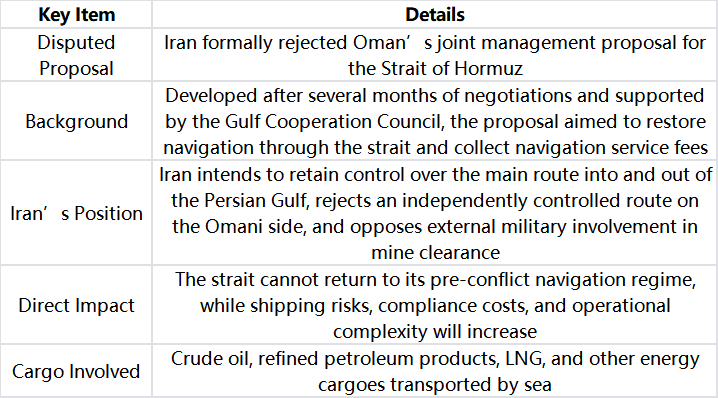
As one of the world’s key energy shipping corridors, the Strait of Hormuz handles more than one-fifth of global crude oil, refined petroleum products, and LNG shipments. It is a major route for cross-border logistics in the Middle East and directly affects global energy trade and freight forwarding costs. Oman had previously led several months of negotiations and worked with the Gulf Cooperation Council on a joint management proposal. The plan involved using external military forces to clear mines from the shipping lanes, establishing a joint management system, and collecting vessel service fees to maintain operations and restore regular post-conflict shipping.
The proposal was once regarded by the industry as the preferred option for restoring navigation through the strait, but Iran firmly rejected it. Iran’s deputy foreign minister stated publicly that the strait would not be allowed to return to the pre-conflict system of unrestricted passage. Iran also rejected an independently controlled route on the Omani side and opposed external military involvement in mine clearance, retaining full control over navigation through the strait and restructuring its shipping rules.
Core Dispute: Control of the Shipping Lanes, Not Whether a Ceasefire Is Reached
Core Conclusion: The main dispute is not the timing of a ceasefire, but sovereignty over the strait and control over its navigation rules. The post-conflict shipping regime will be comprehensively reshaped.
Previously, navigation through the Strait of Hormuz followed the internationally recognized Traffic Separation Scheme, with designated merchant shipping lanes and transparent navigation rules. This provided an important basis for stable shipments on Middle East routes. During the latest regional conflict, however, Iran disrupted shipping operations through military action, leaving large numbers of vessels stranded and services suspended, and bringing the normal navigation regime to a halt.
Iran insists on retaining full control over shipping routes into and out of the Persian Gulf and has rejected all forms of external joint management. Future navigation through the strait may be subject to new mandatory requirements, including security inspections, sailing instructions, and passage controls. Previous shipment practices will therefore no longer be workable. As the changing situation makes quotations more difficult, freight forwarders can use the Inquiry Board to access current market rates and cargo opportunities, improving quotation accuracy and business stability.
Freight Forwarders Face a Time Gap Between a Ceasefire and the Resumption of Normal Navigation
Core Conclusion: Even if military tensions ease, mine risks, gaps in navigation rules, and disputes over control will continue to delay the full resumption of navigation through the strait.
A common misconception in the logistics industry is that navigation can resume quickly once hostilities end. In practice, Iran’s opposition to external military involvement in mine clearance means that remaining mine risks in the strait may not be fully removed, leaving long-term safety concerns in the surrounding waters. At the same time, new navigation control rules have not yet been introduced, while vessel passage standards and risk assessment systems remain undefined, significantly slowing the recovery of navigation.
With multiple risks overlapping, the strait is likely to remain in a transitional period of limited navigation and gradual recovery. Restrictions on vessel passage, higher war-risk insurance premiums, and rising chartering and rerouting costs will make quotation calculations, order fulfillment, and customer management more difficult for freight forwarders. International crude oil prices and logistics premiums on Middle East routes are also continuing to rise, adding further cost pressure on foreign trade and logistics companies.

Operational Self-Check List for Freight Forwarders
• Have you informed customers of the latest controls in the Strait of Hormuz and adjusted quotations and delivery expectations in advance?
• Have you reviewed existing orders on Middle East energy routes and assessed the risks of rerouting, service suspension, and higher insurance premiums?
• Are you continuing to monitor new navigation rules and mine clearance progress and adjusting shipment plans accordingly?
• Have you secured alternative route resources in advance to reduce the risk of fulfillment failures caused by the suspension of a single shipping route?
Overall, Iran’s rejection of the joint management proposal marks the end of the pre-conflict unrestricted navigation model in the Strait of Hormuz and a restructuring of Middle East energy shipping. The shipping market can no longer follow the simple assumption that navigation will resume immediately after a ceasefire. Navigation controls, safety risks, and logistics costs are likely to remain volatile for an extended period. Freight forwarders specializing in Middle East routes will need to establish dynamic risk control systems, closely monitor developments, and optimize shipment arrangements to maintain business stability and avoid losses.
Action Summary: Cross-border freight forwarders should promptly adjust their Middle East route strategies, move away from fixed quotation models, monitor navigation rules and security developments in the Strait of Hormuz in real time, prepare contingency plans in advance, and adjust shipment arrangements flexibly to reduce business disruption caused by geopolitical developments.
Sources: The Wall Street Journal, Iran’s Ministry of Foreign Affairs, the Gulf Cooperation Council, and authoritative cross-border logistics industry platforms
Disclaimer: All information is sourced from publicly available channels and is provided for industry reference only. It does not constitute commercial or logistics operational guidance.

Last
Sudden Reversal: Houthis Deny General Red Sea Transit Fee Plan as Bab el-Mandeb Controls Tighten, Raising Route Risks and Costs for Freight Forwarders
The Red Sea shipping situation has taken a sudden turn. On July 29, Reuters reported that Yemen’s Houthis were considering chargin
Next
Chattogram Port Suspends Storage Fee Increase: Bangladesh Route Logistics Costs Stabilize as Freight Forwarders Review the Policy Change
The latest logistics policy development at Chattogram Port has been confirmed. Bangladesh’s largest port and key logistics hub has