




Compliance requirements for cross-border logistics in Africa are tightening again as Kenya introduces a new import control system.
Maersk recently issued a customer advisory regarding a new requirement introduced by the Kenya Revenue Authority (KRA). From August 3, 2026, all containerized cargo imported through Kenyan ports must complete an Advance Cargo Declaration (ACD) before loading.
The new rule changes the shipping process for Kenya-bound cargo by moving destination customs compliance requirements to the pre-loading stage. Cargo that has not been declared as required, or whose bill of lading does not show the required reference code, may face customs clearance delays, penalties, and other risks. The rule imposes mandatory compliance requirements on freight forwarders and exporters.
The policy is part of Kenya’s move toward digital customs supervision. It marks a shift from completing compliance procedures after shipment to conducting advance reviews before loading, with ACD information linked directly to shipping documents. Booking, documentation, shipment, and customs clearance procedures for Kenya-bound cargo will all need to be adjusted.
Key Highlights
• Mandatory implementation: From August 3, all containerized cargo imported into Kenya must complete an ACD filing.
• Mandatory bill of lading requirement: The 15-character ACD reference code must be obtained before loading and clearly shown on the original bill of lading.
• Shipping process changes: Compliance review moves to the pre-loading stage, adding declaration, verification, and reference-code linkage requirements.
• Clear non-compliance risks: Failure to file an ACD or inconsistencies between documents may result in customs clearance delays and penalties.
• Complete documentation required: Four core documents must be submitted, and the information across all documents must be fully consistent.
Key Requirements: ACD Filing Becomes a Mandatory Pre-Shipment Requirement
Key conclusion: The ACD reference code is required for the shipment and customs clearance of Kenya-bound cargo. Cargo without a valid code, or without the code shown on the bill of lading, will not meet the applicable customs clearance requirements.
According to the official notice issued by the Kenya Revenue Authority and the operating guidelines released by Maersk, the Advance Cargo Declaration requirement applies to all containerized cargo destined for Kenyan ports.
There are no exemptions based on cargo type, route, or shipment volume.
All containerized cargo imported into Kenya must complete the online declaration and fee verification process before loading and obtain an official 15-character ACD reference code.
The code must be linked to the bill of lading before shipment. The final original bill of lading must clearly show the complete ACD reference code, which will be checked during customs clearance at destination.
The ACD reference code follows a fixed 15-character alphanumeric format and can be traced through the system. An example is:ACDKE2026004324
The code contains a category prefix, the Kenya country code, the declaration year, and a system-generated serial number. Each shipment requires a unique code, which cannot be reused.
Companies must apply through the official KRA ACD platform. The process consists of four main steps:
Platform registration → Submission of all required documents → Payment and fee verification → Approval and issuance of the ACD certificate and reference code
The entire process must be completed before loading. Retroactive filing after shipment is not available.
Four documents are required:
1.Draft Bill of Lading
2. Commercial Invoice
3. Freight Invoice
4. Export Declaration

Industry Shift: Compliance Review Moves to the Pre-Loading Stage, Restructuring Existing Shipping Procedures
Key conclusion: Compliance requirements for Kenya-bound cargo have moved forward in the shipping process. Booking, documentation, and shipment schedules must be adjusted, leaving little room for errors.
Before the ACD requirement was introduced, compliance checks for imports into Kenya were mainly carried out during customs clearance after arrival.
At the export stage, companies generally only needed to complete standard booking, export customs declaration, and shipment procedures. Documents could be completed or corrected later in the process.
Under the new rule, the original logistics process will be restructured, with ACD filing becoming a mandatory step before shipment.
All cargo must complete the required declaration and reference-code linkage before loading, final bill of lading confirmation, and shipment. This replaces the traditional process of shipping cargo first and completing destination compliance checks later.
Freight forwarders and exporters must therefore prepare all required documents in advance and allow sufficient time for filing, review, and correction. Existing shipment schedules and document preparation procedures will need to be adjusted.
The new rule also imposes strict document consistency requirements.
Information submitted in the ACD filing must fully match the final bill of lading, commercial invoice, export declaration, and other supporting documents.
Any discrepancy, data mismatch, or subsequent document amendment may trigger a further review, supplementary filing, or bill of lading amendment.
These additional procedures may delay the shipment and result in extra handling costs. In serious cases, they may affect customs clearance and customs release.
Non-Compliance Risks: Missing or Incorrect ACD Filings Carry High Costs
Key conclusion: Failure to comply may result in penalties, cargo being held at port, and order fulfillment problems.
Maersk has stated that the new requirements will be strictly enforced from August 3.
Cargo without a completed ACD filing, cargo whose bill of lading does not show a valid reference code, or cargo supported by inaccurate declaration information will face the following risks:
Customs Penalties
The Kenya Revenue Authority and Kenyan customs authorities may conduct inspections of non-compliant cargo.
Companies involved in missing declarations, falsified documents, or inconsistent information may face administrative penalties.
Customs Clearance Delays
Cargo without a valid ACD reference code may not be accepted for customs clearance at destination.
The cargo may be held at the port and incur substantial demurrage, detention, and port storage charges.
Order Fulfillment Risks
Delivery delays may result in customer complaints, contractual defaults, disputes over outstanding payments, and other operating problems.
Operational Alerts and Recommended Actions for Freight Forwarders: Comparison of Previous and New Compliance Procedures for Kenya-Bound Cargo
Compliance controls on African routes continue to tighten, and Kenya’s ACD requirement is a clear example of compliance checks being moved to the beginning of the shipping process.
As the parties responsible for frontline operations, freight forwarders must update their existing practices, implement compliance controls throughout the shipping process, understand the differences between the previous and new procedures, and reduce operating risks.
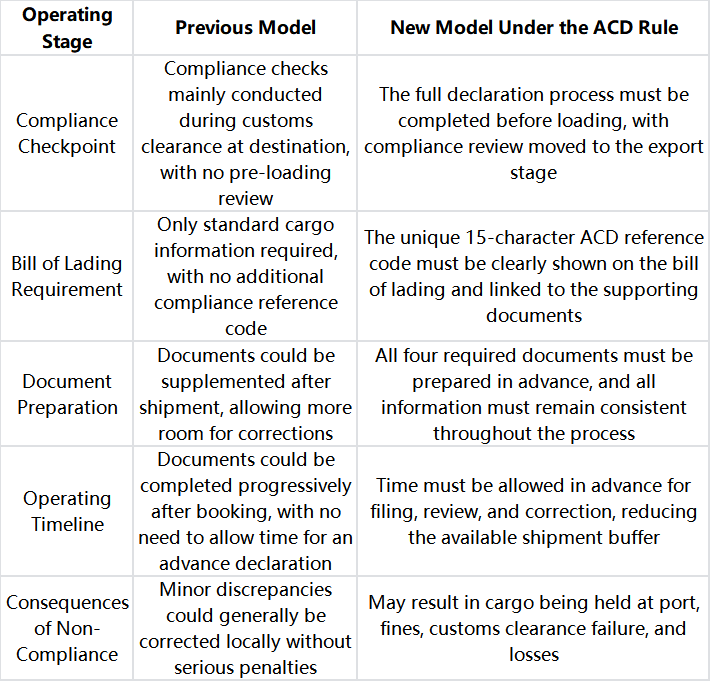
For customers planning shipments to Kenya, freight forwarders should explain the new requirements in advance and manage expectations.
They should review all current orders, particularly containerized cargo scheduled for loading on or after August 3, and begin the ACD filing process in advance.
Kenya’s new requirements allow very little room for documentation errors and place greater demands on local declaration and customs clearance capabilities.
Freight forwarders can use the platform’s Company Directory to identify reliable local partners in Africa with experience in compliance procedures for Kenya-bound cargo.
Working with experienced compliance service providers can help reduce declaration errors and customs clearance risks and maintain stable operations on Kenya routes.
Three Self-Check Questions for Freight Forwarders
• Are shipment dates being managed accurately? Have shipments before and after August 3 been identified, with ACD filings arranged in advance for cargo covered by the new rule?
• Are all documents fully compliant and consistent? Have the four required documents been prepared in advance, with matching information on the bill of lading, invoices, export declaration, and ACD filing?
• Have internal procedures been adjusted? Has sufficient time been allowed for ACD filing, review, corrections, and bill of lading amendments?
Industry Summary
Overall, destination compliance requirements are increasingly being moved to the pre-shipment stage, with import controls gradually shifting from post-arrival checks to advance review.
The implementation of Kenya’s ACD requirement further raises the compliance threshold for African routes.
Logistics companies must adapt to the new requirements and improve document preparation, process control, and customer notification throughout the shipping process.
Standardized compliance procedures can help reduce the risks of fines, cargo being held at port, contractual defaults, and shipment delays and support the stable movement of Kenya-bound cargo.
Sources: Kenya Revenue Authority, official Maersk announcement, authoritative cross-border logistics industry platforms
Disclaimer: This content is based on publicly available information and is provided for industry reference only. It does not constitute commercial or logistics operating advice.

Last
Red Sea Shipping Risks Escalate: RCL Cancels Sailing and Invokes Force Majeure; Shippers to Bear Additional Costs
Security conditions in the Red Sea have deteriorated again, with regional shipping risks escalating from delay warnings to actual

Next
Black Sea Shipping Risks Escalate as Grain Vessel Sinking Impacts Route Insurance and Supply Chains
Geopolitical tensions in the Black Sea continue to intensify, bringing another major black swan event to regional shipping. Follow

