




What Defines a Modern International Air Freight Solution?
A modern International Air Freight Solution is an end-to-end, customizable logistics framework that integrates booking, customs clearance, ground handling, tracking, and last-mile delivery for cross-border air cargo. It prioritizes dispatch speed, regulatory compliance, cost transparency, and real-time visibility to adapt to 2026’s dynamic trade environment, serving high-value, time-critical shipments across global routes.
This solution differentiates itself from traditional air freight services by combining flexible capacity sourcing, digital automation, and regional compliance expertise to cut transit times and reduce human-induced delays. Forwarders need to note that a one-size-fits-all model is obsolete in 2026; the most effective solutions are segmented by cargo type (general, dangerous goods, cold chain), route priority, and client industry.
A common misconception is that faster dispatch only relies on direct flights, while in reality, streamlined documentation and pre-clearance processes reduce lead times by 30% more than flight selection alone. This highlights the need for a holistic approach that encompasses both air and ground operations.
Why Is Agile Air Freight Dispatch Critical for Forwarders in 2026?
Agile air freight dispatch is the ability to adjust capacity, routing, and workflows in real time to minimize cargo dwell time and meet tight delivery deadlines for global shippers. As global trade growth moderates and competition intensifies, dispatch speed directly impacts customer retention, pricing power, and operational profitability for freight forwarding enterprises of all sizes.
According to WTO (2026) projections, global goods trade growth will slow to 1.9% amid geopolitical tensions and energy price fluctuations, making service quality the key differentiator. UNCTAD (2025) data shows that global trade value exceeded $35 trillion for the first time in 2025, with time-sensitive air cargo accounting for over 35% of total trade value by commodity worth.
For forwarders, delayed dispatch not only leads to client penalties but also risks losing market share to competitors with optimized International Air Freight Solution systems. Recommended practice is to align dispatch agility with regional demand trends. IATA (2025) data confirms that Asia-Europe air freight volume surged by 10.3% year-on-year, while Asia-North America volume declined by 0.8%, requiring forwarders to reallocate capacity and streamline dispatch workflows for high-growth routes.
What Are the Core Challenges Slowing Down Air Freight Dispatch?
• Regulatory Compliance Delays: Caused by incomplete customs documentation, inconsistent HS code classification, and unupdated cross-border trade policies across importing and exporting nations. These delays account for 40% of all dispatch holdups, per IATA (2026) industry reports.
• Capacity Constraints: Driven by tight global air cargo supply, with IATA (2026) reporting 8.5% year-on-year capacity growth lagging behind 11% demand growth in February 2026. This imbalance has led to spot rate volatility and reduced flexibility for last-minute bookings.
• Manual Workflow Inefficiencies: Paper-based documentation, manual booking, and offline tracking extend processing time by 40% on average. Forwarders still relying on legacy systems face a competitive disadvantage in 2026’s digital-first landscape.
• Cargo Specialization Barriers: For DG (dangerous goods), cold chain, and oversized cargo, the lack of standardized handling protocols and certified ground teams leads to extended dwell times at hubs. IATA estimates that specialized cargo delays are 2.5 times longer than general cargo delays.
• Geopolitical Disruptions: Route rerouting, increased fuel costs, and port congestion triggered by regional conflicts disrupt scheduled dispatch timelines. In Q1 2026, 15% of transatlantic air freight routes required rerouting due to geopolitical tensions, per Freightos (2026).
Forwarders should note that 60% of dispatch delays originate from pre-shipment processes rather than flight operations. The recommended approach is to conduct a full-process bottleneck audit, focusing on documentation and customs pre-clearance, rather than solely negotiating flight space.
How to Build a Scalable International Air Freight Solution for Rapid Dispatch?
1. Segment Cargo & Client Portfolios: Design tiered service packages, separating express air freight, standard air freight, and economy charter services based on delivery time requirements. This segmentation ensures resources are allocated to high-priority shipments, reducing dispatch delays for critical cargo.
2. Secure Flexible Capacity: Establish long-term contracts with airlines (securing 60–70% of required capacity), partner with global cargo consolidators for spot capacity, and maintain on-demand charter backup for peak seasons (e.g., holiday periods, industry-specific surges).
3. Digitize End-to-End Workflows: Adopt API-integrated booking systems, electronic airway bills (e-AWB), and blockchain-based documentation to eliminate manual data entry errors. IATA (2026) reports that 100% e-AWB adoption reduces documentation processing time by 50%.
4. Implement Pre-Clearance Customs Protocols: Submit declaration documents 24–48 hours before cargo arrival, leveraging authorized economic operator (AEO) certifications for priority clearance. AEO-certified forwarders experience 30% faster customs processing, per WCO (2025).
5. Standardize Special Cargo Handling: Train ground teams for DG, cold chain, and oversized cargo, and partner with IATA-certified handling agents at major hub airports. This reduces specialized cargo handling errors by 70% and shortens dwell times.
6. Establish Real-Time Monitoring Systems: Use GPS tracking, temperature sensors, and exception alerts to resolve delays within 1 hour of detection. Real-time visibility reduces delay resolution time by 65%, according to a 2026 Xeneta industry survey.
7. Optimize Last-Mile Connectivity: Integrate local trucking fleets and cross-border courier networks to minimize airport-to-door transit time. For European routes, partnering with regional LSPs (Logistics Service Providers) reduces last-mile delays by 40%.
A critical mistake forwarders make is overinvesting in flight capacity while neglecting ground handling optimization. Data shows that pre-clearance and digital documentation can reduce total dispatch lead time by 2–3 business days for cross-border air shipments, delivering a faster ROI than additional flight capacity.
What Are the Key Service Models in Premium Air Freight Solutions?
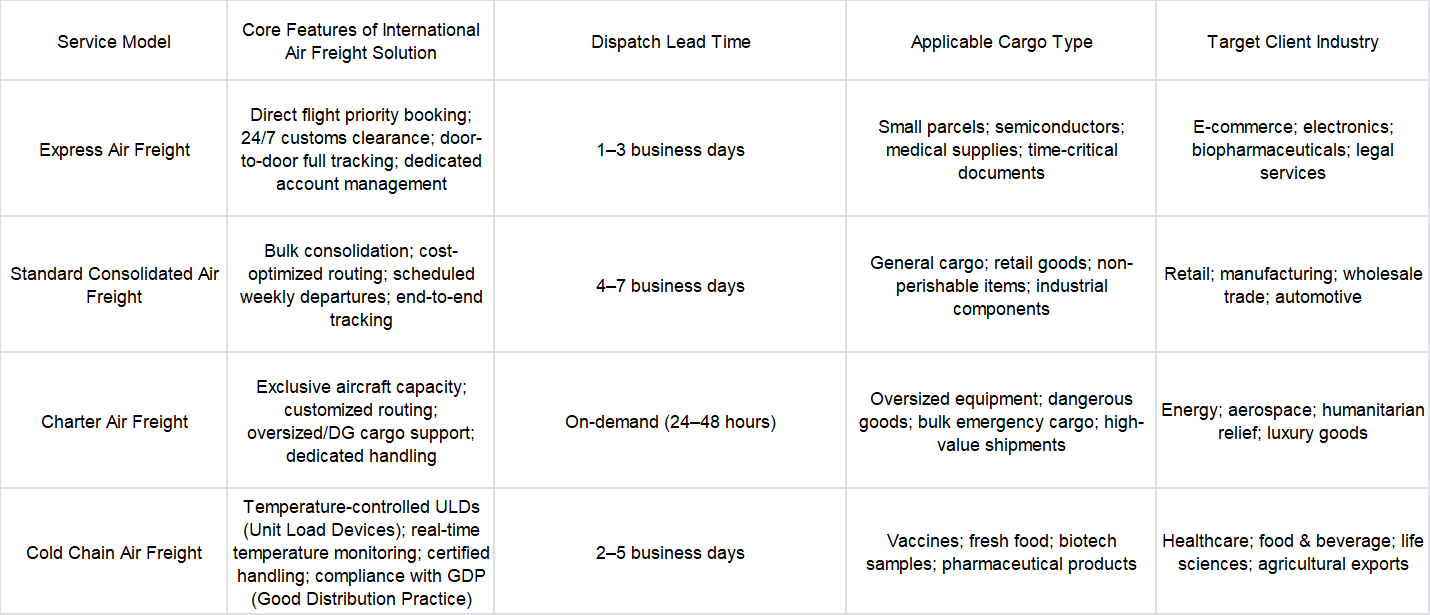
Forwarders need to note that consolidated air freight offers the best balance of cost and speed for 70% of general cargo shipments, while charter services should be positioned as a high-margin premium solution rather than a regular offering. The recommended pricing strategy is to bundle value-added services (customs clearance, insurance, cargo insurance) into each model to improve profit margins instead of competing on basic freight rates.
What Compliance Risks Must Forwarders Avoid in Air Freight Operations?
Compliance is the non-negotiable foundation of a reliable International Air Freight Solution, as regulatory violations result in cargo detention, financial fines, and permanent damage to a forwarder’s global reputation. In 2026, the highest compliance risks stem from cross-border sanctions, dangerous goods regulations, and electronic data submission mandates.
Key Compliance Risk Areas & Mitigation
• IATA DGR Compliance: Strictly follow the latest Dangerous Goods Regulations (DGR 67, 2026 edition) for classification, packaging, and labeling. Non-compliance leads to cargo confiscation, airline blacklisting, and fines of up to $100,000 per violation, per IATA.
• Sanctions & Export Control: Screen all shipments against UN, EU, and US sanction lists (e.g., OFAC SDN List, EU Sanctions List) to avoid restricted destination and consignee violations. A 2026 survey by the International Federation of Freight Forwarders Associations (FIATA) found that 8% of forwarders faced sanctions-related fines in 2025.
• e-AWB Mandates: Comply with 100% electronic airway bill requirements at major global hubs (e.g., Frankfurt, Singapore, Dubai). Paper AWBs cause 25% of customs clearance delays in 2026, per IATA’s e-AWB Adoption Report (2026).
• Country-Specific Rules: Adhere to regional import regulations, such as EU CE certification, US FDA registration for medical goods, and China GB standards for regulated commodities. Failure to comply with country-specific rules results in 30% of cargo detentions, according to UNCTAD (2026).
A common misconception is that compliance responsibility lies solely with the shipper. In practice, freight forwarders bear joint liability for documentation accuracy and regulatory adherence. The recommended practice is to deploy an AI-powered compliance screening tool to automate sanction checks and document validation 24/7, reducing human error by 80%.
How to Leverage Technology to Optimize Your Air Freight Solution?
Digital transformation is the most cost-effective way to boost dispatch speed and operational efficiency, with IATA data showing that fully digital forwarders reduce operational costs by 28% and improve on-time dispatch rates to 98%. For global forwarders, technology integration should focus on automation, visibility, and data analytics to build a future-proof International Air Freight Solution.
Key Technology Integrations for 2026
• API Booking Integration: Connect directly to airline GDS (Global Distribution System) systems for real-time capacity checking, instant booking confirmation, and dynamic rate updates. This eliminates manual booking errors and reduces booking time from hours to minutes.
• AI Document Verification: Use OCR (Optical Character Recognition) and AI tools to auto-validate commercial invoices, packing lists, and customs declarations. These tools reduce document errors by 90% and cut verification time by 75%, per a 2026 Gartner report.
• Cloud-Based TMS: Deploy a Transportation Management System (TMS) to centralize order management, carrier collaboration, and financial settlement across global branches. Cloud-based TMS enables real-time collaboration between regional teams, reducing communication delays by 60%.
• IoT Cargo Tracking: Attach smart sensors to high-value cargo for real-time location, temperature, and shock monitoring, with automated exception alerts. IoT tracking reduces cargo loss and damage by 45% and improves client satisfaction by 35%, according to Xeneta (2026).
• Predictive Data Analytics: Analyze historical route performance, demand trends, and delay risks to proactively adjust routing and capacity allocation. Predictive analytics can reduce dispatch delays by 25% by identifying potential bottlenecks before they impact cargo, per Freightos (2026).
Forwarders should note that technology adoption does not require full-scale overhauls. The recommended phased approach is to prioritize e-AWB and pre-clearance automation first, as these deliver the fastest ROI within 3 months of implementation. Small and mid-sized forwarders can leverage SaaS-based logistics platforms to avoid high upfront IT investment.
What Cost Optimization Strategies Work for 2026 Air Freight Dispatch?
Cost efficiency is critical to maintaining profitability while delivering fast dispatch services, as fuel price volatility and capacity tightness keep air freight rates elevated in 2026. The goal of cost optimization is not to cut service quality but to eliminate wasteful spending and maximize resource utilization within the International Air Freight Solution framework.
According to Xeneta (2026) data, Asia-Europe air freight rates have risen by 15–25% due to regional conflicts and rerouting, making cost control a top priority. Forwarders need to avoid the mistake of sacrificing speed for low-cost indirect flights, as delayed deliveries result in higher client compensation costs than premium direct flight fees.
Proven Cost Optimization Tactics
• Consolidate Cargo: Combine small consignments into consolidated air cargo shipments to reduce per-unit shipping costs. Consolidation can lower freight costs by 15–20% while maintaining dispatch speed for standard cargo.
• Lock in Long-Term Contracts: Secure long-term agreements with airlines to hedge against spot rate fluctuations. Forwarders with 2+ year contracts report 10–12% lower average rates than those relying on spot bookings, per IATA (2026).
• Optimize Packaging: Minimize volumetric weight charges by using lightweight, space-efficient packaging. Volumetric weight optimization reduces shipping costs by 8–10% for high-volume, low-weight cargo (e.g., e-commerce parcels).
• Bundle Value-Added Services: Package customs clearance, cargo insurance, and tracking services into a single offering to increase bundled revenue. Forwarders that bundle services report 20% higher profit margins than those offering standalone air freight.
• Shift to Off-Peak Schedules: Move low-priority cargo to off-peak flight schedules (e.g., overnight, weekend flights) to access discounted rates. This strategy reduces costs by 10–15% without compromising delivery timelines for non-critical shipments.
Conclusion
In 2026’s complex and competitive global logistics landscape, agility, speed, and compliance define the success of every global freight forwarder. A well-crafted, technology-driven, and compliance-focused International Air Freight Solution is the ultimate tool to accelerate cargo dispatch, mitigate operational risks, and secure long-term client partnerships. By segmenting service models, digitizing workflows, adhering to global regulations, and optimizing capacity utilization, forwarders can not only meet the growing demand for fast air freight services but also stand out in a market where service quality surpasses price as the key competitive factor.
As global supply chains continue to evolve, investing in a scalable and adaptive International Air Freight Solution will remain the core strategy for forwarders to achieve sustainable growth and global market expansion. By prioritizing agility and innovation, forwarders can turn 2026’s industry challenges into opportunities to differentiate themselves and drive long-term profitability.
Last
From Ground to Cloud: Integrating Smarter International Solutions into Seamless Air Freight Tracking
In the fast-paced world of global logistics, freight forwarders are under constant pressure to deliver transparency, efficiency, a
Next
Optimizing Global Trade: How the Right International Solution for Sea Freight Can Cut Your Transit Times
In the complex landscape of global trade, freight forwarders are constantly navigating tight deadlines, unpredictable disruptions,

