




In the complex landscape of global trade, freight forwarders are constantly navigating tight deadlines, unpredictable disruptions, and the pressure to deliver cargo efficiently. With maritime transport accounting for around 80% of global trade by volume, the right International Sea Freight Solution is not just a convenience—it’s a strategic necessity that directly impacts transit times, client satisfaction, and bottom-line profitability. For forwarders looking to gain a competitive edge, understanding how to leverage these solutions to streamline operations and reduce delays is critical in today’s fast-paced trade environment.
What Is an International Sea Freight Solution for Freight Forwarders?
An International Sea Freight Solution is a comprehensive, tailored service package designed to manage the end-to-end process of maritime cargo transport for freight forwarders, encompassing everything from cargo booking and route planning to customs clearance, port handling, and real-time shipment tracking. It integrates carrier partnerships, digital tools, and logistical expertise to address the unique challenges forwarders face, such as port congestion, documentation errors, and unpredictable transit delays, with the core goal of optimizing efficiency and reducing delivery times.
Why Do Transit Time Delays Plague Freight Forwarders in International Sea Freight?
Transit time delays are a persistent pain point for freight forwarders, often stemming from a combination of systemic issues, external disruptions, and inefficient processes. These delays not only damage client trust but also increase operational costs, including storage fees, detention charges, and missed business opportunities. To address this, forwarders must first understand the root causes of these delays and how a targeted International Sea Freight Solution can mitigate them.
What Are the Primary Causes of Transit Time Delays?
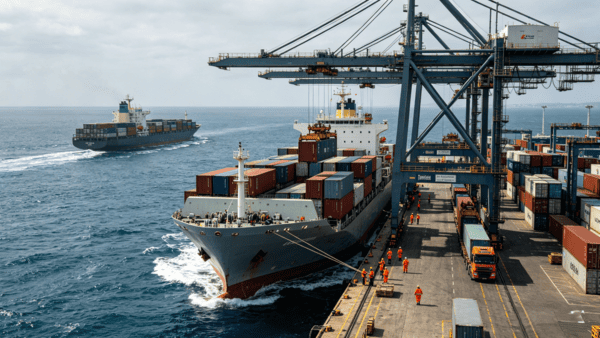
According to UNCTAD’s 2025 Review of Maritime Transport, the global maritime industry continues to face sustained disruptions, with the Suez Canal operating at around 70% below average tonnage transit levels compared to 2023. The average voyage haul increased from 4,831 miles in 2018 to 5,245 miles in 2024 due to security concerns reshaping shipping routes, significantly extending transit times.
Port congestion has become a chronic issue rather than an episodic one, per UNCTAD data. In 2025, major ports worldwide reported an average berthing delay of 3.5 days, up from 3.2 days in 2024, as terminals struggle to handle rising cargo volumes amid infrastructure constraints. This congestion directly adds to transit times, as vessels wait days to dock and unload.
Documentation errors are another major contributor to avoidable delays. APT Logistics notes that customs clearance delays due to incomplete or incorrect paperwork can hold up cargo for 3 to 7 days on average, making it one of the top preventable causes of transit time loss for forwarders.
Carrier reliability and capacity constraints further exacerbate delays. The Freightos Baltic Index (FBX) reported in its Q1 2026 update that transatlantic rates spiked 55% in a single week, partly due to limited capacity and peak-season surcharges. This forces forwarders to select less efficient carriers to meet cost targets, ultimately extending transit times by 5 to 10 days on key routes.
Poor route planning and a lack of real-time visibility into shipment status also lead to missed connections and unnecessary delays. Without access to up-to-date data on vessel schedules and port conditions, forwarders cannot anticipate disruptions until they occur.
Freight forwarders should note that many of these delays are not inevitable. While external factors like geopolitical tensions and weather events are beyond control, the right International Sea Freight Solution can help forwarders anticipate disruptions, optimize routes, and streamline processes to minimize their impact on transit times.
How Can the Right International Sea Freight Solution Cut Transit Times?
A well-designed International Sea Freight Solution addresses the root causes of transit time delays by integrating advanced technology, strategic carrier partnerships, and proactive logistical planning. For freight forwarders, this means moving beyond basic booking services to a holistic approach that optimizes every stage of the shipping process. Below are the key strategies that such solutions employ, along with actionable steps for forwarders to implement.
What Strategic Steps Can Forwarders Take to Reduce Transit Times?
• Optimize Port Selection and Avoid Congested Hubs: The right International Sea Freight Solution provides access to real-time port data, including berthing delays, throughput rates, and congestion levels, allowing forwarders to choose alternative ports when necessary. For example, if the Port of Los Angeles is experiencing significant delays (averaging 4.8 days in Q1 2026, according to the port’s official website), a solution with multi-port access can redirect cargo to the Port of Long Beach, which had an average berthing delay of 2.3 days in the same period. Recommended practice: Forwarders should partner with solution providers that have a global network of port partnerships, enabling seamless switching between ports without disrupting the overall shipping schedule.
• Leverage Consolidation Services for LCL Shipments: Less Than Container Load (LCL) shipments often face longer transit times due to the need for cargo consolidation. A robust International Sea Freight Solution offers optimized LCL consolidation services, grouping smaller shipments from multiple clients into full containers to reduce waiting times for cargo to be consolidated. According to XPO Logistics’ 2025 Global LCL Report, efficient LCL consolidation can cut transit times by 7-10 days for intra-Asia and transatlantic routes, as it eliminates the need for forwarders to wait for enough cargo to fill a container. Freight forwarders should note that: Ensure the solution provider has dedicated consolidation centers in key origin ports to minimize the time between cargo pickup and container loading.
• Implement Digital Tracking and Real-Time Visibility: Lack of visibility is a major contributor to transit time inefficiencies, as forwarders cannot anticipate delays or take proactive action until a problem arises. The right International Sea Freight Solution includes advanced digital tracking tools that provide real-time updates on cargo location, vessel status, and potential disruptions. APT Logistics’ 2026 Supply Chain Visibility Report notes that real-time tracking can reduce transit time delays by up to 18% by allowing forwarders to address issues like port congestion or vessel delays before they escalate. Recommended practice: Choose a solution with AI-powered predictive analytics, which can forecast potential delays (such as weather events or port strikes) and suggest alternative routes or carriers in advance.
• Streamline Customs Clearance Processes: Customs clearance delays are among the most avoidable causes of transit time loss, yet they remain a common issue for forwarders. An effective International Sea Freight Solution includes integrated customs clearance services, with dedicated experts who ensure all documentation is accurate and compliant with local regulations. According to Oceanside Logistics’ 2026 Customs Compliance Report, incomplete or incorrect documentation is responsible for 42% of customs-related delays, so having a solution that offers document validation and pre-clearance services can significantly reduce hold times at the border. Freight forwarders should note that: Prioritize solutions that have local customs expertise in key destination countries, as regulations vary widely and local knowledge is critical to avoiding delays.
• Establish Strategic Carrier Partnerships: Carrier reliability directly impacts transit times, so the right International Sea Freight Solution should include access to a network of trusted carriers with proven on-time performance. According to Wee Freight’s 2026 Express Shipping Report, express shipping services (offered by carriers like Matson and ZIM) can cut transit times by 50% compared to regular shipping—for example, Matson Express ships to the US West Coast in 12-18 days, compared to 30-50 days for regular shipping. Recommended practice: Partner with a solution provider that has long-term contracts with top carriers, ensuring priority booking and stable transit times, even during peak seasons.
What Are the Key Types of International Sea Freight Solutions, and How Do They Compare in Transit Times?
Not all International Sea Freight Solutions are created equal, and choosing the right type for your clients’ needs is critical to cutting transit times. Forwarders must understand the differences between solution types, their transit time capabilities, and which scenarios they are best suited for. Below is a detailed comparison of the most common solutions, based on latest industry data and carrier performance metrics.
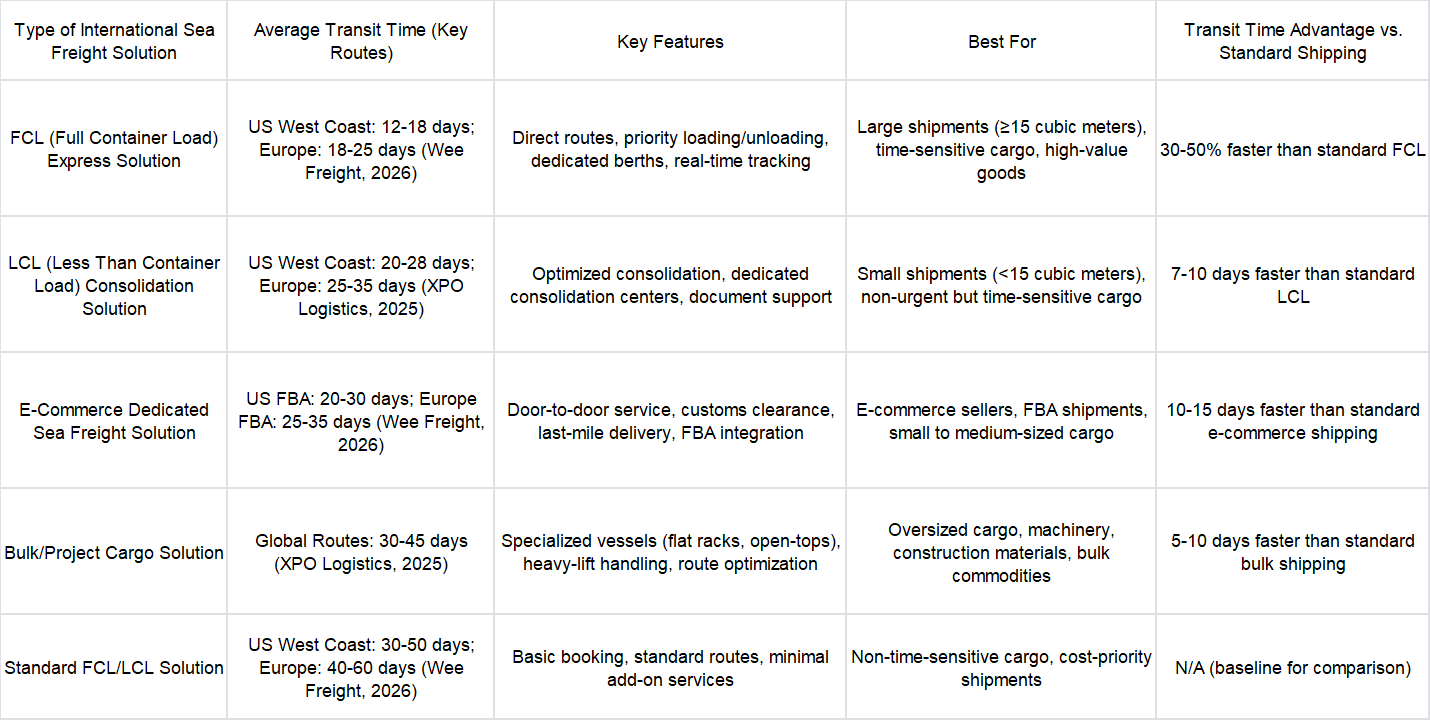
Freight forwarders should note that the choice of solution should align with your clients’ specific needs—prioritizing speed for time-sensitive cargo (e.g., seasonal goods) or cost for non-urgent shipments. A flexible International Sea Freight Solution should allow you to switch between these types based on each client’s requirements, ensuring you can deliver optimal transit times without sacrificing profitability.
What Common Mistakes Do Freight Forwarders Make When Choosing International Sea Freight Solutions?
Even with access to advanced International Sea Freight Solutions, many forwarders still make avoidable mistakes that extend transit times and hurt their business. These mistakes often stem from a lack of research, overreliance on cost alone, or failure to align the solution with client needs. Below are the most common pitfalls and how to avoid them.
• Focusing Solely on Cost, Not Transit Time Reliability: A common mistake is that forwarders choose the cheapest International Sea Freight Solution without considering carrier reliability or transit time guarantees. According to Freightos’ 2026 Q1 report, carriers offering the lowest rates often have on-time performance rates 20-30% lower than premium carriers, leading to longer transit times and higher hidden costs (e.g., detention fees). Recommended practice: Evaluate solutions based on a balance of cost and on-time performance, using data from the FBX or Drewry to compare carrier reliability.
• Ignoring Documentation and Customs Compliance: Many forwarders assume that documentation is a secondary concern, but incomplete or incorrect paperwork is a leading cause of customs delays. Oceanside Logistics’ 2026 Customs Compliance Report states that 42% of transit time delays are due to documentation errors, which can be easily avoided with the right solution. Freight forwarders should note that: Choose an International Sea Freight Solution that includes dedicated documentation support and pre-clearance services to ensure compliance with local regulations.
• Overlooking Route Optimization and Alternative Ports: Forwarders often stick to familiar routes and ports, even when they are experiencing severe congestion. According to UNCTAD’s 2025 Review of Maritime Transport, ships traveling around the Cape of Good Hope instead of the Suez Canal face transit time increases of 2-3 weeks, but many forwarders fail to explore alternative routes until it’s too late. Recommended practice: Use a solution with real-time route optimization tools that suggest alternative ports and routes based on congestion levels and transit time estimates.
• Failing to Leverage Digital Tools for Visibility: Many forwarders still rely on manual tracking and communication, which leads to delays in identifying and addressing issues. APT Logistics’ 2026 Supply Chain Visibility Report notes that forwarders using real-time tracking tools reduce transit time delays by 18% compared to those using manual methods. Freight forwarders should note that: Prioritize solutions with advanced digital platforms that offer end-to-end visibility, predictive analytics, and automated alerts for potential disruptions.
• Not Partnering with a Solution Provider with Local Expertise: Customs regulations, port procedures, and carrier networks vary widely by region, and a lack of local expertise can lead to significant delays. For example, forwarders shipping to Asia often struggle with complex customs procedures in China or Japan, which can hold up cargo for weeks without local support. Recommended practice: Choose an International Sea Freight Solution provider with local offices or partners in key origin and destination countries to ensure smooth operations and faster customs clearance.
What Key Factors Should Freight Forwarders Consider When Selecting an International Sea Freight Solution?
Selecting the right International Sea Freight Solution is a critical decision that impacts every aspect of your business, from transit times to client satisfaction. To make an informed choice, forwarders should evaluate solutions based on the following key factors, which directly influence their ability to cut transit times and optimize operations.
• Global Carrier Network and Capacity: The solution should have partnerships with top carriers (e.g., Maersk, MSC, CMA CGM) and access to priority capacity, especially during peak seasons. According to Freightos’ 2026 Q1 update, carriers with dedicated capacity for solution providers offer 15-20% faster transit times than those without. Freight forwarders should note that: Ask potential providers about their carrier partnerships, contract terms, and capacity guarantees to ensure you can secure space even during high-demand periods.
• Digital Capabilities and Visibility: The solution should include advanced digital tools, such as real-time tracking, predictive analytics, and automated documentation. These tools not only reduce manual work but also allow you to anticipate delays and take proactive action. APT Logistics recommends choosing solutions with AI-powered forecasting tools, which can predict port congestion and weather-related delays up to 7 days in advance.
• Customs Clearance Expertise: Look for solutions with dedicated customs experts who have local knowledge of key markets. According to Oceanside Logistics’ 2026 Customs Compliance Report, solutions with local customs support reduce clearance times by 30-40% compared to those without. Recommended practice: Verify that the provider has expertise in the specific countries your clients ship to, including knowledge of local regulations, tariffs, and documentation requirements.
• Flexibility and Scalability: The solution should be flexible enough to adapt to changing client needs, whether it’s switching between FCL and LCL, adjusting routes, or handling special cargo (e.g., refrigerated, hazardous). As the WTO projected 1.1% growth in global merchandise trade in 2026 (updated Q1 2026), forwarders need scalable solutions that can grow with their business. Freight forwarders should note that: Choose a provider that offers customizable solutions, so you can tailor services to each client’s unique requirements.
• Customer Support and Responsiveness: In the event of a disruption (e.g., vessel delay, port strike), you need a solution provider that offers 24/7 customer support to help you find a resolution quickly. Recommended practice: Test the provider’s support response time before partnering, and ensure they have a dedicated account manager who understands your business and can provide personalized assistance.
How Can Freight Forwarders Measure the Impact of an International Sea Freight Solution on Transit Times?
To ensure your International Sea Freight Solution is effectively cutting transit times, you need to track key metrics and measure performance over time. This not only helps you identify areas for improvement but also allows you to demonstrate value to your clients. Below are the key metrics to monitor, along with industry benchmarks to compare against.
• On-Time Delivery Rate: This is the percentage of shipments delivered within the agreed-upon transit time. According to industry benchmarks (Drewry, 2026), top-performing forwarders using optimized International Sea Freight Solutions achieve on-time delivery rates of 85-90%, compared to the industry average of 65-70%. Recommended practice: Track this metric monthly and work with your solution provider to address any gaps—for example, if on-time rates are low on a specific route, explore alternative carriers or ports.
• Average Transit Time per Route: Monitor the average transit time for key routes (e.g., Asia-US West Coast, Europe-North America) and compare it to pre-solution averages. According to Wee Freight’s 2026 Express Shipping Report, forwarders using express sea freight solutions see a 30-50% reduction in average transit time on key routes. Freight forwarders should note that: Use data from your solution’s tracking tool to identify routes with longer-than-average transit times and work with your provider to optimize them.
• Customs Clearance Time: Track the average time taken to clear customs at key destination ports. The industry benchmark for efficient customs clearance (Oceanside Logistics, 2026) is 1-2 days for compliant shipments; any time longer than that indicates a need for improvement. Recommended practice: Work with your solution provider to streamline documentation and leverage pre-clearance services to reduce clearance times.
• Disruption Rate: This is the percentage of shipments affected by delays (e.g., port congestion, vessel breakdowns). According to UNCTAD’s 2025 Review of Maritime Transport, forwarders using proactive International Sea Freight Solutions with predictive analytics have a disruption rate 25% lower than those using traditional methods. Freight forwarders should note that: Analyze the root causes of disruptions and work with your provider to implement preventive measures—for example, using alternative routes during peak congestion periods.
Conclusion: The Right International Sea Freight Solution Is Your Key to Faster Transit Times
In today’s competitive global trade environment, freight forwarders cannot afford to rely on outdated, inefficient shipping processes. Transit time delays not only damage client relationships but also erode profitability, making the right International Sea Freight Solution a strategic investment. By understanding the root causes of delays, leveraging advanced digital tools, establishing strategic carrier partnerships, and avoiding common pitfalls, forwarders can significantly cut transit times, improve operational efficiency, and gain a competitive edge.
According to the WTO’s Q1 2026 update, global merchandise trade is projected to grow by 1.1%, and with UNCTAD noting that maritime trade routes are becoming longer and more complex, the need for optimized sea freight solutions has never been greater. For forwarders, partnering with a provider that offers a comprehensive, flexible International Sea Freight Solution—one that integrates route optimization, digital visibility, customs expertise, and reliable carrier networks—is the key to navigating these challenges and delivering faster, more reliable service to clients.
By prioritizing transit time optimization through the right International Sea Freight Solution, freight forwarders can not only meet client expectations but also drive long-term business growth in an increasingly dynamic global trade landscape. The time to invest in a tailored solution is now—before your competitors do.
Last
Staying Agile: Crafting an International Solution for Faster Air Freight Dispatch in 2026
What Defines a Modern International Air Freight Solution?A modern International Air Freight Solution is an end-to-end, customizabl
Next
The Digital Shift: Integrating Smarter International Solutions into Modern Sea Freight Management
In 2026, the global freight forwarding industry is navigating an era of unprecedented complexity—geopolitical tensions, port bottl

