




As global trade rebounds in 2026, China’s import policies continue to advance toward liberalization and facilitation. Special import policies implemented in regional hubs such as Hainan Free Trade Port (FTP) have emerged as new growth drivers for cross-border logistics. For global freight forwarders, mastering these regional-specific China's import policies is key to seizing market opportunities and gaining a competitive edge in China’s vast import market.
China, the world’s second-largest import market for 18 consecutive years, has been optimizing its import supervision system by simplifying procedures and reducing barriers. In recent years, it has focused on leveraging regional advantages to launch targeted special import policies, with Hainan FTP, Shanghai Free Trade Zone (FTZ), and Guangzhou Nansha FTZ as core pilots.
These policies, featuring zero tariffs, simplified customs clearance, and relaxed market access, have significantly reduced import costs and improved customs clearance efficiency, bringing unprecedented opportunities for global freight forwarders. This article will systematically analyze the core content, application scenarios, and operation points of China's special import policies in Hainan FTP and other key regions, providing practical guidance for global freight forwarders to utilize these policies and achieve efficient, compliant operations in the Chinese market.
What Are China's Special Import Policies in Hainan Free Trade Port and Other Regions?
China's special import policies in regional hubs such as Hainan FTP are regional extensions and targeted optimizations of China's import policies. They refer to preferential measures formulated to promote regional opening-up, attract foreign investment, and boost cross-border trade, focusing on tariff reduction, customs clearance facilitation, and market access relaxation with distinct regional characteristics and strong operability.
Different from China's unified national import policies, these regional special policies are more targeted, adapting to the industrial positioning and development needs of each region. For example, Hainan FTP focuses on building an international tourism consumption center and a global free trade port, so its import policies are more inclined to support consumer goods, medical equipment, and high-tech products.
Shanghai FTZ, by contrast, focuses on financial innovation and trade facilitation, with more optimized customs clearance procedures and relaxed supervision requirements. This regional differentiation allows freight forwarders to provide more customized services based on customer needs and cargo destinations.
Why Are These Regional Special Import Policies a New Windfall for Global Freight Forwarders?
In the context of increasingly fierce competition in the global freight forwarding industry, China's regional special import policies have become a key breakthrough for freight forwarders to improve service quality and expand customer resources. The reasons why these policies can become a new windfall are mainly reflected in three aspects.
• Cost Reduction for Customers: The core of regional special import policies is tariff reduction and exemption, which can directly help customers reduce import costs. According to the Hainan Free Trade Port Official Website (2026) data, Hainan FTP’s zero-tariff policy covers 1,268 types of goods, with a tax reduction range of 30% to 100%—a huge attraction for importers and a key way for freight forwarders to enhance customer stickiness.
• Improved Customs Clearance Efficiency: Most regional policies optimize customs clearance procedures, implementing paperless declaration, intelligent inspection, and other measures to significantly shorten customs clearance time. According to the Shanghai Shipping Exchange (2026 Q1) data, the average customs clearance time for goods enjoying regional special policies is 3 to 5 hours, 72% shorter than the national average.
• Expanded Business Scope: With the continuous expansion of regional special policy coverage, freight forwarders can expand their business scope. They can provide one-stop services such as policy consultation, document preparation, and customs declaration for customers importing goods to these regions, opening up new profit growth points.
Freight forwarders need to note that these regional special policies are dynamic and will be adjusted and optimized according to regional development needs and national import policy trends. Therefore, real-time policy tracking is crucial to avoid missing policy dividends or causing compliance risks due to outdated policy understanding.
What Are the Core Special Import Policies in Hainan Free Trade Port?
As China’s only provincial-level free trade port, Hainan FTP has the most preferential and flexible special import policies, making it a focus for global freight forwarders. Its core import policies mainly include zero-tariff policies, simplified customs clearance policies, and preferential policies for overseas enterprises, covering the entire process of import declaration, inspection, and tax payment.
What Commodities Are Covered by Hainan FTP's Zero-Tariff Policy?
Hainan FTP's zero-tariff policy is its most distinctive special import policy, covering a wide range of commodities with significant tax reduction effects. It is divided into two categories: zero-tariff for imported goods and zero-tariff for imported vehicles and yachts.
Zero-Tariff for Imported Goods
According to the Hainan Free Trade Port Official Website (2026) data, the zero-tariff commodity list of Hainan FTP has been expanded to 1,268 types, covering four major categories: consumer goods, medical equipment, high-tech products, and production materials. For example, luxury watches, perfumes, and high-end clothing enjoy a zero import tariff, compared with the most-favored-nation (MFN) tariff rate of 15% to 20%.
Medical equipment such as artificial blood vessels and infectious disease diagnostic kits also have a zero tariff, down from the previous MFN tariff rate of 8% to 10%. This policy significantly reduces the import cost of high-value consumer goods and medical supplies, creating more business opportunities for freight forwarders serving related industries.
Zero-Tariff for Imported Vehicles and Yachts
Imported vehicles and yachts that meet Hainan FTP’s requirements can enjoy zero import tariff, value-added tax (VAT), and consumption tax. Freight forwarders need to note that these vehicles and yachts are restricted to use within Hainan FTP and are not allowed to be transferred to other regions of China without official approval.
Violations, such as unauthorized transfer, will result in tax recovery and fines ranging from 50,000 to 500,000 RMB. A recommended practice is that freight forwarders clearly inform customers of these regional use restrictions and include relevant clauses in service agreements to avoid disputes.
What Are the Simplified Customs Clearance Policies in Hainan FTP?
To improve customs clearance efficiency, Hainan FTP has launched a series of simplified customs clearance policies closely related to the daily operations of freight forwarders, which need to be accurately grasped.
• 100% Paperless Declaration Coverage: Since January 2026, Hainan FTP has fully implemented paperless import declaration. All declaration documents, including commercial invoices, packing lists, bills of lading, and certificates of origin, must be submitted electronically through the China International Trade Single Window.
• According to the General Administration of Customs of China (GACC, 2026 Q1) data, the compliance rate of electronic documents for paperless declaration in Hainan FTP must reach 100%—any missing or inconsistent documents will directly lead to declaration rejection and customs clearance delays.
• Intelligent Inspection and Rapid Release: Hainan FTP has promoted the application of artificial intelligence (AI) and big data in customs clearance, implementing a "risk-based inspection" model. For low-risk goods, intelligent inspection is adopted, with release time shortened to 1 to 2 hours.
• For high-risk goods such as medical equipment and food, targeted manual inspection is conducted to ensure both efficiency and safety. According to Xinhua News Agency (2026 Q1) data, the intelligent inspection rate of Hainan FTP's import paperless declaration reached 88% in the first quarter of 2026, ranking first in China.
• Relaxed Requirements for Overseas Customs Brokers: Overseas enterprises can provide customs brokerage services in Hainan FTP without establishing a separate corporate entity in China. They only need to have business premises in Hainan FTP and complete registration with the relevant market supervision department and customs.
• Freight forwarders need to note that overseas enterprises must submit registration applications through the China International Trade Single Window and obtain a Customs Broker Registration Certificate before providing customs brokerage services.
What Are the Common Mistakes of Freight Forwarders in Utilizing Hainan FTP's Import Policies?
In actual operations, many freight forwarders encounter customs clearance delays or fines due to incorrect understanding of Hainan FTP's import policies. The following are common mistakes sorted out based on actual cases, which need to be avoided.
• Mistake 1: Misunderstanding the Scope of Zero-Tariff Policy: Some freight forwarders mistakenly believe that all imported goods in Hainan FTP can enjoy zero tariff, resulting in incorrect declaration and tax arrears. For example, ordinary consumer goods not included in the zero-tariff list are declared as zero-tariff goods, which are verified by customs and result in fines.
• Mistake 2: Ignoring Regional Restrictions for Zero-Tariff Vehicles and Yachts: Some freight forwarders assist customers in transferring zero-tariff imported vehicles and yachts out of Hainan FTP without approval, leading to tax recovery and fines. Freight forwarders must clearly inform customers of these restrictions and verify the intended use of such goods before accepting orders.
• Mistake 3: Failing to Update Policy Information Timely: Hainan FTP's import policies are updated irregularly—for example, the zero-tariff commodity list is adjusted annually. Some freight forwarders still use outdated lists to provide consultation, resulting in customers failing to enjoy preferential policies.
What Are the Special Import Policies in Other Key Regions (Shanghai FTZ, Guangzhou Nansha FTZ)?
In addition to Hainan FTP, China’s Shanghai FTZ and Guangzhou Nansha FTZ also have distinctive special import policies. These policies complement Hainan FTP’s policies and provide more choices for global freight forwarders, focusing on trade facilitation and industrial support with their own characteristics.
What Are the Core Import Policies of Shanghai FTZ?
As China’s first free trade zone, Shanghai FTZ has always been at the forefront of China's import policy innovation, focusing on simplifying customs clearance procedures and promoting financial and trade integration. Its core special import policies mainly include the following aspects.
• Advanced Declaration System: Importers can submit declaration documents in advance before goods arrive at the port, and customs will conduct pre-audit. Once goods arrive, inspection and release can be completed quickly. According to the Shanghai Shipping Exchange (2026 Q1) data, the average customs clearance time for goods using the advanced declaration system in Shanghai FTZ is 50% shorter than that of conventional declaration methods.
• Bonded Maintenance and Processing Policies: Imported goods can be stored, processed, and maintained in Shanghai FTZ’s bonded area without temporarily paying import tariffs and VAT. This policy is particularly suitable for high-value, complex-process goods, helping importers reduce capital occupation.
• Freight forwarders need to note that the storage period of bonded goods shall not exceed 2 years, and extension procedures must be handled in advance if necessary. Failure to do so will result in customs penalties and forced clearance.
• Preferential Policies for High-Tech Imports: Shanghai FTZ provides additional tax reductions and exemptions for imported high-tech products such as semiconductors, precision instruments, and new energy equipment. For example, the import tariff rate of semiconductor chips is reduced to 3%, 12 percentage points lower than the MFN tariff rate.
• A recommended practice is that freight forwarders cooperate with professional technical institutions to help customers confirm the high-tech certification of goods, ensuring they can enjoy preferential policies and avoid declaration errors.
What Are the Core Import Policies of Guangzhou Nansha FTZ?
Guangzhou Nansha FTZ, focusing on connecting the Guangdong-Hong Kong-Macao Greater Bay Area (GBA), has special import policies mainly oriented to promoting cross-border trade between the Chinese mainland, Hong Kong, Macao, and Southeast Asia, with distinct regional advantages.
• Cross-Border E-Commerce Import Policies: Nansha FTZ has optimized cross-border e-commerce import supervision, implemented a "list management system" for cross-border e-commerce imported goods, and simplified declaration procedures. For cross-border e-commerce goods with a single order value of less than 5,000 yuan, customs implements rapid inspection and release, with an average customs clearance time of less than 3 hours.
• Preferential Policies for Agricultural Imports: To meet the demand for agricultural products in the GBA, Nansha FTZ has reduced the import tariff rate of some agricultural products by 30% to 50%. For example, the import tariff rate of fresh fruits such as dates is reduced to 8%, compared with the MFN tariff rate of 15%.
• Freight forwarders need to pay attention to the quarantine requirements of agricultural products and assist customers in preparing relevant quarantine documents, such as plant quarantine certificates and inspection and quarantine reports, to avoid customs clearance delays.
• Customs Clearance Facilitation for Hong Kong and Macao Goods: Goods imported from Hong Kong and Macao to Nansha FTZ can enjoy simplified customs clearance procedures, with customs implementing "one-stop inspection and release" for eligible goods.
• According to the Guangzhou Nansha FTZ Official Website (2026 Q1) data, the customs clearance efficiency of Hong Kong and Macao goods in Nansha FTZ has been improved by 65% compared with other regions, making it an important hub for cross-border trade in the GBA.
How to Compare China's Special Import Policies in Major Regions?
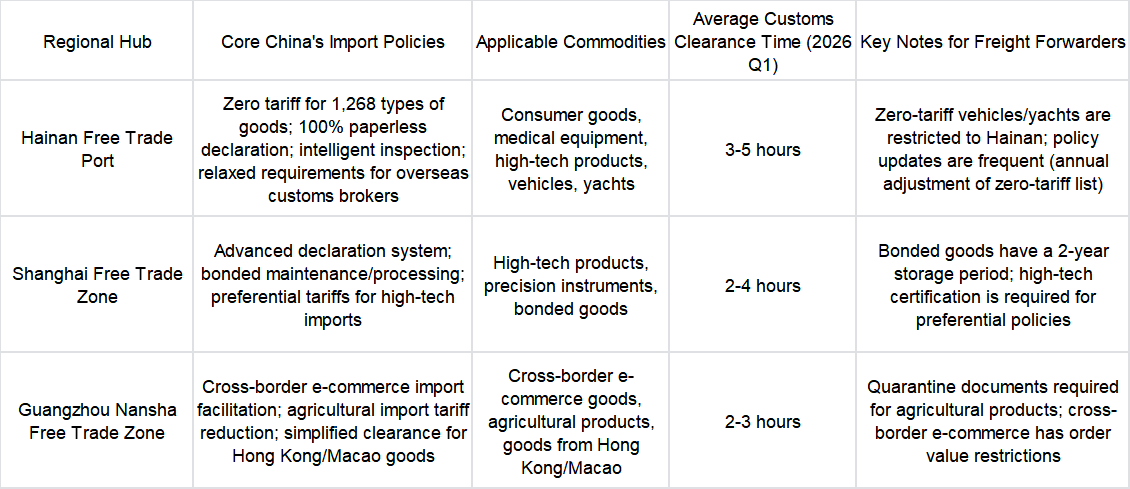
To help global freight forwarders better grasp the differences between China's special import policies in major regions and choose the appropriate policy for customers, the following table compares the core policies, applicable commodities, and customs clearance efficiency of Hainan FTP, Shanghai FTZ, and Guangzhou Nansha FTZ, serving as a daily operation reference.
How Can Global Freight Forwarders Utilize These Special Import Policies to Enhance Competitiveness?
Mastering China's special import policies in Hainan FTP and other regions is not only a requirement for compliant operations but also a key to enhancing competitiveness. Combined with practical operational experience, the following practical suggestions are provided for global freight forwarders to better utilize these policies.
1. Establish a Real-Time Policy Tracking Mechanism: Arrange dedicated personnel to track the latest policy updates of Hainan FTP, Shanghai FTZ, and Guangzhou Nansha FTZ, subscribe to official announcements and policy interpretation materials, and establish a policy update database.
2. A recommended practice is to cooperate with professional policy research institutions to ensure the accuracy and timeliness of policy information, avoiding operational risks caused by outdated policy understanding.
3. Strengthen Professional Training for Employees: Regularly organize employees to receive training on China's regional special import policies, focusing on preferential policy scope, application procedures, document requirements, and common mistakes.
4. Encourage employees to obtain professional qualifications such as Customs Broker Certificates and Cross-Border E-Commerce Operation Certificates to improve their professional capabilities. Freight forwarders need to note that policy training should be combined with actual cases to enhance the operability of training content.
5. Optimize the Document Preparation Process: Establish a standardized document preparation system based on the requirements of different regional policies. For example, when applying for Hainan FTP's zero-tariff policy, prepare certificates of origin and product descriptions; when using Shanghai FTZ's advanced declaration system, sort out declaration documents in advance.
6. A recommended practice is to establish a unified document management system to classify and manage electronic documents and policy application materials, improving the efficiency and accuracy of document preparation.
7. Provide One-Stop Policy Consulting Services: For customers importing goods to these regions, provide one-stop services including policy consultation, eligibility confirmation, document preparation, and customs declaration.
8. Help customers choose the most suitable regional policies based on cargo type, value, and destination to maximize import cost reduction. For example, recommend Hainan FTP's zero-tariff policy for customers importing luxury goods, and Shanghai FTZ's preferential policies for customers importing high-tech products.
9. Establish a Risk Management System: Conduct risk assessments for each import order, identify potential compliance risks (such as policy changes, inconsistent documents, and non-compliant goods), and formulate corresponding risk response plans.
10. For high-risk goods such as medical equipment and food, increase document review and policy verification intensity to ensure compliant operation. Freight forwarders need to note that they should sign clear agreements with customers to clarify the responsibilities and obligations of both parties regarding policy application, avoiding disputes.
What Are the Latest Trends of China's Regional Special Import Policies in 2026?
In 2026, China's regional special import policies will continue to develop toward liberalization, facilitation, and refinement, with further release of policy dividends. Understanding these trends can help global freight forwarders adjust their operational strategies in advance and seize business opportunities.
• Continuous Expansion of Policy Coverage: Hainan FTP will further expand its zero-tariff commodity list, focusing on adding green low-carbon products and advanced manufacturing equipment. Shanghai FTZ will promote the "customs clearance integration" pilot in the Yangtze River Delta region, realizing mutual recognition of customs clearance procedures and results.
• Guangzhou Nansha FTZ will further optimize cross-border e-commerce import policies and expand the scope of cross-border e-commerce imported goods. According to the World Trade Organization (WTO, 2026 Q1) data, the scale of import tax reduction and exemption under China's regional special policies will reach 130 billion yuan in 2026, an increase of 25% compared with 2025.
• Deep Integration of Intelligent Customs Clearance: All major regional hubs will further promote the application of AI, big data, and Internet of Things (IoT) technologies in customs clearance, realizing intelligent declaration, intelligent inspection, and intelligent release.
• According to the Shanghai Shipping Exchange (2026 Q1) data, the intelligent clearance rate of China's regional free trade zones will reach 92% in 2026, with the average customs clearance time shortened to less than 3 hours.
• Strengthened Policy Coordination Between Regions: China will strengthen the coordination and connection of special import policies between different regional hubs, realizing mutual recognition of policy preferences and customs clearance documents to facilitate cross-regional cargo flow.
• For example, goods enjoying zero-tariff policies in Hainan FTP can be transferred to Shanghai FTZ for bonded processing without re-paying tariffs, further improving cross-regional logistics efficiency.
Conclusion
In 2026, China's special import policies implemented in Hainan Free Trade Port and other regions have become a new windfall in the cross-border logistics industry, bringing unprecedented opportunities for global freight forwarders. These policies, with their distinct regional characteristics and strong preferential strength, not only help importers reduce costs and improve efficiency but also provide broad space for freight forwarders to expand their business and enhance competitiveness.
For global freight forwarders, mastering these China's import policies, accurately grasping policy details and application points, optimizing operational processes, and providing professional one-stop services are key to seizing opportunities in China's import market. In the context of China's high-level opening-up, keeping pace with the latest trends of China's regional special import policies, continuously improving professional capabilities, and strengthening cooperation with customers and customs will help global freight forwarders gain a firm foothold in China's market and achieve sustainable development.
Last
Mining Domestic Demand Dividends: How Can Global Freight Forwarders Help Overseas Shippers Seize the New Policy Window of China's Import Trade?
As China continues to promote high-level opening-up and continuously unlock the potential of its super-large domestic demand marke
Next
From the Shanghai CIIE to Trends: Which Areas Is China Relaxing Import Restrictions to Optimize the Logistics Environment?
The 8th China International Import Expo (CIIE) held in Shanghai in November 2025 not only achieved a record-breaking intended tran

