




The 8th China International Import Expo (CIIE) held in Shanghai in November 2025 not only achieved a record-breaking intended transaction volume but also served as a key window to observe the latest trends of China's import policies. For global freight forwarders, understanding the areas where China is relaxing import restrictions is crucial to seizing business opportunities and optimizing logistics efficiency, as China's import policies are continuously being adjusted to promote trade facilitation and optimize the logistics environment.
As the world's second-largest import market for 17 consecutive years, China is committed to expanding high-level opening-up, and the CIIE has become an important platform for the country to release positive signals of import liberalization. This guide will take the 8th CIIE as the starting point, analyze the key areas where China is relaxing import restrictions, interpret the supporting measures to optimize the logistics environment, and provide practical suggestions for global freight forwarders to adapt to policy changes and achieve compliant and efficient operations.
What Role Does the Shanghai CIIE Play in Promoting the Relaxation of China's Import Policies?
The Shanghai CIIE is a major initiative of China to expand imports and promote economic globalization, and it plays a direct guiding role in the adjustment of China's import policies. Each session of the CIIE releases a number of policy measures to relax import restrictions, covering multiple fields such as agriculture, medical care, consumer goods, and services, which directly affects the operational strategies of global freight forwarders.
What Are the Core Achievements of the 8th Shanghai CIIE Related to Import Liberalization?
According to data from the People's Network (2025), the 8th CIIE achieved an intended transaction volume of 83.49 billion US dollars, an increase of 4.4% compared with the previous session, hitting a record high. Meanwhile, data from the Chinese government website (2026) shows that during the 8th CIIE, China granted access to 190 new types of agricultural and food products from 65 countries and regions, further expanding the scope of imported goods.
Freight forwarders need to note that the policy signals released at the CIIE are highly forward-looking. Many of the import restriction relaxation measures announced during the expo are officially implemented within 6 to 12 months, which means freight forwarders must track and study these policies in advance to help customers seize policy dividends. For example, the optimization measures for the registration of overseas food production enterprises released at the 8th CIIE were officially issued by the General Administration of Customs (GACC) in March 2026 and took effect on June 1, 2026.
Why Is the CIIE a Key Window to Observe China's Import Policy Trends?
The CIIE is not only a trading platform but also a policy release platform. Every year, government departments such as the General Administration of Customs (GACC), the Ministry of Commerce (MOFCOM), and the State Taxation Administration release the latest import policy adjustments at the expo, focusing on solving pain points and difficulties in the import link.
According to WTO (2025) data, China's import volume accounted for 11.2% of the global total in 2025, and the policy adjustments released by the CIIE directly affect the global trade pattern and the business layout of freight forwarders. The recommended approach is that global freight forwarders should establish a dedicated CIIE policy tracking mechanism, arrange professionals to participate in the expo's policy interpretation meetings, and timely sort out import restriction relaxation measures related to their core business areas. This helps freight forwarders gain a first-mover advantage and provide customers with more professional policy consulting services.
Which Key Areas Is China Relaxing Import Restrictions?
Combined with the policy signals released at the 8th CIIE and the latest policy adjustments in 2025 and 2026, China is mainly relaxing import restrictions in four key areas: agricultural products, medical devices, consumer goods, and service trade. These areas are not only the focus of the CIIE but also the key fields where China's import demand is growing rapidly.
What Relaxations Have Been Made in Agricultural Product Imports Under China's Import Policies?
Agricultural products are the focus of China's import liberalization, and the 8th CIIE further expanded the scope of import relaxation. China's import policies for agricultural products mainly focus on simplifying the registration process of overseas enterprises, expanding the types of imported products, and adjusting tariff rates to meet domestic market demand.
• Simplification of Overseas Enterprise Registration: According to the revised "Administrative Measures for the Registration of Overseas Production Enterprises of Imported Food" released by GACC in March 2026, 6 categories of primary edible agricultural products, including oilseeds, coarse grains, fresh vegetables, and dried beans, have been removed from the list of products requiring official recommended registration. Enterprises can now apply for registration independently, which significantly shortens the registration cycle.
• Expansion of Imported Product Types: According to data from the Chinese government website (2026), China granted access to 190 new types of agricultural and food products from 65 countries and regions in 2025, including new varieties of fruits, vegetables, and aquatic products. For example, fresh cherries from Argentina and durians from Malaysia have been added to the list of directly importable agricultural products.
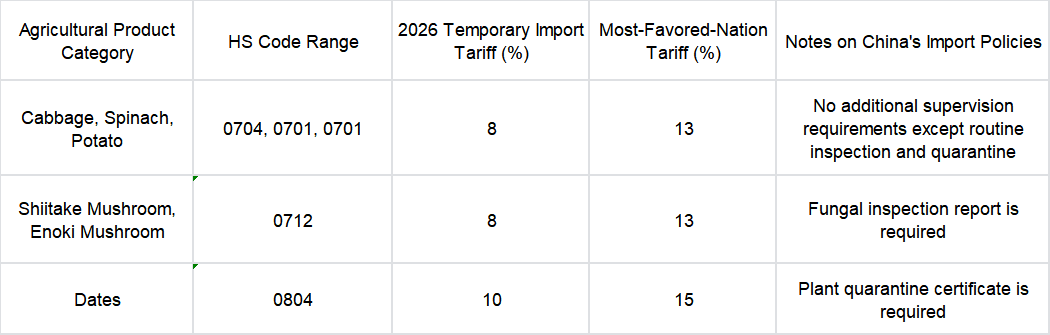
• Tariff Preference Adjustments: According to the "2026 Tariff Adjustment Plan" issued by the Tariff Commission of the State Council, China has implemented a temporary import tariff lower than the most-favored-nation (MFN) tariff for 935 commodities, including many agricultural products. The temporary tariff rate for some fresh vegetables and fruits has been reduced by 30% to 50% compared with the MFN tariff.
Key Considerations for Freight Forwarders in Agricultural Product Imports
Freight forwarders need to note that although China has relaxed import restrictions on agricultural products, inspection and quarantine requirements remain strict. For example, imported edible fungi require a fungal inspection report, and imported dates require a plant quarantine certificate.
A common mistake is that some freight forwarders ignore the inspection and quarantine requirements for specific agricultural products, resulting in customs detention of goods. It is critical to verify the specific regulatory requirements for each type of agricultural product before accepting an import order.
How Has China Relaxed Import Restrictions on Medical Devices?
Medical devices are an important category of sensitive goods, and China has continuously relaxed import restrictions in this field in recent years. Especially after the 8th CIIE, more refined and convenient regulatory measures have been introduced, focusing on the approval process, tariff rates, and inspection and quarantine links.
• Simplification of Approval Process: For imported medical devices with mature technologies and proven safety, China has implemented a "fast-track approval" system. According to data from the National Medical Products Administration (NMPA) (2025), the approval cycle for imported medical devices in the fast-track has been shortened from 6-12 months to 3-6 months, greatly improving market access efficiency.
• Tariff Reduction for Livelihood-Related Products: According to the "2026 Tariff Adjustment Plan", China has reduced import tariffs on some livelihood-related medical products, such as artificial blood vessels and certain infectious disease diagnostic kits. The tariff rate for artificial blood vessels has been reduced from 8% to 3%, significantly lowering import costs.
• Optimization of Inspection and Quarantine Measures: For imported medical devices that have passed NMPA approval, China has implemented a "random inspection" system, reducing the inspection rate from 100% to 30% for qualified enterprises, which shortens customs clearance time.
Recommended Practices for Medical Device Import Operations
The recommended approach is that freight forwarders should assist customers in sorting out approval documents in advance when undertaking medical device import business and confirm the approval status of the products. At the same time, they must ensure the consistency of product names, specifications, and models in the documents with the approval documents to avoid customs clearance delays caused by inconsistent information.
What Relaxation Measures Have Been Taken for Imported Consumer Goods?
Imported consumer goods are one of the most popular categories at the CIIE, and China has continuously relaxed import restrictions to meet the growing domestic demand for high-quality consumer goods. The relaxation measures mainly involve cosmetics, luxury goods, and consumer electronics.
• Simplification of Cosmetics Import Approval: China has abolished the "registration certificate" for imported ordinary cosmetics and replaced it with a "recordation system". The recordation cycle has been shortened from 4-6 months to 1-2 months, significantly lowering the market access threshold for imported ordinary cosmetics.
• Expansion of Duty-Free Shopping Scope: According to data from GACC (2025), China has expanded the scope of duty-free shopping for imported consumer goods, increased the duty-free quota for cross-border e-commerce, and allowed more consumer goods to enjoy duty-free treatment, which promotes the growth of imported consumer goods trade.
• Tariff Reduction for High-End Consumer Goods: China has reduced import tariffs on high-end consumer goods such as luxury watches, perfumes, and high-end clothing. For example, the import tariff for luxury watches has been reduced from 20% to 10%, attracting more overseas luxury brands to enter the Chinese market.
Label Compliance Requirements for Imported Consumer Goods
Freight forwarders need to note that label compliance requirements for imported consumer goods remain strict. For example, imported pre-packaged cosmetics must have Chinese labels that meet Chinese standards, including product name, net content, ingredient list, production date, shelf life, country of origin, and importer information.
A common mistake is that some freight forwarders assume Chinese labels can be pasted after the goods arrive at the port, which may lead to customs detention. It is mandatory to ensure that compliant Chinese labels are attached before the goods are shipped.
How Is China Relaxing Import Restrictions on Service Trade?
Service trade is an important part of China's import trade, and the 8th CIIE has further relaxed import restrictions on service trade, covering logistics, finance, consulting, and other fields. These relaxations are mainly reflected in the market access and business scope of foreign-invested service enterprises.
• Opening Up of the Logistics Service Industry: China has fully opened up the logistics service industry, abolishing restrictions on the shareholding ratio of foreign-invested logistics enterprises and allowing them to engage in the entire logistics chain business, including international freight forwarding, warehousing, and distribution.
• Relaxation of Financial Service Access: China has relaxed access restrictions on foreign-invested financial institutions, allowing foreign-invested banks, insurance companies, and securities firms to expand their business scope in China, providing more financial support for cross-border trade and logistics.
• Optimization of Consulting Service Supervision: For imported consulting services such as management consulting and technical consulting, China has simplified the filing process and abolished unnecessary approval links, improving the efficiency of service imports.
What Supporting Measures Has China Taken to Optimize the Logistics Environment While Relaxing Import Restrictions?
While relaxing import restrictions, China has introduced a series of supporting measures to optimize the import logistics environment, focusing on improving customs clearance efficiency, reducing logistics costs, and strengthening infrastructure construction. These measures provide important support for global freight forwarders to carry out their business.
How Has China Improved Customs Clearance Efficiency?
Improving customs clearance efficiency is the core of optimizing the import logistics environment. China has continuously promoted the construction of the "Single Window" and intelligent customs clearance reforms, significantly reducing the customs clearance time for imported goods.
• Continuous Optimization of the "Single Window": China's international trade "Single Window" has realized online handling of all import declaration links, including declaration, inspection and quarantine, and tax payment. According to data from the Shanghai Shipping Exchange (2025), the average customs clearance time for imported goods in China has been shortened to 24 hours, a 50% decrease compared with 2023.
• Promotion of Intelligent Customs Clearance: China has promoted the application of intelligent technologies such as AI and big data in customs clearance, implementing "intelligent inspection" and "online verification" for imported goods. For example, the intelligent inspection system can automatically identify the type and quantity of goods through image recognition, reducing manual inspection time.
• Implementation of the "Pre-Declaration" System: For imported goods with clear product information, China has implemented a "pre-declaration" system, allowing freight forwarders to declare to the customs before the goods arrive at the port. This enables customs clearance procedures to be completed within 1 hour after the goods arrive at the port.
How Can Freight Forwarders Utilize These Efficiency-Improving Measures?
The recommended approach is that freight forwarders should make full use of the "Single Window" and pre-declaration system to arrange declaration work in advance. At the same time, they must ensure the accuracy and completeness of declaration information to avoid customs clearance delays caused by incorrect declarations.
What Measures Has China Taken to Reduce Import Logistics Costs?
Reducing logistics costs is an important measure to optimize the import logistics environment. China has taken a series of measures to reduce port fees, transportation fees, and inspection fees, lowering the overall import logistics costs for enterprises.
• Reduction of Port Fees: China has abolished or reduced a number of port fees, including port construction fees and container handling fees. According to data from the Chinese government website (2026), the average port fee for imported goods has been reduced by 20% compared with 2024, significantly lowering the logistics costs for freight forwarders.
• Optimization of the Transportation Network: China has continuously improved the cross-border transportation network, strengthening the construction of railway, sea, and air transportation channels. For example, the China-Europe Railway Express has opened more routes, reducing the transportation time between China and Europe by 30% compared with sea transportation.
• Reduction of Inspection Fees: China has reduced inspection fees for imported goods, and for some goods that have passed pre-inspection overseas, it has implemented a "mutual recognition of inspection results" system, avoiding repeated inspections and reducing inspection costs.
How Is China Strengthening the Construction of Import Logistics Infrastructure?
The construction of logistics infrastructure is the foundation for optimizing the import logistics environment. China has increased investment in logistics infrastructure, focusing on the construction of ports, logistics parks, and cold chain logistics facilities.
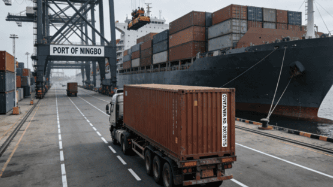
• Port Infrastructure Upgrading: Major ports in China, such as Shanghai Port, Ningbo Zhoushan Port, and Shenzhen Port, have carried out infrastructure upgrades, increasing the handling capacity of container terminals and improving the efficiency of cargo loading and unloading. According to data from UNCTAD (2025), Shanghai Port's container throughput reached 47 million TEUs in 2025, ranking first in the world.
• Construction of Logistics Parks: China has built a number of cross-border logistics parks, integrating functions such as warehousing, sorting, and distribution, providing one-stop logistics services for imported goods. For example, the Shanghai Free Trade Zone Logistics Park has become an important distribution center for imported goods in East China.
• Improvement of Cold Chain Logistics Facilities: For imported perishable goods such as agricultural products and medical products, China has continuously improved cold chain logistics facilities to ensure the quality and safety of goods during transportation. According to data from the Ministry of Commerce (2025), the total length of China's cold chain logistics network has reached 1.2 million kilometers, covering all major cities.
What Challenges and Opportunities Do the Relaxation of China's Import Restrictions Bring to Global Freight Forwarders?
The relaxation of China's import restrictions and the optimization of the logistics environment have brought both opportunities and challenges to global freight forwarders. Grasping policy trends and adapting to policy changes are key for freight forwarders to gain competitive advantages in the Chinese market.
What Opportunities Can Freight Forwarders Seize?
• Expansion of Business Scope: The relaxation of import restrictions in multiple fields such as agricultural products, medical devices, and consumer goods has expanded the business scope of freight forwarders. Freight forwarders can increase their business layout in these fields and provide professional logistics services for customers.
• Improvement of Operational Efficiency: The optimization of the logistics environment, such as improved customs clearance efficiency and reduced logistics costs, has enhanced the operational efficiency of freight forwarders and reduced operational risks caused by long customs clearance times.
• Strengthening Cooperation with Overseas Suppliers: The relaxation of import restrictions has attracted more overseas enterprises to enter the Chinese market. Freight forwarders can strengthen cooperation with overseas suppliers, provide one-stop logistics solutions, and establish long-term cooperative relationships.
What Challenges Do Freight Forwarders Need to Face?
• Rapid Policy Updates: China's import policies are continuously adjusted, with a fast update speed. Freight forwarders need to track the latest policy changes in a timely manner; otherwise, they may face risks such as customs clearance delays and fines due to outdated policy understanding.
• High Professional Capability Requirements: The relaxation of import restrictions does not mean the relaxation of regulatory requirements. On the contrary, regulatory requirements for imported goods have become more refined. Freight forwarders need professional capabilities in policy interpretation, document preparation, and inspection and quarantine to ensure compliant operations.
• Increased Market Competition: The relaxation of import restrictions has attracted more global freight forwarders to enter the Chinese market, leading to increased market competition. Freight forwarders need to improve their service quality and professional level to stand out in the competition.
What Practical Suggestions Do Experts Give to Global Freight Forwarders to Adapt to the Relaxation of China's Import Policies?
Combined with the latest policy trends and practical operational experience, senior experts in the international freight industry have put forward the following practical suggestions for global freight forwarders to help them adapt to the relaxation of China's import policies and achieve sustainable development.
• Establish a Real-Time Policy Tracking Mechanism: Arrange dedicated personnel to track the latest policies released by GACC, MOFCOM, and other government departments, and subscribe to official announcements and policy interpretation materials. It is recommended to cooperate with professional policy research institutions to ensure the accuracy and timeliness of policy information.
• Strengthen Professional Training for Employees: Regularly organize training on China's import policies for employees, focusing on regulatory requirements, document preparation, and HS code classification for imported goods in key fields. Encourage employees to obtain professional qualifications such as customs broker and inspection broker to improve their professional capabilities.
• Optimize the Document Review Process: Establish a strict document review system to verify the consistency of commercial invoices, packing lists, bills of lading, and other documents. For imported goods requiring special documents (such as approval documents for medical devices and inspection reports for agricultural products), ensure the documents are complete and compliant before shipment.
• Strengthen Cooperation with Customs Brokers and Suppliers: Cooperate closely with professional customs brokers who are familiar with the latest customs clearance processes and policy requirements to improve customs clearance efficiency. At the same time, strengthen communication with overseas suppliers, guide them to understand China's import policies, and standardize document preparation and goods packaging.
• Establish a Risk Management System: Conduct risk assessments for each import order, identify potential compliance risks (such as policy changes, inconsistent documents, and unqualified goods), and formulate corresponding risk response plans. For high-risk orders such as dangerous goods and medical devices, increase the review intensity to ensure compliant operations.
What Is the Future Trend of China's Import Policies?
From the perspective of the 8th CIIE and the latest policy adjustments, China's import policies will continue to move towards liberalization, facilitation, and refinement. In the future, China will further relax import restrictions in more fields, optimize the import logistics environment, and promote the high-quality development of import trade.
According to WTO (2025) forecasts, China's import volume will continue to grow at a rate of 3% to 5% in the next three years, and the scope of import liberalization will be further expanded. It is expected that China will further relax import restrictions on high-tech products, environmental protection products, and other fields, while continuing to optimize the customs clearance process and reduce logistics costs.
For global freight forwarders, the relaxation of China's import policies is both an opportunity and a challenge. Only by closely tracking policy trends, continuously improving professional capabilities, and adhering to the principle of compliance can freight forwarders seize business opportunities, avoid operational risks, and achieve sustainable development in the Chinese market. In the context of China's continuous expansion of high-level opening-up, mastering the latest China's import policies has become the core competitiveness of global freight forwarders to carry out business in China.
Last
Cross-Border Logistics New Outlet: An Analysis of China's Special Import Policies Implemented in Hainan Free Trade Port and Other Regions
As global trade rebounds in 2026, China’s import policies continue to advance toward liberalization and facilitation. Special impo
Next
Access and Compliance: Analyzing China's Latest Regulatory Policies on the Import of Food and Sensitive Goods
For global freight forwarders, navigating China's import policies is critical to ensuring smooth customs clearance, avoiding delay

