




Forward-thinking freight forwarding agencies leverage digital tools and data analytics to deploy proactive port congestion solutions that forecast and mitigate chassis shortage bottlenecks at global container terminals. Chassis scarcity has become a recurring operational pain point in modern port logistics, frequently triggering drayage suspensions, container yard overstocking, and reduced terminal throughput efficiency. According to UNCTAD 2025 maritime transport review data, chassis and intermodal equipment shortages account for roughly 26% of recurrent port congestion incidents across major North American and European container hubs. For global forwarders, embedding data-driven predictive systems into daily workflows stands as one of the most practical port congestion solutions to mitigate equipment-related supply chain disruptions.
What defines chassis shortage induced port congestion in modern liner logistics?
Chassis shortage induced port congestion refers to terminal operational stagnation stemming from insufficient intermodal chassis to support container drayage, gate movements, and inland transshipment workflows. This equipment-driven bottleneck differs structurally from labor shortages or vessel overcrowding congestion and imposes sustained throughput limitations.
What structural factors cause modern chassis supply imbalances?
Most contemporary chassis shortages arise from regional resource dislocation rather than pure quantitative equipment deficits. Throughout 2025, major US West Coast hubs including the Port of Los Angeles and Port of Long Beach have recorded surplus idle chassis stockpiled at remote inland depots, while coastal terminal yards face persistent equipment deficits. According to official 2025 port operational bulletins from these two hubs, high terminal capacity utilization leaves minimal operational buffer to absorb supply volatility, turning minor chassis mismatches into large-scale terminal congestion.
What common operational misunderstanding worsens such congestion?
A common mistake is categorizing chassis scarcity as a temporary scheduling issue instead of a systemic port congestion risk. This misjudgment leads conventional forwarders to rely on reactive emergency dispatching rather than building predictive prevention frameworks, resulting in repeated container detention and consistent schedule slippage.
Why do chassis shortages form critical port congestion bottlenecks?
Intermodal chassis act as the core connecting asset linking maritime terminal operations and inland road transportation networks, governing the overall efficiency of container turnover at port hubs. Inadequate chassis supply directly breaks the closed-loop workflow of container discharging, storage evacuation, and hinterland delivery.
How does chassis scarcity restrict terminal container turnover cycles?
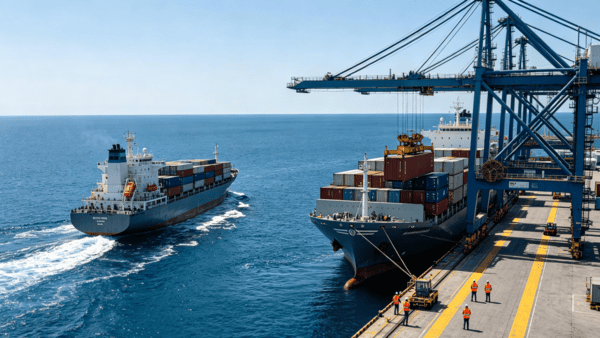
Discharged import containers cannot be evacuated from terminal yards without matched chassis resources, causing continuous container stacking and progressive yard space saturation. As terminal occupancy rates rise, gate-in and gate-out throughput efficiency declines substantially. According to Freightos Baltic Index (FBX) 2025 quarterly logistics analytics, sustained chassis shortages can suppress daily terminal container turnover efficiency by 31% to 38% at saturated North American coastal terminals.
What cascading supply chain risks do chassis shortages trigger?
Insufficient available chassis initiates a chain of secondary logistics disruptions that compound existing port congestion severity. Stranded import containers occupy limited terminal storage capacity, forcing incoming container vessels to extend offshore anchoring waiting periods. Delayed empty container redelivery further tightens chassis circulation speed, forming a self-reinforcing negative cycle of equipment scarcity and worsening terminal congestion.
Forwarders should note that chassis-driven port congestion features longer duration and lower artificial predictability compared with seasonal peak shipping congestion. Cross-regional equipment imbalance and fragmented resource distribution render traditional experience-based manual scheduling ineffective for risk mitigation.
What technological strengths enable forwarders to predict chassis shortage risks?
Technology-enabled freight forwarding firms deploy big data monitoring, real-time asset tracking, and trend forecasting algorithms to identify impending chassis supply gaps ahead of congestion formation. These digital capabilities support proactive early warning and pre-emptive operational adjustment.
Real-time chassis pool inventory monitoring: Cloud-based logistics management systems synchronize dynamic asset data from mainstream North American chassis providers, including TRAC Intermodal, DCLI, and FlexiVan. The platform consolidates idle chassis volumes, depot distribution status, and equipment reservation data across coastal terminals and inland depots, eliminating manual statistical delays and enabling data-backed supply assessment.
Historical seasonal trend correlation analysis: Intelligent analytical models process 12 to 24 months of archived port operational data to summarize chassis shortage patterns correlated with peak shipping windows, tariff policy revisions, and regional cargo volume fluctuations. According to ITC Trade Map 2025 seasonal trade data, peak export cargo surges increase chassis demand by an average of 28% at US West Coast ports, creating periodic structural shortage pressures.
Multi-dimensional quantitative risk threshold alerting: Digital operation platforms set standardized early warning thresholds based on terminal utilization ratios, idle chassis proportions, and daily drayage demand volumes. When monitored indicators approach predefined risk ranges, the system automatically generates operational alerts to prompt pre-emptive chassis resource reservation.
Cross-regional asset reallocation simulation: Advanced logistics technology tools simulate chassis resource migration requirements between oversupplied inland depots and undersupplied coastal terminals. The algorithm calculates optimized equipment reallocation schemes to mitigate regional supply imbalance, which is one of the commonly adopted approaches to relieve localized chassis scarcity and ease port congestion.
How do tech-focused forwarders execute predictive port congestion solutions for chassis risks?
Digital-native forwarding teams implement standardized data-driven workflows to anticipate and resolve chassis-related bottlenecks, forming systematic port congestion solutions covering risk early warning, resource reservation, and dynamic asset scheduling.
Integrate multi-source heterogeneous logistics data: Forwarders consolidate terminal gate transaction data, carrier vessel schedules, chassis pool inventory data, and inland drayage capacity information into a unified digital management ecosystem. Multi-source data integration eliminates one-sided risk judgment caused by isolated data sources and achieves full-spectrum port operational oversight.
Adopt tiered chassis resource reservation tactics: The recommended approach is to classify shipments by delivery urgency and reserve targeted chassis resources based on forecasted demand peaks. Tiered reservation mechanisms prevent centralized resource contention during congestion periods and stabilize overall drayage operational efficiency.
Deploy dynamic cross-depot chassis scheduling: Operational teams adjust chassis allocation schemes in real time according to terminal congestion levels and spatial equipment distribution data. Reallocating idle chassis from low-demand inland depots to high-pressure coastal terminals effectively alleviates localized equipment shortages and accelerates container yard evacuation.
Stagger container pickup and return time windows: Intelligent scheduling systems disperse container pickup and drop-off tasks across different time slots to avoid concentrated instantaneous drayage pressure. Staggered operational arrangements flatten peak chassis demand and reduce artificial equipment shortage risks.
Establish multi-channel emergency chassis backup systems: Tech-forward forwarding firms maintain long-term contractual partnerships with multiple chassis asset suppliers and regional equipment lessors. Reserved backup equipment capacity provides supplementary support during mainstream chassis pool shortages, ensuring uninterrupted drayage and terminal circulation workflows.
What operational errors undermine chassis shortage prediction outcomes?
Many forwarding enterprises adopt digital tools yet fail to achieve stable congestion mitigation due to non-standard operational practices. Avoiding prevalent industry errors helps maximize the practical value of technology-based port congestion solutions.
Relying solely on mainstream chassis pool data: A common mistake is limiting data monitoring to primary cooperative chassis suppliers while ignoring small-scale regional depot resources. Incomplete data coverage distorts overall supply-demand assessment and causes missed supplementary equipment resources during shortage events.
Disregarding policy-induced cargo demand volatility: Trade tariff adjustments, regional policy updates, and cross-border regulatory changes can trigger abrupt cargo volume surges and spike chassis consumption. Forwarders should note that excluding policy variables from prediction models reduces the accuracy of sudden shortage risk forecasting.
Separating data forecasting from on-site execution: Several forwarding teams maintain complete digital early warning systems but lack matched operational adjustment mechanisms. Isolated data analysis cannot translate digital predictive advantages into tangible congestion mitigation results.
Overlooking cost and efficiency losses from chassis splits: 2025 global drayage industry statistics record a 25% year-on-year rise in chassis split incidents at major container ports, increasing average drayage costs by 20% to 30%. Failure to incorporate chassis split risks into predictive frameworks creates hidden operational efficiency losses.
How to upgrade digital systems for sustained chassis-related congestion prevention?
Continuous technological iteration and operational standardization enable forwarders to build long-term risk resilience against chassis-driven port congestion, supporting stable and predictable cross-border logistics operations.
How does AI-powered trend forecasting improve risk prediction accuracy?
AI-driven predictive models conduct iterative machine learning on historical port congestion records, chassis supply cycles, and cargo fluctuation patterns. The system dynamically optimizes algorithm parameters to adapt to evolving market and port operational conditions. According to the 2025 Drewry maritime technology benchmark report, adaptive AI forecasting improves chassis shortage early warning accuracy by over 40% compared with traditional static data analysis methods.
Why is digital workflow standardization operationally critical?
Standardized digital operational procedures unify the full-link workflows of data collection, risk assessment, resource reservation, and emergency disposal. Systematic operational specifications minimize manual intervention errors and ensure consistent implementation of predictive congestion mitigation strategies throughout peak and off-peak shipping cycles.
How does cross-departmental data collaboration boost overall efficiency?
Eliminating internal data silos among sales, operation, and customer service teams enables real-time synchronous sharing of chassis supply updates and congestion risk alerts. Unified information transmission aligns cross-departmental risk response rhythms and improves the overall execution efficiency of port congestion mitigation measures.
To conclude, integrating digital predictive analytics and dynamic chassis asset scheduling into daily operations constitutes a reliable and sustainable approach for modern forwarding agencies to deploy targeted port congestion solutions for chassis shortage bottlenecks. Continuous technological upgrading and standardized operational optimization empower forwarders to mitigate equipment-induced port congestion risks, stabilize container turnover efficiency, and deliver consistent, high-quality cross-border freight services amid volatile global shipping market conditions.
Last
How much does international forwarding history matter when logistics agents pitch for rfq experience
Practical international logistics experience acts as a core evaluation criterion for shippers and procurement teams during logisti
Next
How can modern freight forwarders help global cross-border corporate clients keep their ocean and sea freight logistics costs down?
Learning how to reduce sea freight cost has become a core competitive service for modern freight forwarders to support global cros

