




In the competitive global logistics landscape, high-growth freight forwarders stand out not by moving containers alone, but by leveraging profound Sea Freight Export Experience to turn challenges into long-term competitive advantages. These forwarders understand that success in sea freight goes far beyond basic booking and delivery—it requires a holistic approach that integrates expertise, strategy, and customer-centricity.
While many forwarders struggle to keep up with market volatility, port congestion, and evolving customer demands, high-growth firms have mastered the art of translating Sea Freight Export Experience into actionable strategies. They recognize that every shipment is more than a transaction; it is an opportunity to build trust, optimize efficiency, and create value for their clients. This article explores the key insights and practices that set these forwarders apart, revealing how professional Sea Freight Export Experience can drive sustainable growth in an increasingly complex industry.
What Defines High-Growth Freight Forwarders in the Sea Freight Industry?
High-growth freight forwarders are defined by their ability to consistently outperform industry averages in revenue growth, customer retention, and operational efficiency, largely driven by their strategic use of Sea Freight Export Experience. They prioritize long-term relationships over short-term gains and view expertise as a core asset rather than a secondary consideration.
According to UNCTAD 2025 data, the top 10% of high-growth forwarders globally achieve a compound annual growth rate (CAGR) of 18.7%, compared to the industry average of 6.2%. This gap is not accidental—it stems from a deliberate focus on refining their Sea Freight Export Experience and aligning their services with the evolving needs of global shippers (consignors).
The Difference Between Volume Growth and Strategic Growth
Forwarders should note that high growth is not solely about handling more shipments; it is about handling shipments smarter. High-growth firms invest in training their teams to deepen their Sea Freight Export Experience, ensuring that every employee—from account managers to operations specialists—can navigate the complexities of international shipping with confidence.
This means focusing on operational excellence, risk mitigation, and customer retention rather than just increasing shipment volume. For example, a forwarder with strong Sea Freight Export Experience might prioritize reducing transit time variability for key clients over accepting every available shipment, which ultimately builds long-term loyalty and repeat business.
Technology as an Enabler, Not a Replacement for Expertise
A common mistake is assuming that technology alone can drive growth. While digital tools—such as AI-powered shipment tracking systems, automated documentation platforms, and real-time port data analytics—are critical, they are most effective when paired with seasoned Sea Freight Export Experience. High-growth forwarders use technology to enhance their expertise, not replace it, creating a synergy that streamlines operations and improves customer outcomes.
For instance, a digital platform can alert a forwarder to potential port congestion, but it takes Sea Freight Export Experience to interpret that data, decide whether to reroute the shipment, and negotiate with carriers to secure alternative arrangements—actions that technology cannot execute independently.
Why Is Sea Freight Export Experience More Critical Than Ever for Forwarder Growth?
Sea Freight Export Experience has become a make-or-break factor for forwarder growth due to increasing global trade complexity, frequent supply chain disruptions, and rising customer expectations for reliability and transparency. In an era of geopolitical tensions, port congestion, and shifting regulatory requirements, expertise is the foundation of trust and efficiency.
Lessons from Past Disruptions: The COVID-19 Aftermath
The COVID-19 pandemic exposed the risks of relying on surface-level knowledge rather than deep Sea Freight Export Experience. Forwarders with limited expertise struggled to navigate port closures, shipping capacity shortages, and changing customs regulations, while those with robust experience adapted quickly—securing alternative carrier contracts, negotiating with port authorities for priority unloading, and retaining clients by providing proactive solutions.
This adaptability was not accidental; it was rooted in years of Sea Freight Export Experience that allowed these forwarders to anticipate potential bottlenecks and develop contingency plans before disruptions occurred. Even post-pandemic, the lessons learned have reinforced the value of expertise in navigating ongoing supply chain volatility.
Shipper Priorities: Why Experience Tops the List
According to the ITC Trade Map 2026, 73% of global shippers prioritize working with forwarders who have proven Sea Freight Export Experience, citing it as a key factor in their decision-making process. This is because experienced forwarders can anticipate challenges, mitigate risks, and provide tailored solutions that less experienced firms cannot.
Shippers—especially those with high-value or time-sensitive cargo—understand that Sea Freight Export Experience directly impacts shipment reliability. A forwarder with expertise in hazardous cargo handling, for example, can ensure compliance with international dangerous goods (IMDG) codes, avoiding costly delays or penalties that a less experienced forwarder might overlook.
Treating Experience as a Strategic Investment
The recommended approach is for forwarders to view Sea Freight Export Experience as a strategic investment, not an operational cost. By investing in training, mentorship, and knowledge sharing, forwarders can build a team that is equipped to handle even the most complex shipping scenarios, driving growth through customer loyalty and operational excellence.
This investment pays off in reduced error rates, fewer shipment delays, and higher client retention—all of which contribute to sustainable growth in a competitive market. For example, forwarders that invest in training their teams on latest customs regulations (such as EU’s Import Control System 2, ICS2) can avoid costly non-compliance issues that erode profitability.
How Do High-Growth Forwarders Leverage Sea Freight Export Experience to Mitigate Supply Chain Risks?
High-growth forwarders use their Sea Freight Export Experience to proactively identify and mitigate supply chain risks, turning potential disruptions into opportunities to demonstrate their value. They understand that risk management is not a reactive process but a proactive strategy built on years of industry expertise.
• Proactive Port Congestion Management: Drawing on their Sea Freight Export Experience, high-growth forwarders monitor port dynamics in real time, using historical data and industry insights to anticipate congestion. According to Shanghai Shipping Exchange 2026 data, Shanghai Port’s container throughput reached 5.06 million TEUs in January 2026, a new historical high, and forwarders with robust experience reduce port-related delays by 42% by pre-planning alternative routes and ports.
• Geopolitical Risk Navigation: High-growth forwarders leverage their Sea Freight Export Experience to navigate geopolitical tensions, such as the ongoing Red Sea crisis. As noted in 2026 industry analysis, the Red Sea situation remains a core variable for global shipping, and experienced forwarders stay updated on sanctions, route restrictions, and regional instability, advising clients on the safest and most cost-effective shipping options .
• Regulatory Compliance Expertise: With ever-changing customs regulations and trade policies, Sea Freight Export Experience is critical for ensuring compliance. High-growth forwarders have a deep understanding of documentation requirements (e.g., bill of lading, commercial invoice, packing list), tariff codes (HS codes), and import/export restrictions, reducing the risk of delays and penalties. They also stay updated on policy changes, such as export tax rebate adjustments for photovoltaic products in 2026, to advise clients on optimal shipping timelines.
• Contingency Planning: The recommended approach is to develop comprehensive contingency plans based on Sea Freight Export Experience. High-growth forwarders create backup routes, alternative carriers, and emergency protocols (e.g., transshipment via secondary ports), ensuring that shipments reach their destination even in the face of disruptions like port strikes or extreme weather.
• Supplier and Partner Vetting: Using their experience, high-growth forwarders carefully vet carriers, local agents, and customs brokers, ensuring that every partner meets their high standards for reliability and efficiency. This reduces the risk of service failures (e.g., delayed customs clearance, damaged cargo) and enhances overall supply chain resilience. They prioritize partners with proven track records in handling specific cargo types or regional routes, leveraging their own Sea Freight Export Experience to identify red flags during the vetting process.
Forwarders should note that effective risk management is not possible without deep Sea Freight Export Experience. While technology can provide data and tools, it is the expertise to interpret that data and make informed decisions that sets high-growth firms apart. For example, a data tool might flag a port as congested, but only an experienced forwarder can determine whether the congestion is temporary or long-term and adjust the shipping plan accordingly.
What Role Does Customer-Centricity Play in High-Growth Forwarders’ Sea Freight Export Experience?
Customer-centricity is a core component of high-growth forwarders’ Sea Freight Export Experience, as they recognize that long-term growth depends on building strong, trust-based relationships with clients. They use their expertise to understand and address each client’s unique needs, creating personalized solutions that drive loyalty.
The Link Between Experience and Customer Retention
According to Freightos 2026 data, high-growth forwarders have a customer retention rate of 89%, compared to the industry average of 67%. This difference is largely due to their ability to use Sea Freight Export Experience to deliver personalized, reliable service that exceeds client expectations. For example, a forwarder with experience in the automotive industry can provide specialized containerization solutions for car parts, ensuring that fragile components arrive undamaged—something a generic forwarder might not prioritize.
Avoiding the One-Size-Fits-All Mistake
A common mistake is treating all clients the same, regardless of their industry, shipment type, or specific needs. High-growth forwarders avoid this by using their Sea Freight Export Experience to tailor their services. For instance, they might offer flexible pricing for long-term clients with consistent shipment volumes, provide specialized handling for fragile or perishable goods, or optimize routes for time-sensitive shipments (e.g., just-in-time manufacturing components).
• Transparent Communication: High-growth forwarders use their Sea Freight Export Experience to communicate proactively with clients, providing real-time updates on shipment status, potential delays, and any issues that may arise. This transparency builds trust and reduces client anxiety. For example, if a shipment is delayed due to port congestion, an experienced forwarder will not only inform the client but also explain the root cause, provide a revised delivery timeline, and outline steps being taken to mitigate the delay.
• Tailored Solutions: Drawing on their experience, forwarders create customized shipping solutions that align with each client’s goals, whether it’s reducing costs, improving delivery times, or enhancing sustainability. For example, a forwarder with experience in the renewable energy sector might recommend consolidated shipments for solar panels to reduce costs, while a forwarder specializing in high-fashion goods might prioritize faster transit times to meet seasonal demand.
• Proactive Problem-Solving: When issues arise, high-growth forwarders use their Sea Freight Export Experience to resolve them quickly and efficiently, minimizing the impact on the client. They anticipate potential problems (e.g., customs delays for goods with complex documentation) and take action before they escalate, demonstrating their value as a trusted partner. This proactive approach often turns potential client dissatisfaction into increased loyalty.
• Long-Term Relationship Building: The recommended approach is to view clients as long-term partners, not one-time customers. High-growth forwarders use their Sea Freight Export Experience to provide ongoing support, advising clients on industry trends (e.g., 2026’s expected “pre-export rush” due to export tax rebate changes), cost-saving opportunities, and supply chain optimization strategies. This level of support goes beyond basic shipping services, positioning the forwarder as a strategic advisor rather than just a service provider.
How Do High-Growth Forwarders Use Sea Freight Export Experience to Optimize Costs and Efficiency?
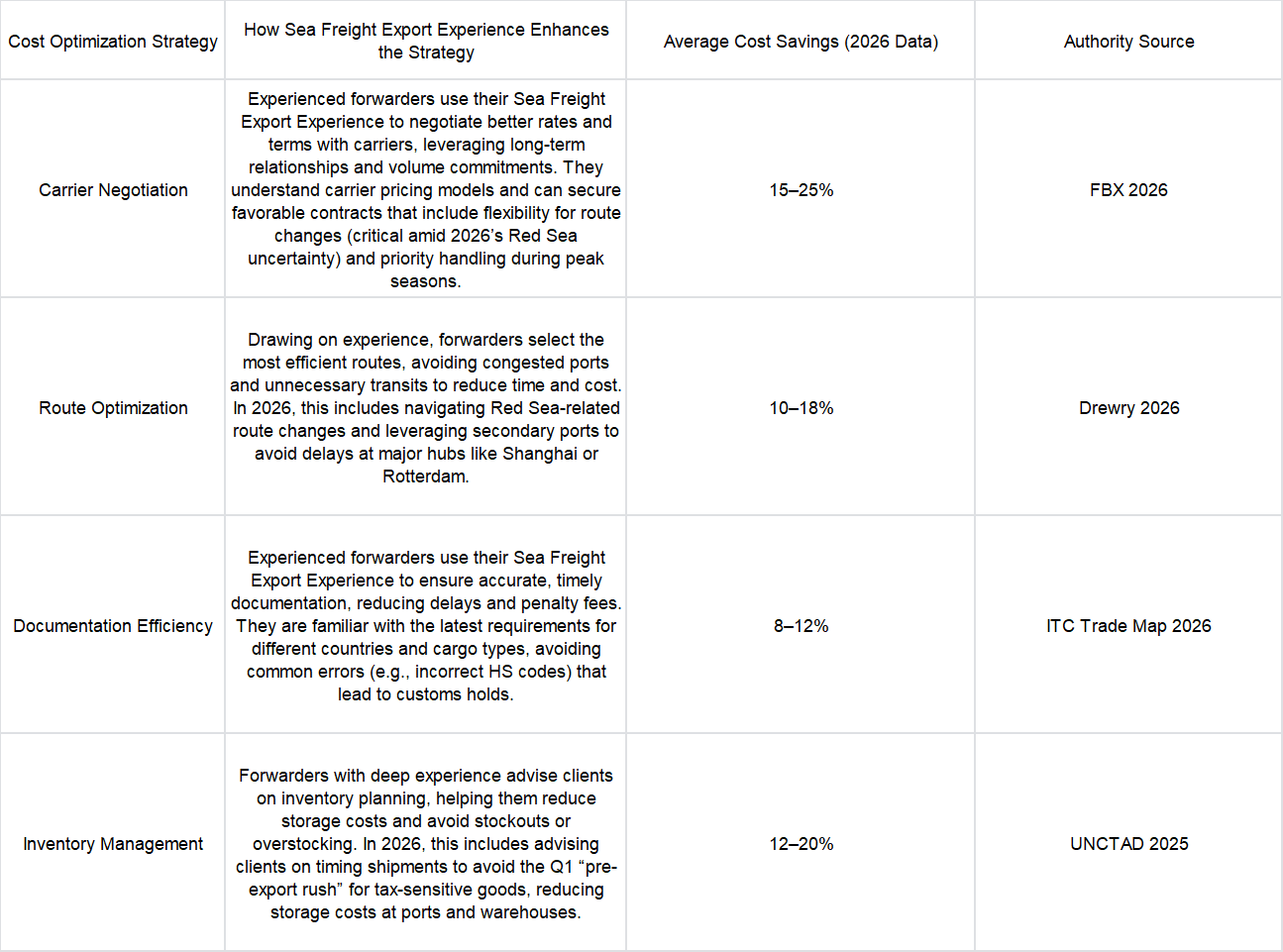
High-growth forwarders leverage their Sea Freight Export Experience to optimize costs and improve operational efficiency, creating a competitive edge that drives growth. They understand that every inefficiency and unnecessary cost erodes profitability, so they use their expertise to streamline processes and negotiate better terms.
Regular Operational Audits
The recommended approach is to conduct regular audits of operational processes, using Sea Freight Export Experience to identify inefficiencies and implement improvements. This might include investing in digital tools to automate manual tasks (e.g., documentation generation), training teams to handle complex shipments more efficiently, or renegotiating contracts with carriers and partners to secure better terms. For example, an audit might reveal that a forwarder is spending unnecessary time on manual customs documentation, prompting them to invest in an automated platform—freeing up team members to focus on high-value tasks that require Sea Freight Export Experience.
How Can Forwarders Build and Scale Their Sea Freight Export Experience?
Building and scaling Sea Freight Export Experience is a long-term process that requires intentional investment in training, mentorship, and knowledge sharing. High-growth forwarders recognize that expertise is not static—it must evolve with the industry to remain relevant and valuable, especially amid 2026’s dynamic market conditions (e.g., Red Sea route changes, export policy adjustments).
• Invest in Team Training: High-growth forwarders provide ongoing training to their teams, covering topics such as port operations, customs regulations, carrier management, and risk mitigation. According to FIATA 2026 data, forwarders that invest in training have a 33% higher employee retention rate and deliver better client service. Training should include updates on latest industry trends, such as 2026’s export tax rebate changes and Red Sea route strategies, to ensure teams have up-to-date Sea Freight Export Experience.
• Mentorship Programs: The recommended approach is to implement mentorship programs, pairing experienced team members with new hires to transfer Sea Freight Export Experience. This ensures that expertise is passed down and that the next generation of forwarders is equipped to handle industry challenges. Mentors can share real-world examples of navigating port congestion, negotiating with carriers, and resolving client issues—lessons that cannot be learned from textbooks alone.
• Knowledge Sharing Systems: High-growth forwarders create centralized knowledge sharing systems, such as databases, wikis, or regular team meetings, where employees can share insights, best practices, and lessons learned from past shipments. This ensures that Sea Freight Export Experience is not siloed with a few senior employees but is accessible to the entire team. For example, a team member might share their experience navigating customs clearance for solar panels in the EU, helping others handle similar shipments more efficiently.
• Industry Engagement: Forwarders should actively engage with the industry, attending conferences, joining trade associations (e.g., FIATA, WSC), and networking with peers. This allows them to stay updated on industry trends, emerging technologies, and best practices, enhancing their Sea Freight Export Experience. In 2026, this includes engaging with industry events focused on Red Sea route strategies and export policy changes to stay ahead of the curve.
• Data-Driven Learning: Using data from past shipments, high-growth forwarders analyze performance, identify areas for improvement, and refine their strategies. This data-driven approach, combined with Sea Freight Export Experience, allows them to make more informed decisions and scale their operations efficiently. For example, analyzing shipment data might reveal that a particular port has consistent delays during Q1, prompting the forwarder to recommend alternative ports to clients—a decision rooted in both data and experience.
A common mistake is assuming that experience comes only from time on the job. While hands-on experience is critical, high-growth forwarders accelerate the learning process by combining on-the-job training with formal education, mentorship, and industry engagement. This holistic approach ensures that their teams develop well-rounded Sea Freight Export Experience that can adapt to changing industry conditions.
What Does the Future Hold for Forwarders Who Prioritize Sea Freight Export Experience?
The future of the sea freight industry belongs to forwarders who prioritize and invest in Sea Freight Export Experience, as global trade becomes increasingly complex and competitive. As supply chains become more interconnected and disruptions more frequent, expertise will remain the most valuable asset for forwarders looking to grow and thrive.
Global Trade Projections: 2026 and Beyond
According to WTO 2026 projections, global merchandise trade growth has been revised downward to 0.5% for 2026, down from the previous forecast of 1.8%, due to global economic recovery乏力 and trade policy uncertainties. However, UNCTAD 2025 data shows that global trade continued to grow through the second half of 2025, reaching over 35 trillion USD, and 2025’s global merchandise trade growth was revised upward to 2.4%. These mixed projections mean that forwarders with strong Sea Freight Export Experience will be best positioned to capitalize on opportunities amid uncertainty, such as the Q1 2026 “pre-export rush” for tax-sensitive goods.
Digitalization and the Future of Expertise
Forwarders should note that the rise of digitalization and automation will not replace Sea Freight Export Experience; instead, it will enhance it. Technologies such as AI-powered route optimization, real-time shipment tracking, and digital documentation will free up forwarders to focus on high-value tasks that require expertise, such as client consultation, risk management, and strategic planning. For example, AI can automate routine tasks like generating bills of lading, allowing forwarders to spend more time advising clients on complex shipping strategies—leveraging their Sea Freight Export Experience to add value.
Embracing Change While Building Expertise
The recommended approach is for forwarders to embrace digital transformation while doubling down on building their Sea Freight Export Experience. By combining technology with expertise, they can create a competitive advantage that is difficult for competitors to replicate, driving sustainable growth in the years to come. This includes adapting to 2026’s key market variables—such as Red Sea route changes and export policy adjustments—and using their experience to help clients navigate these challenges.
Conclusion
High-growth freight forwarders understand that success in the sea freight industry is not about moving containers—it’s about leveraging professional Sea Freight Export Experience to create value, build trust, and navigate complexity. These forwarders prioritize expertise, customer-centricity, and continuous improvement, using their experience to mitigate risks, optimize costs, and drive long-term growth.
In an industry defined by volatility and change—from 2026’s revised global trade projections to ongoing geopolitical tensions and policy adjustments—Sea Freight Export Experience remains the cornerstone of sustainable success. Forwarders who invest in building and scaling their expertise will not only survive but thrive, outperforming competitors and capturing new opportunities in the global marketplace. As the industry evolves, the forwarders who understand that their most valuable asset is their Sea Freight Export Experience will be the ones who lead the way, shaping the future of international shipping and logistics.
Last
Avoiding Port Bottlenecks: Lessons Learned from Years of Practical Sea Freight and Export Experience
Port bottlenecks are a persistent threat to global freight forwarders, causing costly delays, lost revenue, and damaged client rel
Next
Lessons from the Frontline: Why International Logistics Success Depends on Systematic Pitfall Avoidance
In the high-stakes world of international freight forwarding, success is not just about moving cargo—it’s about avoiding the hidde

