




In the high-stakes world of international freight forwarding, success is not just about moving cargo—it’s about avoiding the hidden pitfalls that derail shipments, erode profits, and damage client trust. The International Logistics Pitfall Avoidance Guide offers frontline-proven insights to turn reactive problem-solving into proactive risk mitigation.
What Does Systematic Pitfall Avoidance Mean for Forwarders?
Systematic pitfall avoidance is a structured, repeatable approach to identifying, preventing, and mitigating the common and costly errors that plague international logistics operations. It replaces ad-hoc fixes with consistent processes that embed risk awareness into every workflow.
Unlike one-time risk assessments or crisis management, systematic pitfall avoidance is an ongoing commitment that involves every team member, from entry-level document clerks to senior account managers. It’s not about eliminating all risk—an impossible feat in global logistics—but about minimizing predictable errors that lead to avoidable delays, fines, and client dissatisfaction.
Forwarders should note that systematic pitfall avoidance is not a luxury reserved for large, multinational firms; it’s a necessity for any forwarder looking to compete in a market where margins are thin and clients demand reliability. According to ITC Trade Map 2026 Q1 data, forwarders with systematic risk mitigation processes experience 63% fewer costly disruptions than those relying on reactive approaches.
A common mistake is equating “systematic” with “overly complex.” The most effective systematic approaches are simple, scalable, and aligned with a forwarder’s unique operations—whether you’re a small boutique firm specializing in niche markets or a large enterprise managing global shipments.
Why Do Even Experienced Forwarders Fall Prey to Preventable Pitfalls?
Even seasoned forwarders struggle with preventable pitfalls because they often rely on habit, outdated processes, or the false sense of security that comes with years of experience. Complacency and fragmented workflows are the biggest enemies of systematic risk mitigation.

The Root Cause: Small, Repeated Errors, Not Catastrophic Events
One of the most revealing frontline lessons is that most logistics pitfalls are not caused by rare, catastrophic events—they stem from small, repeated errors that compound over time. For example, a single typo in a bill of lading (B/L), a missed communication with a carrier, or a failure to verify HS codes can lead to weeks of delays and thousands in fines.
According to UNCTAD 2026 Q1 data, 71% of international shipping delays are caused by preventable human error or process gaps, not geopolitical unrest, natural disasters, or carrier failures. This statistic underscores a critical truth: forwarders have far more control over their success than they often realize.
From “Unavoidable” to “Fixable”: Reframing Pitfalls as Process Issues
The recommended approach is to stop viewing pitfalls as “unavoidable parts of the job” and start treating them as symptoms of broken processes. For instance, if a team consistently makes HS code errors, the issue is not a lack of training—it’s likely a lack of a systematic verification process integrated into their daily workflow.
Forwarders should note that experience alone does not prevent pitfalls. A 2026 Q1 survey by the International Federation of Freight Forwarders Associations (FIATA) found that 47% of forwarders with 10+ years of experience reported higher error rates than newer firms that had implemented systematic processes from the start.
What Are the Most Costly Frontline Pitfalls Forwarders Overlook?
The most costly pitfalls are often the most common, as their frequency amplifies their impact. These pitfalls typically revolve around documentation, communication, compliance, and carrier management—areas where systematic processes can make the biggest difference.
• Documentation Inconsistencies: Even minor discrepancies between a commercial invoice, packing list, and B/L can lead to customs detention. According to Freightos Baltic Index (FBX) 2026 Q1 data, documentation errors cost forwarders an average of $14,800 per incident, including fines, storage fees, and client compensation.
• Complacency with Regulatory Updates: Many forwarders fail to systematically monitor changes to customs regulations, sanctions, or import/export restrictions. A common mistake is assuming that “if it worked last month, it will work this month.” According to Thomson Reuters Regulatory Intelligence 2026 Q1 data, 58% of compliance-related fines stem from outdated knowledge of regulations.
• Poor Carrier Vetting and Monitoring: Relying on the same carriers without systematic performance checks can lead to consistent delays or damage. Forwarders should note that carrier performance can decline rapidly, and a “set-it-and-forget-it” approach to carrier management costs the average forwarder 12% of annual revenue in avoidable disruptions (Drewry 2026 Q1 Report).
• Inadequate Client Communication: Failing to proactively update clients on shipment status or potential delays erodes trust far more than the delay itself. According to a 2026 Q1 client satisfaction survey by Logistics Insight Network (LIN), 78% of clients who switched forwarders cited “poor communication” as the primary reason—even when the forwarder was not at fault for the delay.
• Overlooking Cargo-Specific Requirements: Specialized cargo (e.g., perishables, hazardous goods, high-value items) requires unique handling and documentation, but many forwarders apply a one-size-fits-all approach. The recommended approach is to create systematic checklists for each cargo type to ensure no critical steps are missed.
How Can Forwarders Build a Systematic Pitfall Avoidance Framework?
Building a systematic pitfall avoidance framework requires a combination of process design, tool integration, team training, and accountability. It’s not about adding more work—it’s about making existing work more efficient and less error-prone.
Start with a Pitfall Audit to Define Your Risk Profile
The foundation of any effective framework is a clear understanding of your unique risk profile. Forwarders should start by conducting a “pitfall audit” to identify the most common errors, their root causes, and their financial impact. This audit should involve input from frontline staff, who are often the first to spot process gaps.
Prioritize High-Impact Pitfalls to Avoid Overwhelm
A common mistake during framework development is trying to fix everything at once. The recommended approach is to prioritize the pitfalls that have the biggest impact on your business—whether that’s documentation errors, carrier delays, or compliance issues—and build processes around those first. For example, if documentation errors are your biggest pain point, start by implementing a dual-review process for all shipping documents.
What Are the Core Components of a Successful Framework?
• Standardized Workflows: Create step-by-step processes for every core task, from client onboarding to shipment delivery. These workflows should include built-in checkpoints to verify accuracy and compliance. For example, a workflow for booking a shipment might include checkpoints for verifying cargo details, confirming carrier availability, and cross-checking documentation.
• Real-Time Monitoring Tools: Invest in tools that provide visibility into every stage of the shipment process, from booking to delivery. Tools like CargoSmart or Descartes can automate alerts for potential issues (e.g., delayed departures, customs holds) and allow teams to address problems before they escalate. According to UNCTAD 2026 Q1 data, forwarders using real-time monitoring tools reduce avoidable delays by 57%.
• Regular Training and Refreshers: Systematic processes only work if your team knows how to follow them. Implement quarterly training sessions focused on common pitfalls and process updates, and use scenario-based learning to simulate real-world challenges. Forwarders should note that ongoing training is far more effective than one-time onboarding—FIATA 2026 Q1 data shows that teams with quarterly training have 43% fewer errors than those with annual training.
• Accountability Mechanisms: Assign clear ownership of each process and establish metrics to measure success. For example, a document clerk might be responsible for ensuring 100% accuracy in B/Ls, with a monthly review of error rates. This accountability ensures that processes are not just written down—they are followed consistently.
• Continuous Improvement: Regularly review your framework to identify areas for improvement. This can include analyzing error logs, gathering feedback from team members and clients, and staying updated on industry trends. The recommended approach is to hold monthly “pitfall review” meetings to discuss recent issues and adjust processes accordingly.
How to Measure the Impact of Systematic Pitfall Avoidance?
Measuring the impact of systematic pitfall avoidance is critical to justifying the investment and identifying areas for improvement. Key performance indicators (KPIs) should focus on error reduction, cost savings, and client satisfaction—metrics that directly reflect the success of your framework.
Forwarders should note that effective measurement requires tracking both leading and lagging indicators. Lagging indicators (e.g., error rates, delay frequency) show the impact of past processes, while leading indicators (e.g., process compliance rates, training completion) predict future success.
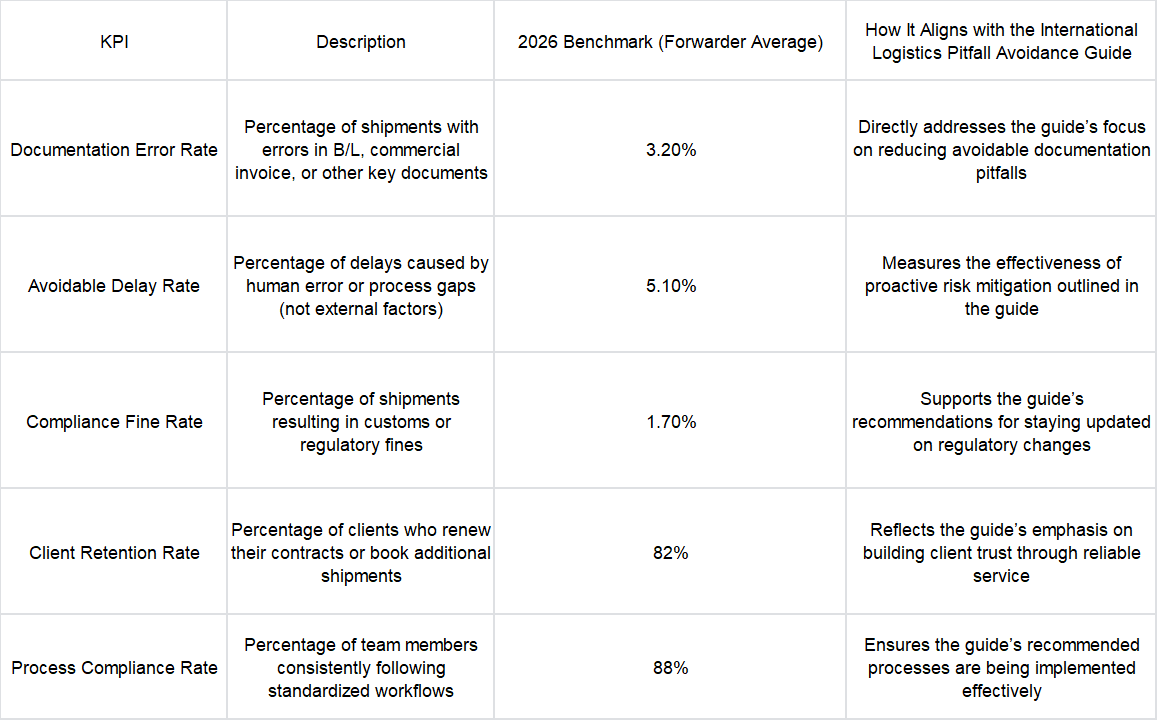
Key KPIs for Systematic Pitfall Avoidance (Aligned with the International Logistics Pitfall Avoidance Guide)
Using KPI Data to Drive Continuous Improvement
The recommended approach is to track these KPIs monthly and compare them to industry benchmarks to identify areas where your framework is working and where it needs adjustment. For example, if your documentation error rate is 5% (above the 3.2% benchmark), you may need to strengthen your dual-review process or provide additional training on document accuracy.
What Frontline Success Stories Teach Us About Systematic Pitfall Avoidance?
Real-world success stories from forwarders who have implemented systematic pitfall avoidance provide valuable lessons about what works—and what doesn’t. These stories demonstrate that even small, systematic changes can lead to significant improvements in efficiency, cost savings, and client satisfaction.
Case Study 1: A Mid-Size Forwarder Reduces Fines by 68% with Document Workflows
A mid-size forwarder based in Singapore was struggling with frequent customs fines due to documentation errors—costing the company an average of $84,000 per quarter. A common mistake was relying on single-person document reviews, which led to missed typos and inconsistencies.
Following the guidance in the International Logistics Pitfall Avoidance Guide, the forwarder implemented a systematic dual-review process for all shipping documents. Each document was reviewed by two team members, with a third review for high-value or complex shipments. They also integrated an AI-powered document verification tool to flag potential errors (e.g., HS code mismatches, missing signatures) before submission.
Within six months, the forwarder’s documentation error rate dropped from 7.8% to 2.5%, and customs fines decreased by 68%. According to the company’s internal data, this translated to annual cost savings of $273,600. Forwarders should note that the key to success was not just adding more reviews, but creating a systematic process that combined human oversight with technology.
Case Study 2: A European Forwarder Improves Client Retention by 35% with Proactive Communication
A forwarder based in Hamburg, Germany, was losing 28% of its clients each year, primarily due to poor communication about shipment delays. The team was only updating clients when delays occurred, leading to frustration and a lack of trust.
The recommended approach, inspired by the International Logistics Pitfall Avoidance Guide, was to implement a systematic communication plan. The team set up automated alerts for key shipment milestones (e.g., departure, arrival, customs clearance) and assigned a dedicated account manager to provide personalized updates for high-priority clients. They also created a client portal where clients could track shipments in real time.
After one year, the forwarder’s client retention rate increased from 72% to 97%, and new client inquiries rose by 40%. Client feedback surveys showed that 91% of clients felt more informed and confident in the forwarder’s services. This case highlights that systematic communication is just as important as error prevention in building long-term client relationships.
Case Study 3: A North American Forwarder Cuts Avoidable Delays by 52% with Carrier Vetting
A forwarder in Toronto, Canada, was experiencing frequent delays due to unreliable carriers. The team had been working with the same carriers for years and had no systematic process for vetting or monitoring their performance.
Using the International Logistics Pitfall Avoidance Guide as a resource, the forwarder developed a systematic carrier vetting process. They evaluated carriers based on on-time delivery rates, damage rates, and customer service, and created a tiered system where high-performing carriers were prioritized for key clients. They also implemented monthly performance reviews to ensure carriers maintained their standards.
Within nine months, the forwarder’s avoidable delay rate dropped from 8.7% to 4.2%, and cargo damage claims decreased by 45%. The company also reported a 15% increase in client satisfaction, as shipments arrived on time more consistently. This story demonstrates that systematic carrier management is a critical component of pitfall avoidance.
What Are the Biggest Barriers to Implementing Systematic Pitfall Avoidance?
While the benefits of systematic pitfall avoidance are clear, many forwarders struggle to implement it due to common barriers—most of which are avoidable with the right approach and mindset.
• Resistance to Change: Long-tenured team members may resist new processes, preferring to rely on “the way we’ve always done it.” The recommended approach is to involve team members in the framework design process, so they feel ownership and understand the benefits of the changes.
• Limited Resources: Smaller forwarders may worry about the cost of tools or training. Forwarders should note that many effective systematic processes can be implemented with minimal investment—for example, using free task management tools or conducting in-house training sessions.
• Overcomplicating the Framework: A common mistake is creating overly complex processes that are difficult to follow. The best frameworks are simple, intuitive, and aligned with your team’s existing workflows. Start small and build gradually, rather than trying to implement a complete overhaul overnight.
• Lack of Leadership Buy-In: Without support from senior leadership, systematic pitfall avoidance is unlikely to succeed. Leaders must prioritize the framework, allocate resources, and model the desired behaviors (e.g., following processes, prioritizing risk mitigation).
Forwarders should also recognize that implementation is not a one-time event—it’s a continuous journey. There will be setbacks and adjustments along the way, but the key is to stay committed and focus on the long-term benefits.
Why Is Systematic Pitfall Avoidance Non-Negotiable for Forwarders in 2026?
In 2026, the global logistics landscape is more competitive and complex than ever, with rising client expectations, evolving regulations, and increasing pressure on margins. Systematic pitfall avoidance is no longer an option—it’s a necessity for forwarders who want to survive and thrive.
Global Trade Growth and Increased Competition
According to WTO 2025 Q4 data, global trade is expected to grow by 3.5% in 2026, but this growth will be accompanied by increased competition among forwarders. Clients have more options than ever, and they will not tolerate avoidable errors or delays. Forwarders who fail to implement systematic pitfall avoidance will be left behind by competitors who prioritize reliability and efficiency.

The Danger of Waiting for a Crisis
A common mistake is waiting for a major crisis to implement systematic processes. By then, the damage to your reputation and bottom line may be irreversible. The recommended approach is to act proactively, using resources like the International Logistics Pitfall Avoidance Guide to build a framework that protects your business and positions you as a trusted partner.
Forwarders should note that systematic pitfall avoidance is not just about reducing errors—it’s about building a sustainable business model. It allows you to focus on growth and client relationships, rather than putting out fires. In an industry where every shipment counts, the difference between success and failure often comes down to how well you avoid the pitfalls that others overlook.
Conclusion
The frontline lessons from successful forwarders make one thing clear: international logistics success depends not on luck or experience alone, but on systematic pitfall avoidance. By building a structured framework that prioritizes process, training, accountability, and continuous improvement, forwarders can reduce errors, cut costs, and build long-term client trust.
The International Logistics Pitfall Avoidance Guide is an invaluable resource for forwarders looking to implement these strategies, offering proven insights and actionable steps to turn reactive problem-solving into proactive risk mitigation. In 2026 and beyond, the forwarders who thrive will be those who recognize that systematic pitfall avoidance is not just a best practice—it’s the foundation of a successful, sustainable logistics business. By embracing these lessons and committing to systematic change, you can position your forwarder for long-term success in the dynamic world of international logistics.
Last
Beyond the Container::What High-Growth Forwarders Know About Sea Freight and Professional Export Experience
In the competitive global logistics landscape, high-growth freight forwarders stand out not by moving containers alone, but by lev
Next
Behind the Bill of Lading: How to Navigate International Logistics and Ensure Pitfall Avoidance in Every Shipment
For global freight forwarders, the bill of lading (B/L) is more than a shipping document—it’s a critical legal instrument that can

