






Prologue: A Routine Shipment Turns into a Cross-Border Dispute
In early spring 2026, an international logistics company in Vietnam received an order to transport a high-precision optical inspection machine, valued at approximately US$75,000, from eastern China to a major electronics assembly plant in Vietnam.
The Vietnamese company entrusted a Shenzhen-based freight forwarder, with whom it had worked for years, to handle the first leg of the shipment, including factory pickup, wooden-crate packing, inland transportation in China, export customs clearance, and delivery to the China-Vietnam border.
Everything appeared to be proceeding smoothly.
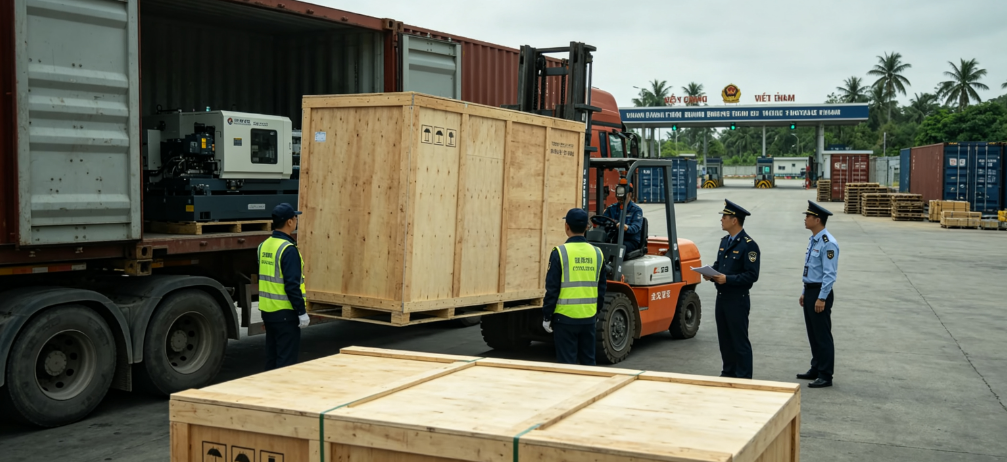
In mid-April, the truck arrived at the Vietnamese border with the outer packaging apparently intact. The Vietnamese company then arranged for the machine to be transferred to a flatbed truck for the onward journey.
But when the equipment arrived at the factory and was unpacked, everyone was stunned.
The machine was tilted. The base was broken. The marble support column was shattered. The precision spindle had been deformed.
The original manufacturer quoted more than US$18,000 for repairs, while the customer initially claimed damages of up to US$37,000.
The Vietnamese company asked the Shenzhen freight forwarder to provide photos and videos taken during loading and transportation. The Shenzhen company provided video footage showing that the outer packaging and securing appeared to be intact when the shipment reached the border. It argued that the damage may have occurred during the subsequent short-haul transportation in Vietnam.
Both sides stood their ground. And neither could conclusively establish where the damage had occurred.
Act I: The Cargo Damage Remained Unresolved—But Trust Collapsed First
At the end of April, before the cargo damage dispute had been resolved, the Shenzhen company sent the Vietnamese company a bill for approximately US$30,000 and demanded immediate payment, warning that otherwise it would “hold all subsequent shipments.”
It happened to be a public holiday in Vietnam. The Vietnamese company said it would make payment as soon as the holiday ended.
The Shenzhen company refused to wait.
It went even further, holding two other trucks belonging to the Vietnamese company that were already operating in Vietnam.
Eventually, the Vietnamese company was forced to pay approximately US$19,000.
In writing, it stated that the payment covered the freight charges associated with the disputed shipment, while explicitly reserving its right to pursue a claim for the cargo damage.
But after receiving the payment, the Shenzhen company’s contact person suddenly disappeared.Calls went unanswered. WeChat messages received no response. Emails were ignored.
Act II: Two Trucks Turn a Commercial Dispute into a Cross-Border Standoff
Frustrated and increasingly concerned, the Vietnamese company, together with the end customer, sent formal letters to the relevant authorities and sought to have the Shenzhen company’s two other trucks detained, citing the unresolved cargo damage claim and the other party’s refusal to cooperate.
The Shenzhen company strongly objected, calling the action an unlawful detention.
It threatened to contact the Chinese Embassy and relevant authorities in Vietnam, while also demanding compensation for vehicle detention costs exceeding US$1,300 per day.
What had started as a cargo damage dispute worth tens of thousands of dollars had rapidly escalated into a complex cross-border conflict involving vehicle detention, cargo claims, detention charges, and the breakdown of a long-standing business relationship.
Act III: JCtrans Steps In and Reconstructs the Evidence Within 24 Hours
Just as the dispute appeared to be heading toward litigation, JCtrans’ Risk Control team stepped in to mediate.
The team quickly collected and reviewed the evidence from both sides, including:
·Loading and transportation videos provided by the Shenzhen company;
·The Vietnamese company’s complete unpacking video;
·A third-party inspection report;
·The original manufacturer’s repair quotation of more than US$18,000;
·Two months of emails and communication records between the parties.
The evidence showed that while the outer packaging remained intact, there were still questions surrounding the internal securing and packing method.
Based on the available evidence, neither party could conclusively establish sole responsibility for the damage.
JCtrans therefore organized a three-way conference call and encouraged both sides to shift their focus from “Who is responsible?” to “How can we resolve this?”
Act IV: Both Sides Compromise and the Dispute Finally Comes to an End
After negotiations, the parties reached an agreement on compensation.
The Shenzhen company agreed to pay US$6,500 in compensation for the cargo damage.
At the end of May, the compensation was transferred to a designated JCtrans escrow account. The Vietnamese company then proceeded with the release of the two trucks, which safely returned to China in early June.
JC Pay subsequently initiated the settlement process.
As a first-time JC Pay user, the Vietnamese company completed account registration, identity verification, and invoice submission with the assistance of JCtrans staff.
The US$6,500 compensation was successfully received within just two business days.
A cross-border logistics dispute that had nearly escalated into a legal battle had finally come to an end.
Seven Golden Rules for Cross-Border Logistics Companies
1. Define Responsibility in the Contract
Who is responsible for packing? What packing standards must be followed? Who bears liability if cargo is damaged?
These responsibilities must be clearly defined in the contract.
Never rely solely on verbal agreements.
2. Preserve Evidence Before a Dispute Happens
Take photos and videos throughout critical stages of the shipment, including loading, packing, securing, handover, transportation, delivery, and unpacking.
When something goes wrong, evidence is far more valuable than arguments.
3. Never Disappear When a Dispute Arises
Being highly responsive when collecting payment but becoming unreachable when a dispute occurs will only make matters worse.
Maintaining communication keeps the door open for negotiation and resolution.
4. Leave a Clear Record When Making a Disputed Payment
When making payment in connection with a disputed transaction, clearly state that the payment does not constitute a waiver of any rights or claims relating to the disputed matter.
A clear written record can prevent unnecessary legal disputes later.
5. Think Twice Before Using Extreme Measures Such as Detaining Vehicles
Detaining a vehicle may appear to provide additional leverage in a dispute.
But it can also create exposure to detention charges, liability claims, and even cross-border legal risks.
Unless absolutely necessary, do not casually press the “escalate” button.
6. Put Platform-Based Safeguards in Place Before Problems Occur
If the parties had used a JCtrans Credit Assurance Order from the outset, payment, performance, and dispute handling could have been brought under a structured platform mechanism.
When an abnormal situation emerged, the platform could have stepped in earlier—rather than waiting until the dispute had already escalated into a crisis.
7. Prevention Will Always Be Better Than Damage Control
The cargo damage itself may have been nothing more than a business incident.
What truly turned it into a major crisis was the chain reaction that followed:
communication breakdown → payment dispute → vehicle detention → cross-border escalation.
In cross-border logistics, preventing that chain reaction is often more important than resolving the original dispute after it has exploded.
Epilogue: Cargo Can Be Repaired. Trust Is Much Harder to Restore.
The dispute ultimately ended with a US$6,500 settlement.But the trust that had been built through years of cooperation had also been put through a serious test.
For cross-border logistics companies, what moves across borders is not just cargo.
It is also trust, credibility, and the business relationship between partners.
A damaged machine can be repaired.A financial loss can be recovered.
But once trust is broken, no amount of time or money can guarantee that the relationship will return to what it once was.
In cross-border logistics, the real cost of a dispute is often far greater than the value of the cargo itself.

Last
The Same DDP Shipment, Yet a $1,300 Difference in Duties: How One Customs Clearance Document Triggered a Dispute
USD 2,574.53 vs. USD 3,874.73.For the same DDP shipment and the same destination customs clearance process, why did the two partie

Next
A 7-Container Shipment Turned into a Cost Trap: Fair Quotes Upfront, Surprise Charges After Sailing
In freight forwarding, the most dangerous risks are not vessel delays or port congestion—they're the hidden costs that appear only

