


Nigeria's anti-narcotics agency said on Sunday (January 4) it had arrested 22 crew members of a cargo ship after discovering about 32 kilograms of cocaine on board in Lagos.
The seizure was made on January 2 on board the vesseluna Hulya, said Femi Babafemi, spokesperson for the National Drug Law Enforcement Agency (NDLEA), in a statement.
The bulk carrier Ar Hulya, which departed from Santos, Brazil, in November, a port regarded by many in the industry as a cocaine smuggling hub, began its transatlantic voyage and in Lagos, Nigeria, on December 26, docking at the Lagos Gateway Terminals (LGT) complex.
Nigeria and its neighbors have new waystations in an evolving drugs network connecting the cocaine-producing regions of South America with users in Europe. The drugs arrive in the region in vessels from Brazil, and there are transshipped into "clean" containerized cargo for onward shipment to European seaports.
Once in Europe, containers from Nigeria arouse less suspicion those from Santos, and the consignment may be more likely to evade customs inspections.
Often, the crew of a merchant vessel has no idea that cocaine cargo is in their ship's hold, cabin or freshwater tanks. Syndicates working in collusion with port workers often stash the drugs without the crew's knowledge, and then recover at the other end. Even when crew members are involved, it is usually limited to a few; nonetheless, some jurisdictions hold all crew members responsible when drugs are found on board.
Nigeria has carried out large-scale arrests before. In November, Nigerian officials detained all 20 crew members of the bulk carrier Nord Bosporus after discovering 0 kilograms of cocaine in its cargo. Like Aruna Hulya, Nord Bosporus's previous port of call was also Santos, Brazil
Last
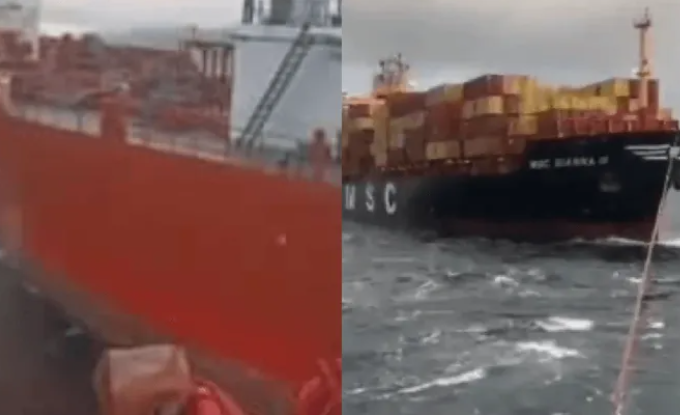
MSC Container Ship and an Oil Tanker in Distress in Turkish Waters One After the Other
On January 3 and 4, the General Directorate of Coastal Safety (KEGM) of Turkey reported two separate incidents of failure in Turki

Next
2.14 Trillion Yuan! China-South Korea Trade is Steadily Rising, and Economic and Trade Cooperation is Moving Deeper and Further.
Customs statistics show that between January and November 2025, the total import and export value of China-South Korea 2.14 trilli

