As global trade rebounds in 2026, China’s import policies continue to move toward liberalization and facilitation, with paperless declaration and preferential tax policies serving as the two core drivers to accelerate customs clearance. For global freight forwarders, mastering these two key strategies is essential to improving operational efficiency, reducing costs, and gaining a competitive edge in China’s vast import market.
As the world’s second-largest import market for 18 consecutive years, China has been optimizing its import regulatory system to simplify procedures and lower barriers. In 2026, the further promotion of paperless declaration and adjustments to tax incentives have brought new opportunities and operational standards for freight forwarders. This guide details the specific requirements, operational steps, common pitfalls, and practical strategies of China’s paperless import declaration and tax incentives, helping global freight forwarders adapt to China’s import policies and achieve efficient, compliant customs clearance.
What is China’s paperless import declaration and why is it crucial for freight forwarders?
China’s paperless import declaration refers to the process by which freight forwarders or importers submit electronic declarations, electronic documents, and other materials through the China International Trade Single Window, replacing traditional paper documents for customs clearance. It is a core measure of China’s import policies to optimize customs clearance efficiency and reduce operational costs.
With the deepening of China’s digital trade reform, paperless declaration has become a mandatory requirement for most imported goods, and its coverage and scope of application are constantly expanding. For freight forwarders, mastering paperless declaration is not only a compliance requirement but also a key way to shorten customs clearance time, reduce document management costs, and improve customer satisfaction.
What are the core requirements for China’s paperless import declaration in 2026?
In 2026, China’s General Administration of Customs (GACC) further optimized the paperless declaration system, clarifying core requirements for document standards, system operation, and compliance management. Freight forwarders must strictly abide by these requirements to avoid customs clearance delays or penalties.
• Electronic Document Requirements: All declaration documents must be submitted in electronic form, including commercial invoices, packing lists, bills of lading, certificates of origin, and other relevant supporting documents. According to GACC (2026) data, the electronic document compliance rate must reach 100% for paperless declaration, and any missing or inconsistent electronic documents will directly result in declaration rejection.
• System Operation Requirements: All paperless declarations must be completed through the China International Trade Single Window (www.singlewindow.cn), and freight forwarders must complete enterprise real-name authentication and system authorization. The use of third-party non-official platforms for declaration is prohibited; otherwise, the declaration results will be deemed invalid.
• Data Consistency Requirements: The information in the electronic declaration form must be completely consistent with that in the electronic documents (e.g., commodity name, specification model, quantity, unit price, and HS code). According to Shanghai Shipping Exchange (2025) data, 60% of paperless declaration failures are caused by inconsistent data between the declaration form and supporting documents.
• Electronic Archiving Requirements: After completing customs clearance, freight forwarders must archive all electronic documents and declaration records for at least 5 years. Customs will conduct random inspections of electronic archives, and failure to archive or incomplete archives will result in fines ranging from RMB 10,000 to RMB 50,000.
How to complete China’s paperless import declaration efficiently in 2026?
Efficient paperless declaration requires freight forwarders to establish a standardized operational process—from document preparation to declaration submission and result feedback—to ensure every link is accurate and efficient. Below is a step-by-step operational guide combined with practical experience:
1. Step 1: Confirm the declaration scope: First, confirm whether the imported goods are eligible for paperless declaration. Currently, except for a small number of special goods (e.g., dangerous goods, fresh and perishable goods with special inspection requirements), 98% of imported goods in China can be declared paperlessly. According to GACC (2026) data, the coverage rate of paperless declaration for imported goods in China reached 98.5% in 2026, an increase of 3 percentage points compared with 2025.
2. Step 2: Prepare electronic documents: Collect and sort out all electronic documents required for declaration, ensuring they are true, complete, and consistent. A recommended practice is to establish a document review mechanism, assigning special personnel to check electronic documents one by one, focusing on verifying the consistency of the HS code, commodity name, and quantity with the actual goods.
3. Step 3: Fill in the electronic declaration form: Log in to the China International Trade Single Window, select the "import declaration" module, and truthfully fill in the declaration information in accordance with the electronic documents. Freight forwarders should note that the HS code must be accurately classified in line with the latest "China Import and Export Tariff Schedule"; any misclassification will lead to tax miscalculations and customs clearance delays.
4. Step 4: Submit the declaration and wait for review: After completing the form, submit the electronic declaration and supporting documents. Customs will conduct either automatic or manual review based on the risk level of the goods. According to Shanghai Shipping Exchange (2025) data, the average review time for paperless declarations is 1-2 hours, 70% shorter than that for traditional paper declarations.
5. Step 5: Handle tax payment and customs clearance: If the declaration is approved, the system will automatically generate a tax payment notice. Freight forwarders should assist customers in completing electronic tax payment in a timely manner. Once tax is paid, customs will issue an electronic release notice, allowing the goods to be picked up or transported.
What are the common mistakes and precautions for paperless declaration?
In the actual operation of paperless declaration, many freight forwarders encounter customs clearance delays or penalties due to ignoring details. Below are common mistakes and key precautions summarized from practical cases:
• Common Mistake 1: Ignoring the validity of electronic documents: Some freight forwarders use expired electronic documents (e.g., expired certificates of origin) for declaration, leading to rejection. Freight forwarders should note that all electronic documents must be within their validity period, with clear marking of information such as the issue date and expiration date.
• Common Mistake 2: Inconsistent data between Chinese and English documents: For imported goods requiring both Chinese and English documents, the information in both versions must be completely consistent. A common mistake is inconsistency between the commodity name in the English invoice and its Chinese translation in the declaration form, which triggers manual review and delays.
• Common Mistake 3: Failure to update the declaration system in a timely manner: The China International Trade Single Window is updated irregularly, and some freight forwarders fail to update the system promptly, resulting in functional failures or submission errors. A recommended practice is to assign special personnel to check for system updates daily and update the system in a timely manner.
• Key Precaution: Establish a risk early warning mechanism: For high-risk goods (e.g., medical devices, food, and cosmetics), freight forwarders should conduct pre-declaration risk assessments, confirm regulatory requirements in advance, and avoid declaration errors caused by unclear policies. Additionally, maintain close contact with customs and respond promptly to customs inquiries and review requirements.
What are the key tax incentives in China’s import policies for 2026?
China’s import tax incentives are an important component of its import policies, formulated to encourage the import of goods needed for national economic and social development. These include temporary tax rates, preferential tax rates under free trade agreements, and tax exemptions for specific goods.
In 2026, the State Council Tariff Commission issued the "2026 Tariff Adjustment Plan", which further optimized import tax incentive policies, expanding the scope of goods eligible for preferential treatment and increasing the intensity of tax reductions. For global freight forwarders, familiarity with these tax incentives can help customers reduce import costs and enhance the competitiveness of their goods in the Chinese market.
What types of commodities are eligible for China’s import tax incentives in 2026?
In 2026, China’s import tax incentives mainly cover four categories of commodities. Freight forwarders must accurately grasp the scope of application to help customers apply for preferential treatment in a timely manner. The specific categories and preferential measures are as follows:
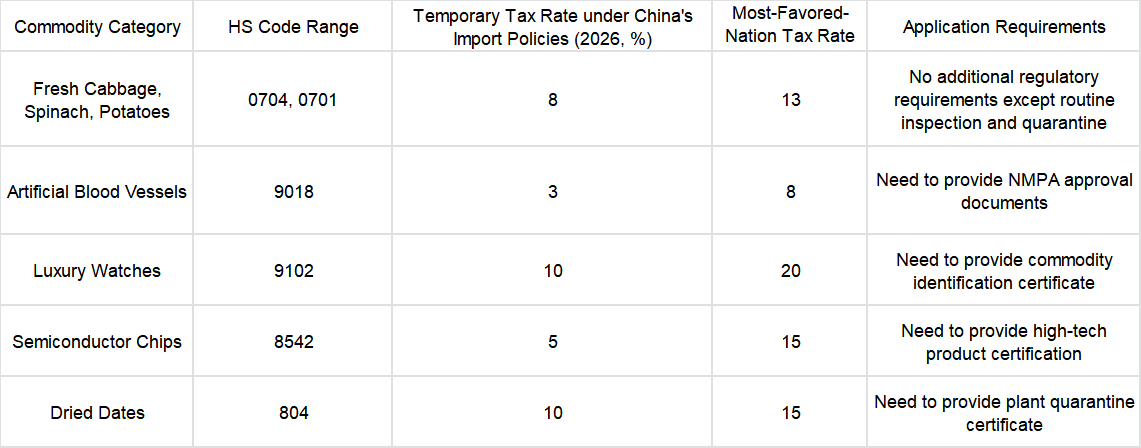
• Agricultural Products: China implements temporary import tax rates for 935 commodities, including various agricultural products. According to the "2026 Tariff Adjustment Plan", the temporary tax rate for some fresh vegetables and fruits is 30% to 50% lower than the most-favored-nation (MFN) tax rate. For example, the temporary tax rate for fresh cabbage is 8%, compared to the MFN rate of 13%.
• Medical Devices: To meet domestic demand for medical and healthcare services, China has reduced import tax rates for livelihood-related medical products. According to GACC (2026) data, the import tax rate for artificial blood vessels has been reduced from 8% to 3%, and the tax rate for some infectious disease diagnostic kits has been cut by 50%.
• High-tech Products: To promote technological innovation, China implements preferential tax rates for imported high-tech products such as semiconductors, precision instruments, and new energy equipment. The temporary tax rate for some high-tech products is 10% to 40% lower than the MFN tax rate.
• Consumer Goods: To meet domestic demand for high-quality consumer goods, China has reduced import tax rates for high-end consumer goods such as luxury watches, perfumes, and high-end clothing. For example, the import tax rate for luxury watches has been reduced from 20% to 10%.
How to apply for China’s import tax incentives correctly?
Applying for China’s import tax incentives requires strict compliance with application procedures and document requirements. Freight forwarders must assist customers in completing the application process in accordance with regulations to ensure they can successfully enjoy the preferential policies. The specific application steps are as follows:
• Confirm eligibility for preferential treatment: First, confirm whether the imported goods are included in the scope of tax incentives. A recommended practice is to check the latest "2026 Tariff Adjustment Plan" and the list of preferential goods released by GACC, and accurately confirm the HS code and preferential tax rate of the goods.
• Prepare application materials: Prepare corresponding application materials based on the type of preferential policy. For example, to apply for preferential tax rates under a free trade agreement, a certificate of origin issued by the exporting country is required; to apply for a temporary tax rate, relevant certification materials for the goods are needed.
• Submit the application during declaration: When submitting the paperless declaration, fill in the relevant tax incentive information in the declaration form and upload the application materials. Freight forwarders should note that the application materials must be true and complete; any false materials will result in the revocation of preferential treatment and penalties.
• Cooperate with customs verification: Customs may conduct random verification on goods applying for tax incentives. Freight forwarders should assist customers in providing relevant supporting materials and cooperating with customs verification to ensure the smooth progress of the verification process.
What is the comparison of tax rates under China's import policies in 2026?
To help freight forwarders better grasp tax incentives, the following table compares the temporary tax rate, MFN tax rate, and application scope of some key commodities under China’s import policies in 2026, which can be used as a reference for daily operations:
How to integrate paperless declaration and tax incentives to accelerate customs clearance?
For global freight forwarders, integrating paperless declaration and tax incentive strategies is key to achieving efficient customs clearance and cost reduction. By optimizing operational processes and strengthening coordination between the two, customs clearance efficiency can be significantly improved, and customers’ import costs can be reduced.
• Optimize the document preparation process: When preparing electronic documents for paperless declaration, simultaneously sort out materials required for tax incentive applications and integrate the two sets of materials to avoid redundant preparation. A recommended practice is to establish a unified document management system to classify and manage electronic documents and tax application materials, improving document preparation efficiency.
• Coordinate declaration and tax application timelines: Submit the tax incentive application alongside the paperless declaration to avoid delays caused by separate submissions. Freight forwarders should note that the information in the tax application materials must be consistent with that in the paperless declaration form to avoid review conflicts.
• Strengthen communication with customers and customs: Communicate with customers in advance to confirm the tax incentive eligibility of the goods and the required materials, and timely feedback declaration progress and tax application results to customers. Meanwhile, maintain close contact with customs to understand the latest review standards and promptly resolve issues encountered during declaration and tax application.
• Establish a professional team: Assign professional personnel responsible for paperless declaration and tax incentive applications, who are familiar with China’s import policies, declaration procedures, and tax regulations. Regularly organize training to update the team’s professional knowledge and improve operational capabilities.
What are the latest policy trends of China's import policies in 2026?
In 2026, China’s import policies will continue to develop toward liberalization, facilitation, and refinement, with further optimization of paperless declaration and tax incentive policies. Understanding these trends can help freight forwarders adjust their operational strategies in advance and seize business opportunities.
• Further expansion of paperless declaration coverage: According to GACC’s plan, by the end of 2026, the coverage rate of paperless declaration for imported goods in China will reach 100%, and customs will gradually cease accepting traditional paper declarations. Freight forwarders need to accelerate the transition to paperless operations and improve their enterprises’ informatization level.
• Expansion of tax incentive scope: China will further expand the scope of goods eligible for import tax incentives, focusing on increasing support for high-tech products, green and low-carbon products, and livelihood-related products. According to World Trade Organization (WTO, 2025) data, China’s import tax reduction and exemption scale will reach 100 billion yuan in 2026, a 15% increase compared with 2025.
• Intelligent upgrading of customs clearance: China will further promote the application of artificial intelligence, big data, and other technologies in customs clearance, realizing intelligent review, intelligent inspection, and intelligent release of paperless declarations. According to Shanghai Shipping Exchange (2025) data, the intelligent review rate of paperless declarations will reach 80% in 2026, further shortening customs clearance time.
Practical suggestions for global freight forwarders to adapt to China's import policies
Combined with the latest policy trends and practical operational experience, the following practical suggestions are provided for global freight forwarders to help them better adapt to China’s import policies, master paperless declaration and tax incentive strategies, and achieve efficient, compliant operations:
• Establish a real-time policy tracking mechanism: Assign special personnel to track the latest policies released by GACC, the Ministry of Commerce (MOFCOM), and the State Taxation Administration, subscribe to official announcements and policy interpretation materials, and establish a policy update database. A recommended practice is to cooperate with professional policy research institutions to ensure the accuracy and timeliness of policy information.
• Strengthen professional training for employees: Regularly organize employee training on China’s import policies, focusing on paperless declaration operations, tax incentive applications, HS code classification, and other content. Encourage employees to obtain professional qualifications such as customs broker and inspection declarer to improve their professional capabilities.
• Optimize the document review process: Establish a strict document review system, assigning special personnel to review electronic documents and tax application materials, focusing on verifying the consistency and completeness of information. For high-risk goods, increase review intensity to avoid declaration errors and compliance risks.
• Strengthen cooperation with customs brokers and suppliers: Cooperate closely with professional customs brokers familiar with the latest customs clearance processes and policy requirements to improve customs clearance efficiency. Meanwhile, strengthen communication with overseas suppliers, guiding them to understand China’s import policies and standardize document preparation and goods packaging.
• Establish a risk management system: Conduct risk assessments for each import order, identify potential compliance risks (e.g., policy changes, inconsistent documents, unqualified goods), and formulate corresponding risk response plans. For high-risk orders such as medical devices and food, increase review intensity to ensure compliant operations.
Conclusion
In 2026, China’s import policies will continue to move toward liberalization and facilitation, with paperless declaration and tax incentives serving as the core drivers for accelerating customs clearance. For global freight forwarders, mastering these two key strategies is not only a compliance requirement but also a key to seizing business opportunities in China’s import market. By understanding the core requirements, operational steps, and common pitfalls of paperless declaration, accurately grasping the scope and application methods of tax incentives, and integrating these two strategies to optimize operational processes, freight forwarders can significantly improve customs clearance efficiency, reduce operational costs, and enhance customer satisfaction. In the context of China’s high-level opening up, keeping abreast of the latest trends in China’s import policies and continuously improving professional capabilities will help global freight forwarders gain a competitive edge in the Chinese market and achieve sustainable development.