1. What are 20ft / 40ft / 40HQ Container Dimensions?
The 20ft, 40ft, and 40HQ container dimensions refer to the standardized sizes of these commonly used shipping containers in the international freight industry. These dimensions are crucial as they determine the volume of goods that can be transported and influence various aspects of the shipping process.
2. Core Elements Explained
What are the Standard External Dimensions of These Containers?
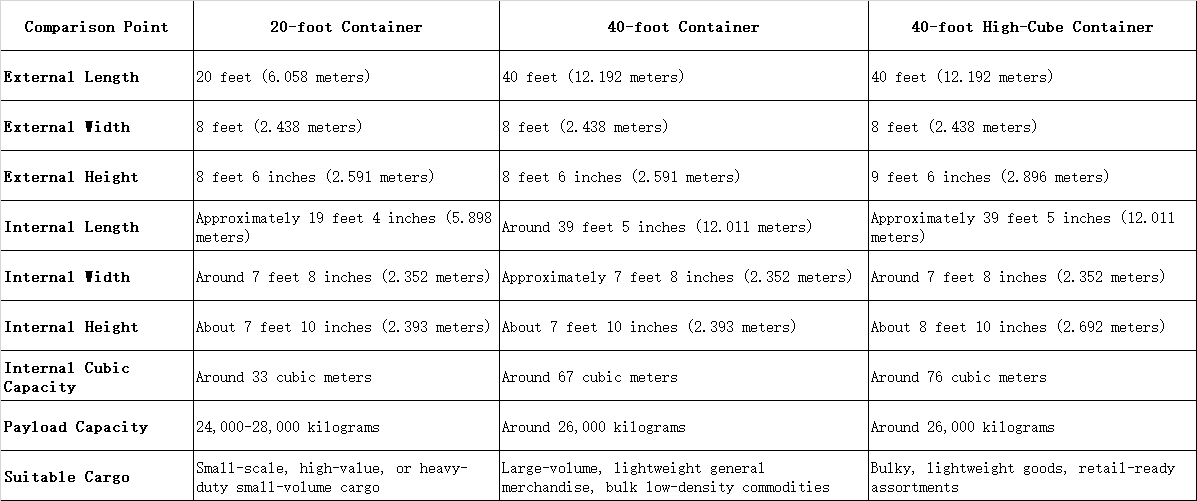
20-foot Container (20ft)The 20-foot container, also known as a 20-TEU (Twenty-foot Equivalent Unit), has a standard external length of 20 feet (6.058 meters), width of 8 feet (2.438 meters), and height of 8 feet 6 inches (2.591 meters). This compact size makes it suitable for a variety of cargo, especially when the volume is relatively small or when flexibility in handling is required.
40-foot Container (40ft)A 40-foot container, or 40-TEU, is double the length of a 20-foot container. Its external length measures 40 feet (12.192 meters), with the same width of 8 feet (2.438 meters) and height of 8 feet 6 inches (2.591 meters). It offers a significantly larger capacity for transporting large-volume, lightweight goods.
40-foot High-Cube Container (40HQ)The 40HQ container shares the same length and width as the 40-foot container, but it is taller. Its height is 9 feet 6 inches (2.896 meters), which provides additional cubic capacity. This extra height is ideal for bulky, lightweight items such as furniture, textiles, and some consumer goods.
How Do the Internal Dimensions Differ?
20-foot Container (20ft)The internal length of a 20-foot container is approximately 19 feet 4 inches (5.898 meters), internal width is around 7 feet 8 inches (2.352 meters), and internal height is about 7 feet 10 inches (2.393 meters). The internal cubic capacity is around 33 cubic meters. However, it's important to note that these dimensions can vary slightly depending on the container's construction and any internal fittings.
40-foot Container (40ft)For a 40-foot container, the internal length is around 39 feet 5 inches (12.011 meters), internal width is approximately 7 feet 8 inches (2.352 meters), and internal height is about 7 feet 10 inches (2.393 meters). The internal cubic capacity is around 67 cubic meters. Similar to the 20-foot container, minor variations can occur due to construction differences.
40-foot High-Cube Container (40HQ)The 40HQ container has an internal length of approximately 39 feet 5 inches (12.011 meters), internal width of around 7 feet 8 inches (2.352 meters), and internal height of about 8 feet 10 inches (2.692 meters). This results in a larger internal cubic capacity of around 76 cubic meters, offering more space for goods.
What about the Payload Capacities?
20-foot Container (20ft)The payload capacity of a 20-foot container typically ranges from 24,000 to 28,000 kilograms, depending on factors such as the container's construction materials, the strength of its chassis, and any regional regulations. This capacity makes it suitable for a wide range of general cargo.
40-foot Container (40ft)A 40-foot container usually has a payload capacity of around 26,000 kilograms. Although it has a larger volume, the longer length and potential stress on the structure limit the maximum payload compared to some 20-foot containers.
40-foot High-Cube Container (40HQ)The payload capacity of a 40HQ container is similar to that of a 40-foot container, around 26,000 kilograms. Despite the additional height, the structural integrity requirements keep the payload capacity at a comparable level.
Who Are the Key Players Affected by These Dimensions?
Shippers:Shippers need to consider container dimensions when planning their cargo shipments. They must ensure that the volume and weight of their goods can fit into the chosen container type. For example, if a shipper has a large quantity of lightweight, bulky items, a 40HQ container might be more suitable. On the other hand, if the cargo is heavy but of a smaller volume, a 20-foot container could be a better option.
Carriers:Carriers, such as shipping lines, need to manage their fleets of containers with different dimensions. They must optimize the use of these containers to maximize their shipping capacity and efficiency. For instance, they need to ensure that the containers are properly loaded and stowed on vessels to maintain balance and safety during transit.
Freight Forwarders:Freight forwarders play a crucial role in advising shippers on the appropriate container dimensions based on the nature of the cargo. They also need to coordinate with carriers to secure the right containers at the right time. A freight forwarder should be well-versed in the dimensions and capacities of different containers to provide accurate and cost-effective shipping solutions.
3. Real-World Application
How Are 20-foot Containers Used in Real-World Shipping?
Small-scale Exporters:Small-scale exporters often rely on 20-foot containers. For example, a local handicraft producer in a developing country may use a 20-foot container to ship their products to international markets. The smaller size is easier to manage in terms of loading, unloading, and transportation to and from the port. It also provides a more cost-effective option when the volume of goods is not extremely large.
Specialty Cargo:Specialty cargo, such as high-value electronics or precision machinery parts, may be shipped in 20-foot containers. These containers offer better security and easier handling for such sensitive items. The limited space can also be an advantage as it reduces the risk of damage due to shifting during transit.
In What Scenarios Are 40-foot Containers Preferable?
Large-volume General Merchandise:For large-volume general merchandise shipments, such as clothing, toys, or household goods, 40-foot containers are commonly used. A large retailer importing a significant quantity of these items from a manufacturing hub in Asia to the United States would likely opt for 40-foot containers to maximize the quantity of goods shipped in one go, thereby reducing shipping costs per unit.
Bulk Commodities with Lower Density:Bulk commodities like grains or certain types of building materials that have a relatively low density can be efficiently transported in 40-foot containers. The large volume of the 40-foot container can accommodate a substantial amount of these goods without exceeding the payload capacity.
When Do Shippers Choose 40HQ Containers?
Bulky, Lightweight Goods:As mentioned earlier, goods like furniture, textiles, and some consumer goods are prime candidates for 40HQ containers. A furniture manufacturer exporting a shipment of sofas and chairs to a foreign market would find the extra height of the 40HQ container beneficial as it allows for more efficient stacking and packing, maximizing the use of the container's space.
Retail-ready Assortments:Retail-ready assortments, which often consist of a variety of products in different shapes and sizes, can be better accommodated in 40HQ containers. The additional height provides more flexibility in packing, enabling shippers to fit in a larger quantity of products while still ensuring proper protection during transit.
4. Key Differences
5. Common Misconceptions
Do All Containers of the Same Type Have Identical Dimensions?
A common misunderstanding is that all containers of the same type, such as 20-foot containers, have exactly the same dimensions. In reality, there can be minor variations in dimensions due to manufacturing tolerances, the addition of internal fittings (such as lashing points or insulation in some cases), and the age and wear of the container. For example, an older 20-foot container may have slightly different internal dimensions due to structural changes over time. In practice, freight forwarders should always check the specific dimensions of the container they are using, especially when dealing with cargo that has precise size requirements.
Are the Payload Capacities Fixed?
Another misconception is that the payload capacities of 20ft, 40ft, and 40HQ containers are fixed. While there are standard ranges, these can be affected by various factors. The construction materials of the container can impact its strength and thus the payload it can carry. Additionally, regional regulations may impose different weight limits. For instance, in some areas, the maximum payload for a 40-foot container may be reduced due to road or port infrastructure limitations. Shippers and freight forwarders should be aware of these potential variations and verify the allowable payload for each shipment.
Can Any Cargo Fit into Any Container Based on Volume?
Some may assume that as long as the volume of the cargo fits into the container, it can be shipped in that container. However, this is not always the case. The shape of the cargo also matters. Irregularly shaped cargo may not be able to be efficiently packed into a container, even if the volume seems to fit. For example, long, thin items may not be able to be properly stowed in a 20-foot container without causing issues during transit. It's essential to consider both the volume and the shape of the cargo when choosing a container.
6. Step-by-Step Process
How to Choose the Right Container Dimension?
Assess the Cargo Volume:The first step is to accurately measure the volume of the cargo. This can be done by calculating the dimensions of each item and multiplying to get the total volume. For example, if shipping a batch of boxes, measure the length, width, and height of each box and sum up the volumes. Based on this volume, a general idea of whether a 20-foot, 40-foot, or 40HQ container would be suitable can be determined.
Consider the Cargo Weight:Next, determine the weight of the cargo. If the cargo is heavy, a container with an appropriate payload capacity should be selected. A 20-foot container may be more suitable for heavier cargo as it often has a relatively high payload capacity. On the other hand, if the cargo is lightweight but voluminous, a 40-foot or 40HQ container might be a better choice.
Account for Cargo Shape and Fragility:Take into account the shape of the cargo. If the cargo has an irregular shape, it may require a container that can accommodate it better. For fragile cargo, extra space for proper packing and cushioning may be needed. For example, if shipping large-scale artworks, a 40HQ container may provide more room for protective packaging.
Evaluate Shipping Costs:Shipping costs can vary depending on the container type. Generally, larger containers may have a lower cost per cubic meter or per kilogram of cargo. However, if the cargo does not fully utilize the container's capacity, it may be more cost-effective to choose a smaller container. Freight forwarders should compare the costs of different container options, including any additional charges for handling, storage, or special requirements.
How to Measure the Container for Loading?
External Inspection:Before loading, conduct an external inspection of the container. Measure the external dimensions to ensure they match the standard specifications. Check for any signs of damage, such as dents or bulges, as these can affect the internal space and the safety of the cargo. Use a measuring tape or other appropriate measuring tools to verify the length, width, and height.
Internal Measurement:Measure the internal dimensions of the container. Start with the length, then the width, and finally the height. Pay attention to any internal fittings or protrusions that may reduce the available space. Record these measurements accurately to plan the loading of the cargo. For example, if there are lashing points inside the container, note their position and how they may impact the packing of the goods.
Verify Payload Capacity:Check the payload capacity of the container. This information is usually provided by the container manufacturer or the carrier. Ensure that the weight of the cargo, including any packaging materials, does not exceed the specified payload capacity. Overloading can not only cause damage to the container and the cargo but also pose a safety risk during transportation.
7. Fees and Costs
What Are the Cost Components Related to Different Container Dimensions?
Rental Fees:Rental fees for containers can vary based on their dimensions. Generally, 20-foot containers may have a lower daily or monthly rental fee compared to 40-foot and 40HQ containers. According to industry reports from Armstrong & Associates, the average daily rental fee for a 20-foot container might range from $3-$8, while a 40-foot container could cost $5-$12 per day, and a 40HQ container may be slightly more expensive, around $6-$15 per day. The larger containers cost more to rent due to their higher production cost and greater demand in some markets.
Transportation Costs:Transportation costs also differ. Shipping lines may charge more for transporting larger containers. The cost per TEU (Twenty-foot Equivalent Unit) is often used as a basis for calculating ocean freight. For example, a 40-foot container, which is equivalent to two TEUs, may have a higher ocean freight charge compared to a 20-foot container. Additionally, inland transportation costs, such as trucking or rail transport, may be higher for larger containers due to their size and weight.
Storage Costs:Storage costs can be affected by container dimensions. In a port or a storage facility, larger containers may occupy more space and thus incur higher storage fees. If a container needs to be stored for an extended period, these costs can add up significantly. For instance, a 40HQ container may have a storage fee that is 20-30% higher than that of a 20-foot container, depending on the location and the specific storage facility's pricing structure.
Handling Costs:Handling costs can vary depending on the container's size. Larger containers may require more complex handling equipment and additional labor, especially during loading and unloading. For example, a 40-foot or 40HQ container may need a larger crane or more workers to move it compared to a 20-foot container. These additional handling requirements can result in higher handling fees.
8. Expert Tips
What Should Freight Forwarders Keep in Mind Regarding Container Dimensions?
Stay Updated on Industry Standards:Freight forwarders should stay informed about any changes in container dimensions standards. Although the basic dimensions are relatively stable, new manufacturing techniques or international regulations may introduce minor variations. By staying updated, freight forwarders can ensure accurate planning for their clients' shipments. For example, new ISO standards may be introduced to improve container safety and efficiency, which could potentially affect the dimensions or payload capacities.
Build Relationships with Container Suppliers:Establishing strong relationships with container suppliers is crucial. Suppliers can provide valuable information about the availability of different container sizes, any special features or modifications, and potential cost savings. A good relationship may also lead to preferential treatment, such as better rental rates or priority access to containers during peak seasons. For instance, a long-term partnership with a container leasing company may result in more flexible rental terms.
Train Staff on Dimension-related Knowledge:It is advisable to train staff on the importance of container dimensions and how to handle related tasks. Staff should be proficient in measuring containers, assessing cargo suitability, and understanding the cost implications. Well-trained staff can help prevent errors in container selection and loading, which can save both time and money. For example, trained employees can quickly determine if a particular cargo can be efficiently packed into a specific container based on its dimensions and shape.
Use Technology for Dimension-based Planning:Leverage technology tools for dimension-based planning. There are software applications available that can help freight forwarders visualize how cargo will fit into different containers, calculate volumes, and estimate costs. These tools can improve the accuracy of planning and make the decision-making process more efficient. For example, 3D cargo-packing software can simulate the loading of goods into containers, allowing freight forwarders to optimize the use of space.
9. Conclusion and Key Takeaways
In conclusion, understanding the dimensions of 20ft, 40ft, and 40HQ containers is fundamental for freight forwarders and other stakeholders in the international shipping industry. The distinct dimensions, payload capacities, and cost implications of each container type play a pivotal role in determining the most suitable option for transporting various types of cargo.
From the shipper's perspective, accurately assessing the cargo's volume, weight, shape, and fragility is essential in choosing the right container dimension. This not only ensures the safe and efficient transportation of goods but also helps in optimizing costs. For carriers, managing a diverse fleet of containers with different dimensions requires careful planning to maximize capacity utilization and operational efficiency.
Freight forwarders, as key players in the shipping process, have the responsibility of providing expert advice on container selection. By avoiding common misconceptions, following a systematic step-by-step process, and taking into account the various cost components and expert tips, they can offer cost-effective and reliable shipping solutions to their clients.
In the highly competitive and dynamic international shipping market, a thorough understanding of 20ft, 40ft, and 40HQ container dimensions is an invaluable asset. It enables freight forwarders to meet the diverse needs of their clients, enhance customer satisfaction, and stay ahead in the industry. Container dimensions are indeed a key factor that freight forwarders must master to succeed in their operations.
Last
Detention Fee: Unraveling Its Intricacies in Freight Logistics
1. What is a Detention Fee?A detention fee is a charge imposed on the shipper, consignee, or other relevant parties when they reta
Next
What is HS Code? A Comprehensive Guide for Freight Forwarders
1. What is HS Code?The HS Code, short for Harmonized System Code, is a globally-recognized classification system for traded produc