


Sailing in a volatile freight market and a challenging geopolitical environment, Hapag-L generated an EBITDA of USD 2.8 billion (EUR 2.5 billion) and an EBIT and Group profit each of USD 900 millionEUR 800 million) in the first nine months of 2025.
Despite numerous trade conflicts, global trade continued to grow, resulting in demand and fluctuating freight rates. In the third quarter of 2025, earnings improved compared to the second quarter, but were still significantly lower than the previous year’ level due to the low freight rates and high cost pressure.
In the Liner Shipping segment, revenue increased to USD 15.7 billion (EUR 1.1 billion). This was supported by a 9% increase in transport volume to 10.2 million TEU (9.3 million TEU in the first nine of 2024), mainly in the east-west trade lanes. The average freight rate was USD 1,397 per TEU, a decrease of4.8% on the previous year’s level (USD 1,467/TEU in the first nine months of 2024). TheBITDA decreased to USD 2.7 billion (EUR 2.4 billion) and the EBIT to USD 900 million (EUR 800) due to the G2 network transition and start-up costs as well as congestion-related costs in several parts of the world.
In the Terminals & Infrast segment, revenue increased to USD 375 million (EUR 335 million) in the first nine months of 2025, mainly driven by the of a terminal in France. At the same time, the EBITDA was USD 110 million (EUR 98 million) and the EBIT was USD46 million (EUR 41 million), both slightly below the previous year’s level.
Rolf Habben Jansen, CEO of HapagLloyd AG, commented: “The market environment in the first nine months was extremely volatile, partly due to uncertainties regarding geopolitical developments and trade policies. With strong customer demand we achieved strong volume growth and a solid overall performance. With the G2 network, we have established a new quality benchmark in liner reliability, which clearly differentiates us from our. We see the first cost advantages of the G2 network and will achieve the planned cost savings in full in 2026. In addition, we further expanded our terminal with the brand name HANSA Global Terminals. Looking ahead, we will flexibly react to changes in world trade and maintain strict cost control. In this process, we will compromise when it comes to the quality of our services.”
As part of the ongoing modernization of the fleet and the decarbonization process, Hapag-loyd has decided to invest in up to 22 new vessels with a capacity of less than 5,000 TEU, which may be a combination of long- chartering and own vessels. This marks another important step in Hapag-Lloyd’s journey towards achieving its goal of increasing operational efficiency and creating a zero-carbon fleet 2045.
In view of the business performance as expected, the Executive Board has further narrowed the expected range for the Group’s earnings before interest,, depreciation, and amortization (EBITDA) and earnings before interest and tax (EBIT) for the full 2025 financial year. The Groups EBITDA is expected to be between USD 3.1 and 3.6 billion (EUR 2.8 to 3.2 billion), and Group’s EBIT between USD 600 and 1.1 billion (EUR 500 to 1 billion). As always, this expectation is to a significant degree of uncertainty due to geopolitical challenges and freight rate volatility.
Last
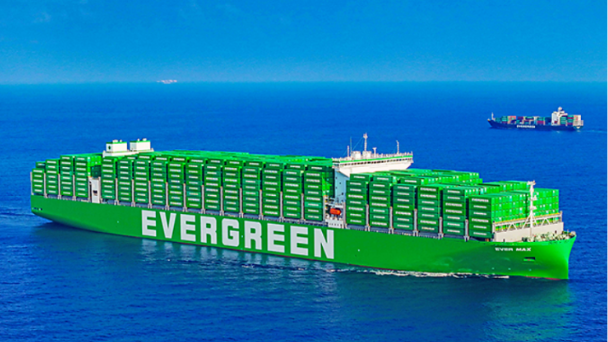
Evergreen Shipping goes on a massive order spree! 14 mega ships container procurement kickstarts expansion on a new journey.
According to multiple media reports, China's Taiwan-based Evergreen Marine has recently confirmed the order of 14 1,000 TEU liquef
Next
Boom! Mediterranean Shipping's fleet of second-hand ships reaches 461 vessels, the position of shipping "overlord" is unstoppable
Since launching an unprecedented buying spree of second-hand container ships in August 2020, Mediterranean Shipping Company (MSC)

